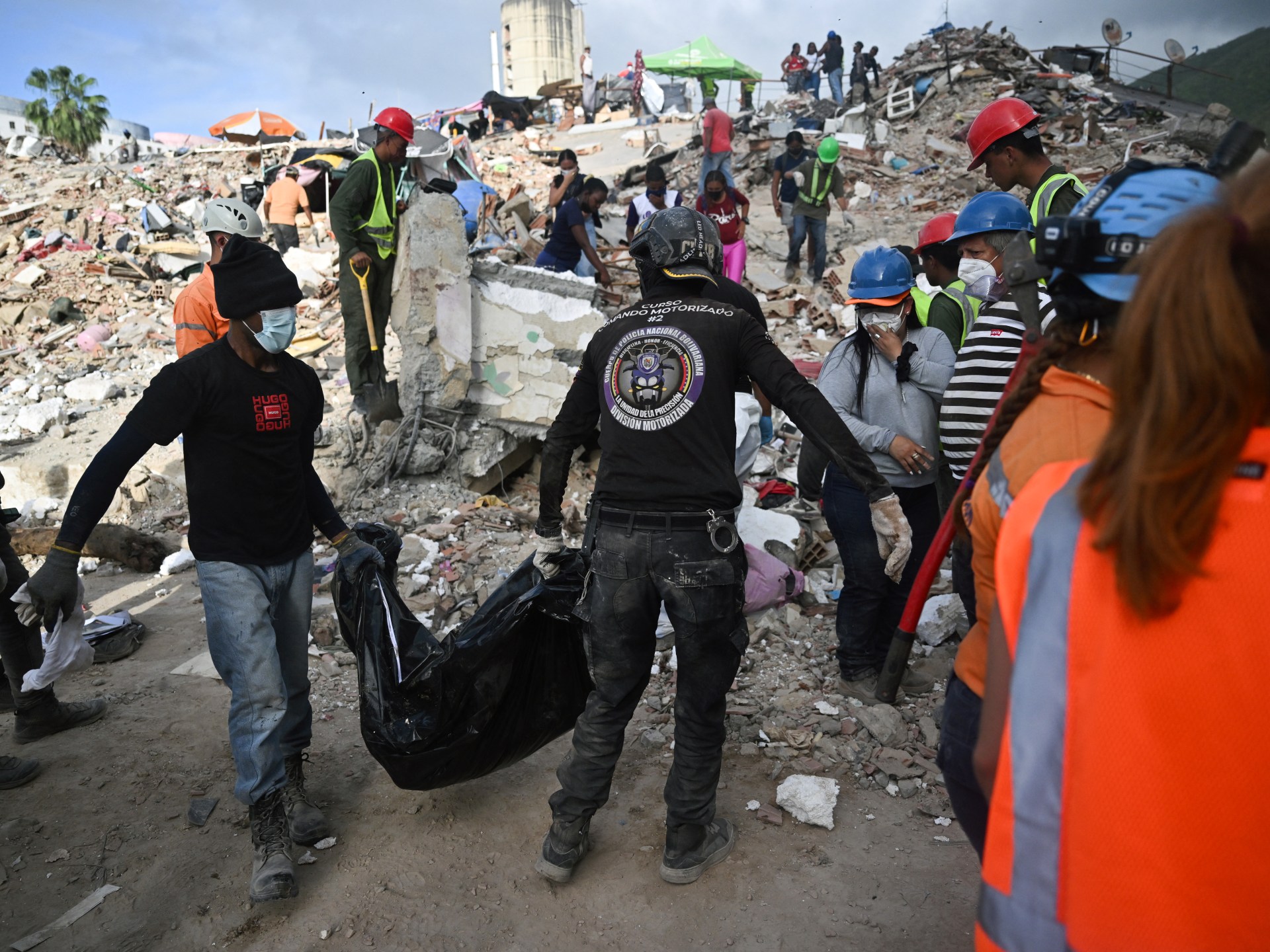

The death toll from the twin earthquakes that tore through Venezuela’s Caribbean coast last month has surpassed 5,000, as authorities continue recovering bodies from the rubble.
National Assembly President Jorge Rodriguez said on Friday that 5,069 people have now been confirmed dead, most of them in the coastal state of La Guaira, where the earthquakes caused the worst destruction. Another 16,740 people were injured, though Rodriguez said most have since been discharged from hospital.
- list 1 of 4Venezuela’s turn to Israel is about survival, not conviction
- list 2 of 4‘All we see is decay’: Covering the human toll of Venezuela’s earthquakes
- list 3 of 4Venezuela’s recovery clouded by uncertainty three weeks after earthquake
- list 4 of 4Venezuela earthquake: Number of known dead rises to nearly 5,000 victims
end of list
The toll has continued to climb as rescue crews clear collapsed buildings and reach areas that were difficult to access in the chaotic days after the disaster.
The magnitude 7.2 and 7.5 earthquakes, which struck within a minute of each other on June 24, devastated La Guaira, north of Caracas. The coastal state is home to Venezuela’s main international airport, a major seaport and hundreds of apartment towers, many of which partially or completely collapsed.
More than 1,300 aftershocks have been recorded since then, authorities say. Approximately 20,000 people remain displaced, many living in overcrowded shelters without reliable access to clean water or sanitation.
The grim milestone comes as Interim President Delcy Rodriguez announced on Friday that Venezuela had secured $346m in emergency financing from the International Monetary Fund (IMF).
IMF Managing Director Kristalina Georgieva confirmed the money was being released from Venezuela’s reserve tranche at the fund to meet urgent humanitarian needs.
Advertisement
It was only in April that the IMF and World Bank restored relations with Venezuela, following the United States forcibly removing former President Nicolas Maduro from power in January. The institutions had suspended ties with the country in 2019 after refusing to recognise Maduro’s government.
Public outrage over the government’s handling of the earthquakes has continued to grow in the weeks since they struck, with survivors and critics accusing authorities of responding too slowly as people remained trapped beneath collapsed buildings.
New details uncovered by the news agency Reuters have added to those questions. In an investigation published on Saturday, the news agency found the crucial first days of the rescue effort were hampered by delayed military deployment orders, shortages of basic rescue equipment and confusion caused by overlapping chains of command, according to military and diplomatic sources.
Rodriguez has repeatedly rejected accusations that authorities were slow to act, dismissing claims of chaos as a narrative manufactured by “media laboratories” and insisting the government responded swiftly.
Related News
Sons of Iran’s leader Ali Khamenei attend funeral, but Mojtaba is absent

Who is Zeynep Sonmez, the Wimbledon with the ‘Palestine’ watermelon racket?
Andy Burnham in line to become British PM after securing party support