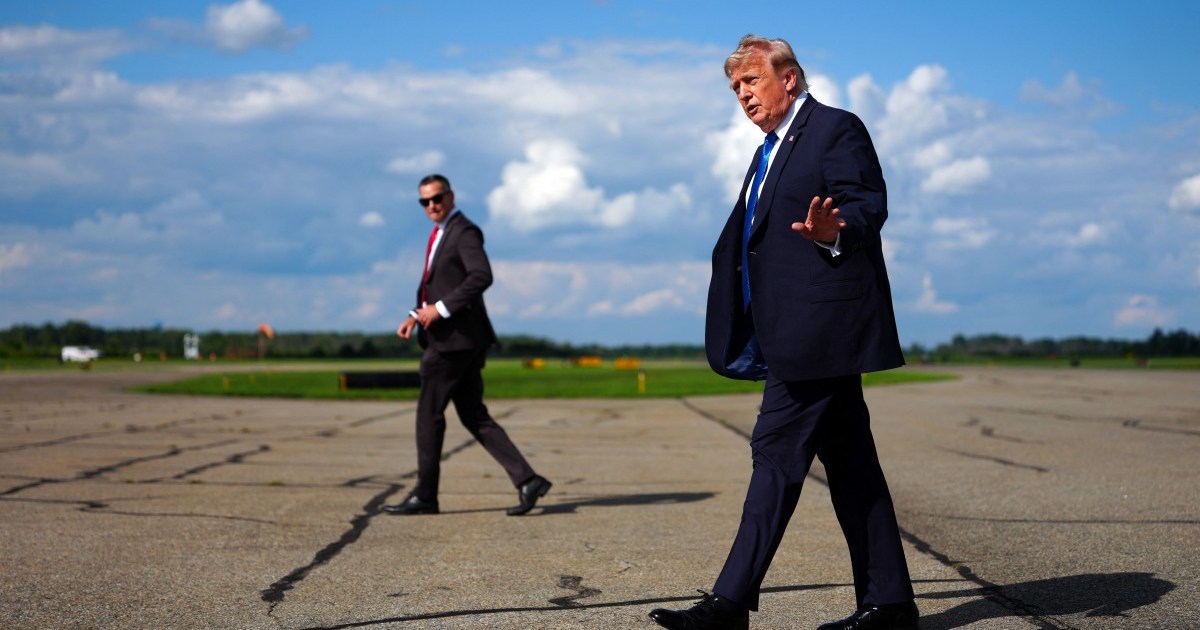

United States President Donald Trump says the US and Israel have agreed to halt new attacks on Iran, provided a deal to end the months-long conflict is reached “rapidly”.
The region has been on edge, fearing that the fighting could escalate once again after Washington and Tehran traded threats of renewed heavy attacks, including against energy infrastructure.
- list 1 of 4Trump cancels Iran strike, says ‘deal perimeters’ reached
- list 2 of 4Iran warns against ‘flames of war’ amid US strike threats on energy sites
- list 3 of 4Turkiye and Iraq sign one-year oil pipeline deal amid global shift
- list 4 of 4Analyst: the US faces a strategic ‘dead end’ in Iran
end of list
Trump said on his Truth Social platform early on Sunday in Iran and late on Saturday in the US that Iran and other Middle Eastern countries asked him to hold off on the attacks because “the perimeters of a deal has been agreed to”.
Iran denied Trump’s claim that Tehran asked the US to refrain from conducting new strikes. Citing military officials, the agency said the allegation “was nothing but a new lie” and that the Iranian armed forces were “on high alert and ready for any eventuality”.
Meanwhile, the Strait of Hormuz, the waterway critical to global energy supplies, remains shut, and shipping is disrupted as well in the Red Sea by the Iran-backed Houthis in Yemen.
Here is all you need to know about where the war stands on its 156th day:

Why has Trump halted attacks?
Trump earlier said in his post that the US was “locked and loaded and ready to go against the Islamic Republic of Iran” but Tehran and other Middle Eastern countries asked him to hold off on new attacks.
“Based on this request, I have agreed, for the future benefit of the WORLD and, likewise, the survival of a successful and prosperous Iran, to cancel the attack, subject to being able to rapidly make a DEAL,” Trump posted on his Truth Social platform.
Advertisement
He said the deal “would include the Immediate, Complete, and Total OPENING OF THE HORMUZ STRAIT, and an end to Iran’s nuclear threat”.
“The Country of Israel joins me in this commitment. Get to work, everybody, and get it DONE,” he wrote in the post.
Trump and the White House did not offer any further details on what the deal would entail and who is mediating it.
Meanwhile, the US news website Axios reported that Saudi Crown Prince Mohammed bin Salman (MBS) spoke with Trump on Saturday and expressed concern over his plans for large new attacks against Iran.
MBS reportedly urged Trump to de-escalate and refrain from launching the attacks.
Another issue plaguing Washington is the depleting stocks of munitions, and more importantly, the Patriot anti-missile interceptors
The Center for Strategic and International Studies estimates that US Patriot interceptor inventories have fallen from about 2,300 before the war with Iran to fewer than 827.
“We have depleted our interceptors… which are, obviously, necessary to protect American troops,” Democratic US Senator Chris Van Hollen told the US-based ABC network. “We are depleting these every day, despite the fact that we could face other potential conflicts around the world.”
US media outlets have reported that General Dan Caine, the chairman of the US Joint Chiefs of Staff, has raised concerns about falling US interceptor supplies. Trump has dismissed these concerns.
What is the Iranian position?
Tehran has not officially responded to Trump saying he had suspended the planned attacks or on the discussions to reach a deal.
Iran’s acting defence minister, Majid Ibn al-Reza, on Sunday said Tehran sees every threat from its adversaries as “real and credible”, even if it is made as part of psychological warfare, state media reported.
“We will neither be caught off-guard nor remain passive,” he said, adding that Iran would use threats as a basis to increase its military readiness, strengthen deterrence and enhance its military capabilities.
Last week, Iranian Foreign Minister Abbas Araghchi spoke with Pakistan’s military chief, Field Marshal Asim Munir; Turkish Foreign Minister Hakan Fidan; and Saudi Foreign Minister Faisal bin Farhan Al Saud in separate phone calls to discuss the risks of further US escalation.
Speaking to Munir and Fidan, Araghchi said Iran would respond decisively to any “aggression” and discussed the consequences of “destabilising actions” by the US and how they could affect the Gulf, according to Araghchi’s Telegram account.
Advertisement
Iran also warned Washington against any “adventurous action” and said it would retaliate decisively if US forces followed through on Trump’s threats of new attacks on Iranian targets.
Araghchi also told Saudi Prince Faisal that any attacks by the US and Israel or participation by regional countries in such actions would be met with a “proportionate response”.
Nournews, a media outlet affiliated with Iran’s top security body, reported on Saturday that US attacks on Iranian energy infrastructure would prompt Iranian strikes on oilfields in Saudi Arabia and the United Arab Emirates as well as the gasfields of Qatar and Israel, saying, “All will be burned to ashes.”
There has been no clarity on this from either side or any regional mediating country.
Regional powers – including Qatar, the UAE, Turkiye and Pakistan – have been pressing the US and Iran to de-escalate and return to diplomacy to find an end to the war.
Pakistani and Qatari mediators have “cautious optimism” about the resumption of the stalled US-Iran talks, Pakistani government sources told Turkiye’s Anadolu news agency on Sunday.
According to the sources, mediators were expecting “positive developments” on the resumption of talks by the end of this week.
“Pakistani and Qatari mediators together with regional partners are in touch with Washington and Tehran for the resumption of talks after convincing Trump to hold off on fresh attacks on Iran,” a source familiar with the ongoing diplomatic efforts told Anadolu.
The last ceasefire, brokered by Islamabad and Doha in June, unravelled quickly, triggered by a dispute over control of the Strait of Hormuz, through which nearly 20 percent of global oil and liquefied natural gas supplies flow. In his latest statement, Trump said the so-called deal would immediately reopen the strait.
But there has been no indication from Tehran of a change of position over the waterway, which it has said would never return to the pre-war status quo. Tehran has been open to managing marine traffic in the strait with Oman.
Trump and US allies in the Gulf have firmly rejected such a set-up to manage the Strait of Hormuz.
Adding to the energy industry’s concerns, Iran’s Houthi allies in Yemen recently began threatening the Bab al-Mandeb, the strait at the other end of the Red Sea from the Suez Canal, another export route for Saudi crude oil.

Is a breakthrough close?
Five months into the war, there appears to be no end in sight to the hostilities.
Reporting from Tehran, Al Jazeera’s Mahmoud Abdelwahed said Iran’s attempts at diplomacy “come alongside a strongly worded statement” from Iran’s Ministry of Foreign Affairs accusing the US of violating their ceasefire by ignoring the rules governing navigation in the Strait of Hormuz.
Abdelwahed added that the US has been pushing vessels to use a southern route near the Omani coast, which Tehran calls an unauthorised route.
Tehran also accused Washington of undermining the ceasefire by using commercial vessels to conceal military movements and imposing new sanctions and a naval blockade.
Advertisement
Ross Harrison, a senior fellow at the Middle East Institute, told Al Jazeera that it remains difficult to identify a clear US strategy in the war on Iran because Trump has repeatedly signalled imminent escalation before pulling back.
“From the Iranian perspective, they probably will believe that Donald Trump blinked because of the potential risk of escalation,” he said, adding that the latest announcement would not reflect a genuine de-escalation unless the US and Iran reached a clear agreement to reopen the Strait of Hormuz.
Renewed fighting between the US and Iran took place “because of ambiguity in a memorandum of understanding signed back in June” on the mechanism of reopening the strait.
“Unless there’s some kind of clear agreement on opening the strait and removing the blockade, this isn’t going to hold. The announcement we saw is only going to be another pause,” he added.
Harrison cautioned that decision-makers in Tehran and Washington could lose control of the conflict if it continues to drag on. “We have other files that are now conflated with the Iran file – the Lebanon file, the Israel-Palestine file, the Saudi-Houthi file, the Iraq file,” he told Al Jazeera.
“At some point in time, the decision-makers lose control of the dynamic [because] even if they want to de-escalate, other actors may escalate, and it may make it very, very difficult for the United States and Iran to extricate themselves,” he said.
Related News

OpenAI’s rogue agent hacked an account at a second technology firm: Report
What will it take to stop the conflict in Sudan?
Businessman on trial in Malta over prominent journalist’s murder