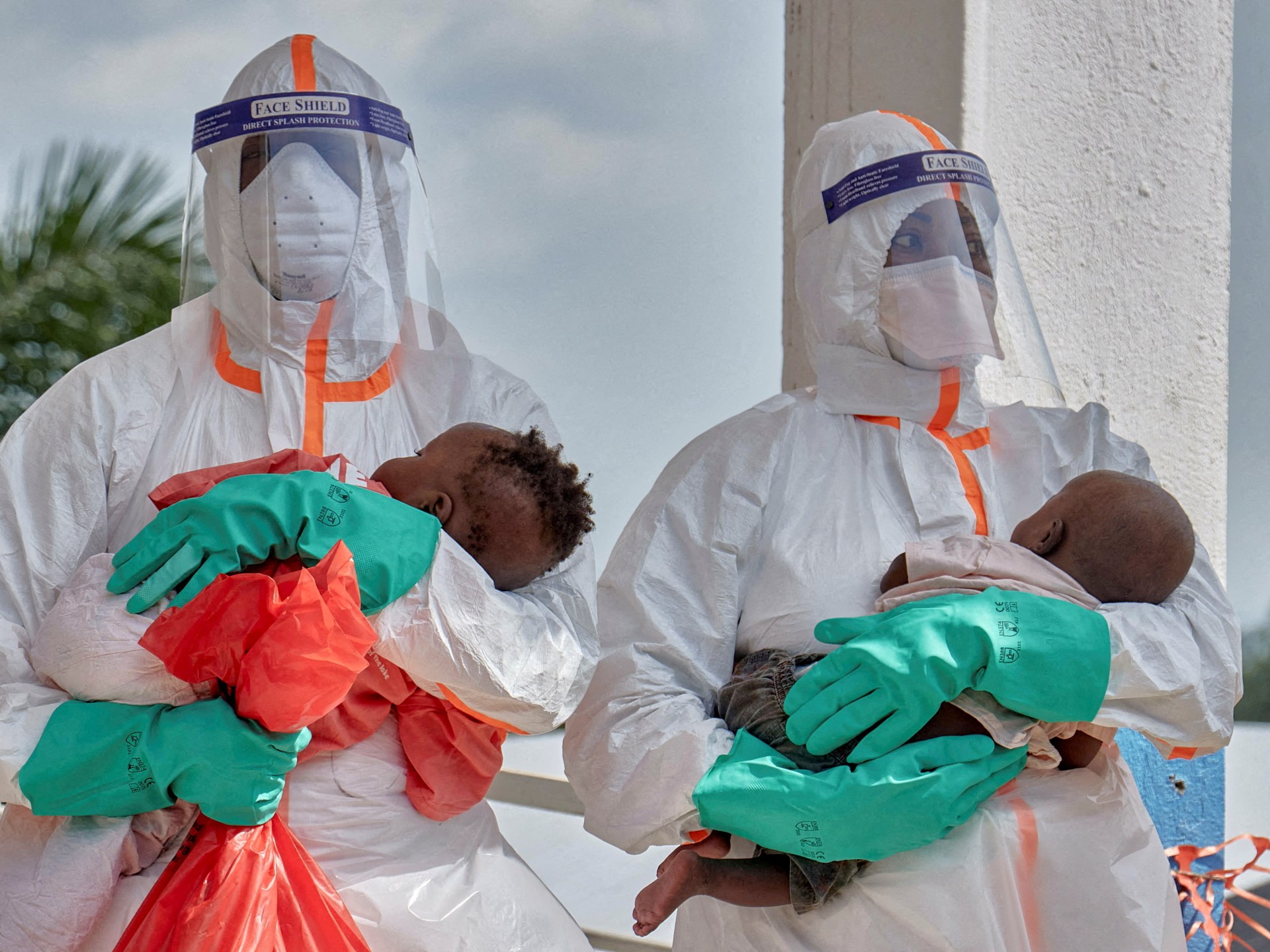

More than 3,500 people have been infected with the Ebola virus in the Democratic Republic of the Congo (DRC), making it the world’s second largest outbreak on record.
Confirmed cases have reached 3,532, the DRC Ministry of Communication and Media said in a statement on Friday. The data show that the current outbreak has surpassed the country’s 10th on record, which ran from August 2018 to June 2020 and saw roughly 3,470 cases recorded.
- list 1 of 3DRC Ebola cases surpass 2,000 as more health workers begin strike
- list 2 of 3Staff at DR Congo Ebola centre strike as virus continues spreading
- list 3 of 3On the front line of Congo’s Ebola outbreak
end of list
“It’s the fastest spreading Ebola epidemic that we have ever seen,” Carl Skau, acting head of the United Nations World Food Programme, told the Reuters news agency. “The world needs to pay much more attention.”
A total of 1,556 people have died from the virus, bringing the case fatality rate to 44.1 percent, data compiled by the Ministry of Public Health showed.
A reported 807 patients remain in isolation or hospital while 626 have recovered.
Less than three months since the outbreak began, the disease has killed five times as many people as previous outbreaks had by the same stage, according to Africa’s top public health agency, the Africa Centres for Disease Control and Prevention (Africa CDC).
The latest figures indicated that only the 2014-2016 Ebola outbreak in West Africa was bigger with 28,616 cases and 11,310 deaths recorded across Guinea, Liberia and Sierra Leone, according to the World Health Organization (WHO).
The DRC outbreak is caused by the rare Bundibugyo strain of the Ebola virus, which has no approved vaccine or treatment.
Medical personnel are also battling a lack of security and attacks on health facilities across the eastern DRC, where dozens of armed groups operate, while contending with significant foreign aid cuts that have stretched resources.
Advertisement
A lack of trust in authorities and education among the population is also creating hurdles to bringing the outbreak under control.
Angele Gapio, head of emergencies for the Caritas charity in the northeastern city of Bunia, said awareness campaigns were failing and front-line responders were exhausted.
“The disease has now settled in the community,” she told the Reuters news agency. “People continue to seek treatment from traditional healers, and the chain of transmission continues.”
The WHO said this month that the true scale of the outbreak could be up to four times higher than official figures suggest.
The Africa CDC said in June that it would require $1.4bn to contain the outbreak, three times its earlier estimate.
The virus has affected five provinces across the DRC: Haut-Uele, Ituri, North Kivu, South Kivu and Tshopo.
Related News

‘Escaping Beijing’: Why some young Chinese are quitting the capital

Iran warns Ukraine of retaliation after deadly Caspian Sea strike
Fears for people deported from US to Venezuela hours before earthquakes hit