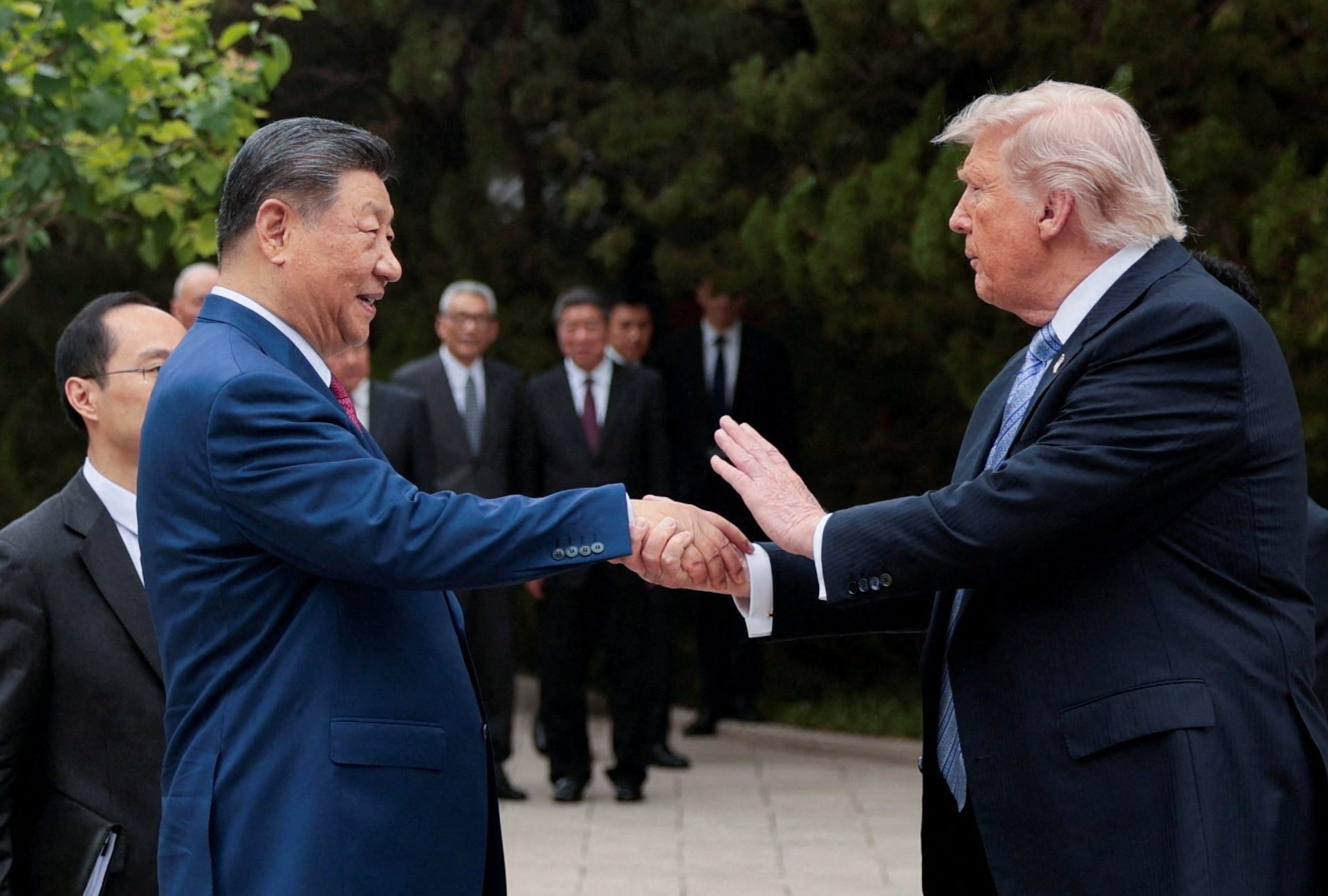

United States President Donald Trump left China on Friday following a two-day summit with Chinese counterpart Xi Jinping.
While Washington touts wins in terms of bilateral trade agreements, Beijing has warned the US against overstepping on the issue of Taiwan and stated that the US-Israel war on Iran should have never started.
Both sides have released statements detailing what Trump and Xi discussed, but they only overlap in limited areas. The two White House readouts published on Thursday addressed issues not mentioned in the Chinese Ministry of Foreign Affairs statements, and vice versa.
We break down what these issues are, what each side said and where they do align.
On trade deals
Trump said several business deals were struck between the US and China during the two days he was in Beijing. “We’ve made some fantastic trade deals for both countries,” Trump said in his remarks concluding the summit.
Xi also met with US business leaders who accompanied Trump on his trip.
Specifically, Trump told Fox News on Friday that China had agreed to buy 200 jets from US aviation manufacturer Boeing – fewer than half the 500 Boeings predicted by markets, which led to Boeing shares falling by more than 4 percent on Friday. If this deal is happening, it will mark China’s first purchase of US jets in almost a decade.
However, China has not mentioned this deal or any other trade deals in its post-summit statement. Boeing has not confirmed this deal either.
Other trade deals have not been confirmed or announced by either side so far. There was also no indication of any breakthrough deal of the US selling advanced AI Nvidia chips to China, despite CEO Jensen Huang’s dramatic, last‑minute addition to the trip.
Advertisement
On Thursday, Xi said that China will open the door wider to US businesses, but did not clarify what this means in terms of trade deals.
“President Xi noted that China-US economic and trade ties are mutually beneficial and win-win in nature,” was all a statement published on the Chinese Foreign Ministry website on Thursday said.
A statement published by the White House on X on Thursday also said that the two sides had expressed “expanding market access for American businesses into China and increasing Chinese investment into our industries”. Additionally, the two sides discussed increasing Chinese purchases of US agricultural products.
However, the Chinese statements make no reference to any specific business or trade agreements between the US and China.
On drug trafficking
From the start of his second term as president in January last year, Trump alleged that China was to blame for a fentanyl crisis in the US. He said this was one of the reasons for imposing sweeping tariffs on Chinese exports last year.
Following the two-day summit this week, the White House stated, “The Presidents also highlighted the need to build on progress in ending the flow of fentanyl precursors into the United States.”
However, the statements published by the Chinese Foreign Ministry make no mention of fentanyl or the flow of drugs into the US.
On the Iran war
While both the US and China said in statements that the Iran war was discussed, their statements about what was said differ.
“Both countries agreed that Iran can never have a nuclear weapon,” the White House said in a statement posted to its X account on Thursday.
But a statement posted by the Chinese Foreign Ministry on X on Friday did not explicitly mention that Iran should never have a nuclear weapon. Instead, it said, “This conflict, which should never have happened, has no reason to continue.”
“It is important to steady the momentum in easing the situation, keep to the direction of political settlement, engage in dialogue and consultation, and reach a settlement on the Iranian nuclear issue and other issues that accommodates the concerns of all parties.”
Iran has never officially declared any intent to build nuclear weapons, and China previously worked with the US, European nations and Russia to secure the 2015 Barack Obama-era nuclear deal with Iran, which limited Tehran’s nuclear programme. Iran is believed to have about 440kg (970lb) of uranium enriched to 60 percent. A 90 percent threshold of enriched uranium is needed to produce a nuclear weapon.
Advertisement
The White House also said in a statement that “the two sides agreed that the Strait of Hormuz must remain open to support the free flow of energy”.
Since early March, Iran has restricted shipping through the strait, a narrow waterway linking Gulf oil producers to the open ocean and through which 20 percent of the world’s oil and liquefied natural gas (LNG) supplies were shipped before the war. Iran has allowed passage by vessels from select countries, but they are required to negotiate transit with the Islamic Revolutionary Guard Corps (IRGC).
In its previous proposals to end the war, Iran has proposed charging fees or tolls for vessels seeking to pass through the state. Washington has repeatedly rejected the prospect. In April, the US announced a naval blockade on ships entering or leaving Iranian ports, further adding to the disruption of global oil and gas supplies.
A White House statement following the Trump-Xi summit says: “President Xi also made clear China’s opposition to the militarisation of the Strait and any effort to charge a toll for its use, and he expressed interest in purchasing more American oil to reduce China’s dependence on the Strait in the future.”
But the Chinese statement does not mention Iranian tolls, the militarisation of the strait or China’s interest in purchasing more US oil.
It does acknowledge that “the conflict has put a heavy strain on global economic growth, supply chains, international trade order and the stability of global energy supply, which hurts the common interests of the international community”.
Trump and Xi held their final meeting at the Zhongnanhai complex, a former imperial garden housing the offices of Chinese leaders. During this meeting, Trump said that he and Xi felt “very similar” about Iran, but Xi did not directly confirm Trump’s claim.
On US-China relations
A statement released by the Chinese Foreign Ministry said, “The two presidents agreed on a new vision of building a constructive China-US relationship of strategic stability to provide strategic guidance for China-US relations over the next three years and beyond.”
The statements from the White House do not mention the three-year timeline and focus more on developing the economic relationship between the US and China, rather than on strategic stability.
On Taiwan
“President Xi stressed that the Taiwan question is the most important issue in China-US relations,” the statement published on the Chinese Foreign Ministry’s website says.
“If it is handled properly, the bilateral relationship will enjoy overall stability. Otherwise, the two countries will have clashes and even conflicts, putting the entire relationship in great jeopardy.”
The White House post-summit statements do not mention Taiwan, however, and Trump notably ignored a question from reporters about his stance on Taiwan during his time in Beijing.
While China claims Taiwan as part of its own territory, the Taiwanese government maintains that the self-governing island of 23 million people is a sovereign state.
Advertisement
The US government officially acknowledges that China views Taiwan as part of its territory, but it does not explicitly state whether or not it agrees with that stance.
The US formally severed official diplomatic ties with Taiwan – also known as the Republic of China – decades ago, but remains committed under the 1979 Taiwan Relations Act to supporting the defence of the self-governing democracy.
That law has enabled Washington to supply Taiwan with billions of dollars worth of weapons and to deepen cooperation in areas such as military training and intelligence sharing, moves Beijing regards as meddling in its internal affairs.
Where is the overlap?
Statements from both sides reported that Trump and Xi had discussed strengthening the relationship between the US and China, as well as “major issues” concerning the two countries and the world.
In its statements, Washington said the US and China were on the same page about several issues, and the Chinese Foreign Ministry echoed this, saying Trump and Xi “reached a series of new common understandings”.
Both sides also confirmed that Trump and Xi discussed the war in Iran, and mentioned concerns about the closure of the Strait of Hormuz.
Related News
Poll finds 61 percent of Americans believe attacking Iran was a mistake

‘May your village burn’: Israeli Flag March returns to East Jerusalem
China’s Xi warns Trump about Taiwan at Beijing summit