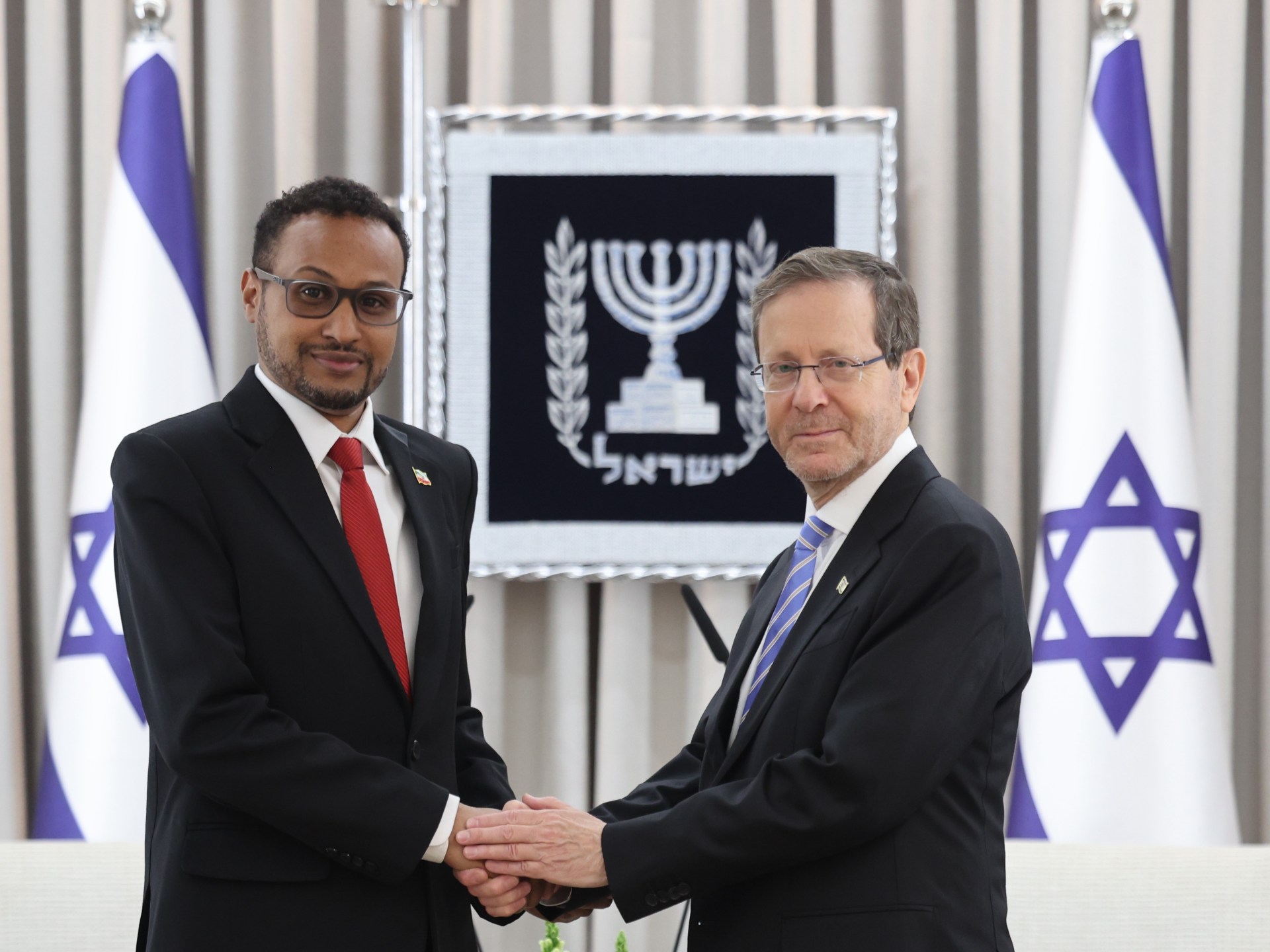

Somaliland will open its embassy to Jerusalem and Israel will establish its representation in Hargeisa “soon”, according to Mohamed Hagi, the ambassador of Somalia’s breakaway region to Israel.
The development, which comes months after Israel officially recognised the independence of Somaliland, reflects “growing friendship, mutual respect, and strategic cooperation between our two peoples”, Hagi said in a statement on X on Tuesday.
- list 1 of 3Somaliland minister says US may access its minerals, military bases: Report
- list 2 of 3AU summit tackles climate change and Somaliland tensions
- list 3 of 3What’s Netanyahu’s planned ‘hexagon’ alliance – and can it work?
end of list
Israeli Foreign Minister Gideon Saar welcomed the announcement, calling it a “significant step” in strengthening relations between the two. “We will work together to implement this decision soon,” he said on X.
In December last year, Israel became the first country in the world to recognise Somaliland, ending more than 30 years of diplomatic isolation.
The decision has drawn wide condemnation from the UN Security Council, the African Union, the Organisation of Islamic Cooperation, and the European Union.
Somaliland declared independence from Somalia in 1991, but it has failed to gain recognition from any United Nations member state. The region controls the northwestern portion of what was once the British Protectorate in northern Somalia.
Somalia has never accepted Somaliland’s independence.
Saar visited Hargeisa in January, and Somaliland subsequently sent a delegation from its water ministry to Israel for training in water management.
Hagi, also a presidential adviser, was central to brokering the recognition.
Somaliland’s would be the eighth embassy located in Jerusalem, following the US, Guatemala, Kosovo, Honduras, Paraguay, Papua New Guinea and Fiji.
Advertisement
The location is controversial as the status of Jerusalem remains at the heart of the decades-long Israeli-Palestinian conflict. Israel claims the entirety of the ancient city as its capital, while the Palestinian Authority (PA) insists that occupied East Jerusalem should serve as the capital of a Palestinian state.
Israel first occupied East Jerusalem during the 1967 war, before unilaterally annexing it in 1980 in a move rejected by the UNSC.
Due to its disputed status, the vast majority of the 96 diplomatic missions present in Israel host their embassies in the Tel Aviv area to avoid interfering with peace negotiations.
In a significant blow to Palestinians’ ambitions and peace prospects, US President Donald Trump unilaterally recognised Jerusalem as Israel’s capital during his first term in 2017.
The announcement triggered a wave of deadly protests across the occupied Palestinian territory, but also across other countries, including Malaysia and India.
The US moved its embassy to Israel from Tel Aviv to Jerusalem in May 2018. The decision was not reversed under the following administration of President Joe Biden, and Washington continues to recognise Jerusalem as Israel’s capital today.
Other countries that followed the US’s move were Guatemala in 2018, Kosovo and Honduras in 2021, Paraguay in 2018 (it returned the embassy to Tel Aviv a few months later, and then relocated back to Jerusalem in 2024), Papua New Guinea in 2023, and Fiji in 2025.
Last year, Argentina’s President Javier Milei announced his intention to also move the Argentinian embassy to Jerusalem.
Related News
US, Iran, UAE trade Hormuz attack claims: What we know
Four reported killed, 30 injured, in Kenyan fuel price protests
Israeli attack on Gaza kills one person, wounds son of Hamas’s al-Hayya