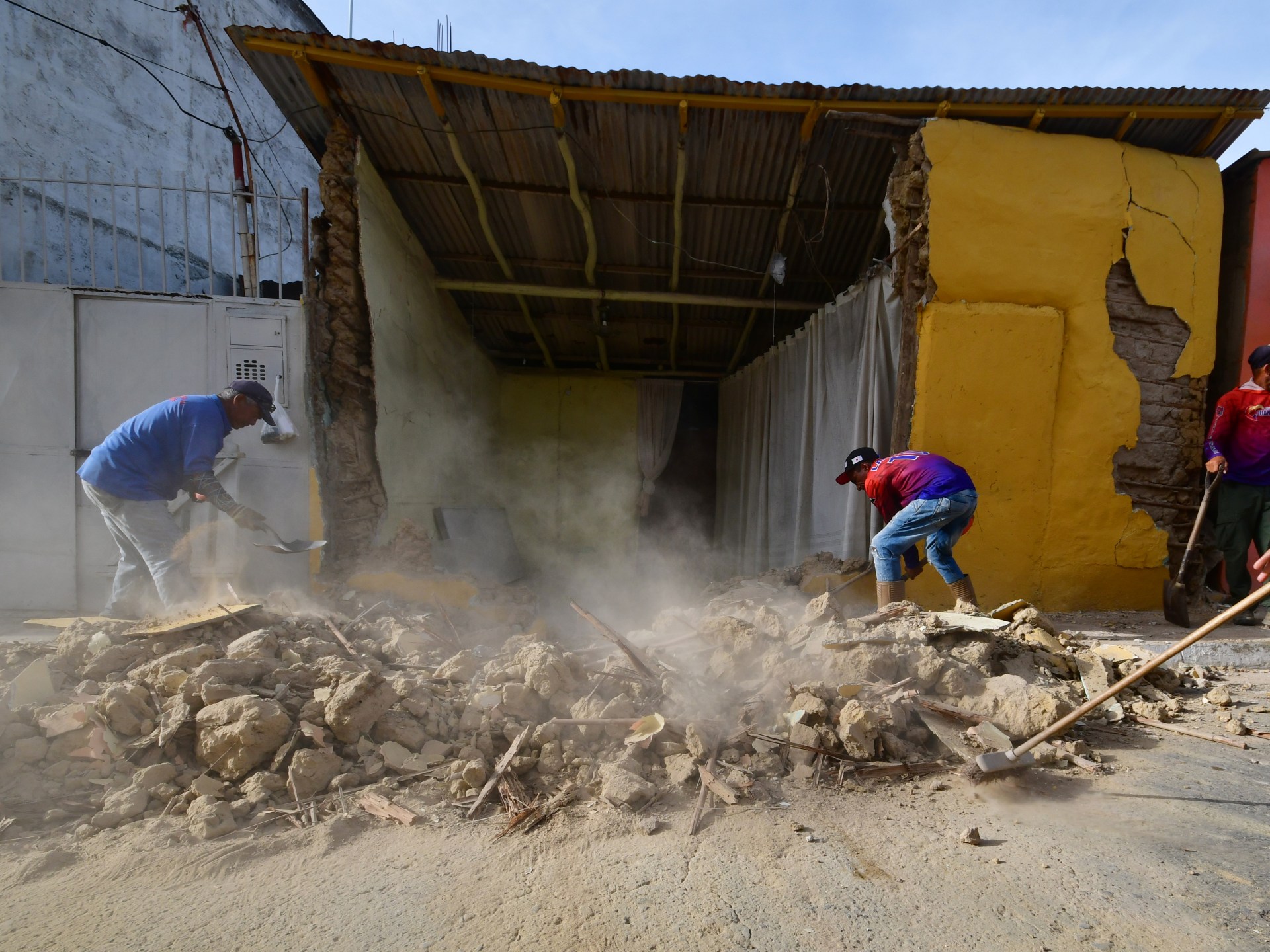

The series of powerful earthquakes that struck Venezuela on Wednesday could cause economic losses equal to as much as 7 percent of the country’s gross domestic product (GDP), according to preliminary estimates from the United States Geological Survey.
Initial assessments released on Thursday estimate that the damage could amount to between 1 and 7 percent of Venezuela’s $111bn GDP after twin earthquakes measuring 7.2 and 7.5 struck about 160 kilometres (100 miles) west of the capital, Caracas, on Wednesday afternoon, leaving at least 188 dead.
- list 1 of 4Trump White House requests $87.6bn in spending, including for Iran war
- list 2 of 4Oil prices back to pre-war levels on rising Middle East supply
- list 3 of 4IRGC warns against new Hormuz route for ships: What we know
- list 4 of 4US Supreme Court scales back Roundup cancer lawsuits in victory for company
end of list
Interim President Delcy Rodriguez has said that there will be a $200m fund from the International Monetary Fund that will be used to help rebuild infrastructure, hospitals and housing.
“Significant reconstruction will likely be necessary, and this will likely require foreign support, including from the US, regional actors, and international financial institutions. The government appears to have moved quickly to announce a reconstruction fund with support from the IMF [International Monetary Fund],” Rachel Ziemba, economist and senior adjunct fellow at the Center for a New American Security, told Al Jazeera.
“Other adjustments to the sanctions regime may be necessary to facilitate remittances, capital flows, and greater flexibility for imported material.”
The US is sending resources to assess the damage and provide aid. Secretary of State Marco Rubio said that the US has deployed rescue operations, and it should have a better understanding of what is needed in the next 48 hours.
Advertisement
“We will have a whole government response,” Rubio said on Thursday to reporters in Bahrain amid logistical challenges as Simon Bolivar international airport, the country’s main airport, remains closed.
Experts are watching closely how the US response will impact diplomatic ties.
“I think this could be an opportunity, perhaps a catalyst, to compel or propel the relationship to develop in a positive economic direction,” John Deal, managing director of capital markets at the Post Oak Group investment bank, told Al Jazeera.
“The administration has been very interested in securing oil and gas assets, and it doesn’t appear that Venezuela’s oil infrastructure was significantly damaged. Meanwhile, the country has sustained massive damage in the most psychologically sensitive location in Venezuela: its capital city,” Deal said.
The United Nations has also “fully mobilised” humanitarian efforts, the group’s humanitarian chief said, and Switzerland has sent 18 tonnes of rescue equipment to help elevate pressure on local authorities. Al Jazeera’s Noris Soto reported from Caracas that private companies have been asked to help remove rubble.
The challenges for aid come amid an already sensitive economic situation. Of the country’s 31.7 million people, more than 20 million were already living in poverty with insufficient access to food and medicine, and many hospitals lack even reliable running water or power supplies.
At Caracas’s Hospital de Clinicas, staff were asked to double up on the night shift to help treat the injured, a worker there said. Classes were cancelled for the rest of the week as authorities began to take stock of the damage.
The destruction comes on top of existing challenges to both the country’s healthcare and housing infrastructure. Healthcare data from Venezuela is limited. The government has not published any epidemiological bulletins since 2016.
Roughly 10 percent of the country’s population pre-quake had been living in vulnerable situations because of inadequate housing, according to the National Survey of Living Conditions report published by researchers at Andres Bello Catholic University in Caracas as of 2023. The home-buying market has been frozen amid heightened inflationary pressures as purchasing power has dropped.
The quakes had a limited impact on the country’s oil and gas sector, which typically produces 1.2 million barrels per day of crude oil. The El Palito refinery in central Carabobo state near the epicentre did not sustain damage, according to preliminary reports shared with the Reuters news agency.
Advertisement
Meanwhile, at the Moron Petrochemical Complex, the country’s second-largest petrochemical plant, production restarted on Thursday after a brief shutdown. Workers were told not to come as initial assessments found a leak in a storage tank on Wednesday. It was not immediately clear if the leak was repaired since the order to reopen, according to Reuters.
Chevron told Al Jazeera that it remains operational.
“As a longtime employer and partner in Venezuela, we stand in solidarity with the country and its people during this difficult time. We remain committed to supporting our employees and the communities surrounding our facilities and ensuring the continued safe operation of our assets,” a Chevron spokesperson told Al Jazeera.
Other companies, including Shell, Eni and Repsol said that all workers are accounted for.
“The human toll is likely to be greater than economic, especially if, as it seems, the energy infrastructure does not appear to have been damaged significantly. Most of Venezuela’s revenues come from oil, even if the US sanctions limit the inflow of these funds into the country,” Ziemba, the economist, added.
Related News

De la Espriella pledges to restore Colombia’s relations with Israel

Are UK Prime Minister Keir Starmer’s political days numbered?
UN adopts treaty setting standards for gig economy workers