
Canadian Prime Minister Mark Carney says Alberta is “at the centre” of his plans for the country’s economy, hours after the province announced that it will vote later this year on whether to hold a referendum on separating from Canada.
Speaking to reporters on Friday, Carney highlighted cooperation between the federal government and various provinces and territories, repeatedly stressing the importance of Alberta.
- list 1 of 3Canada’s Carney travels to Alberta as separatists face legal setback
- list 2 of 3US suspends joint defence effort with Canada dating back to World War II
- list 3 of 3Western nations warn Israel to end illegal settlement expansion, violence
end of list
He did not mention the October referendum in the oil-rich province on whether to remain as part of Canada or hold a vote for separatism.
“Canada is the greatest country in the world, but it can be better. And we’re working on making it better; we’re working with Alberta on making it better,” he said.
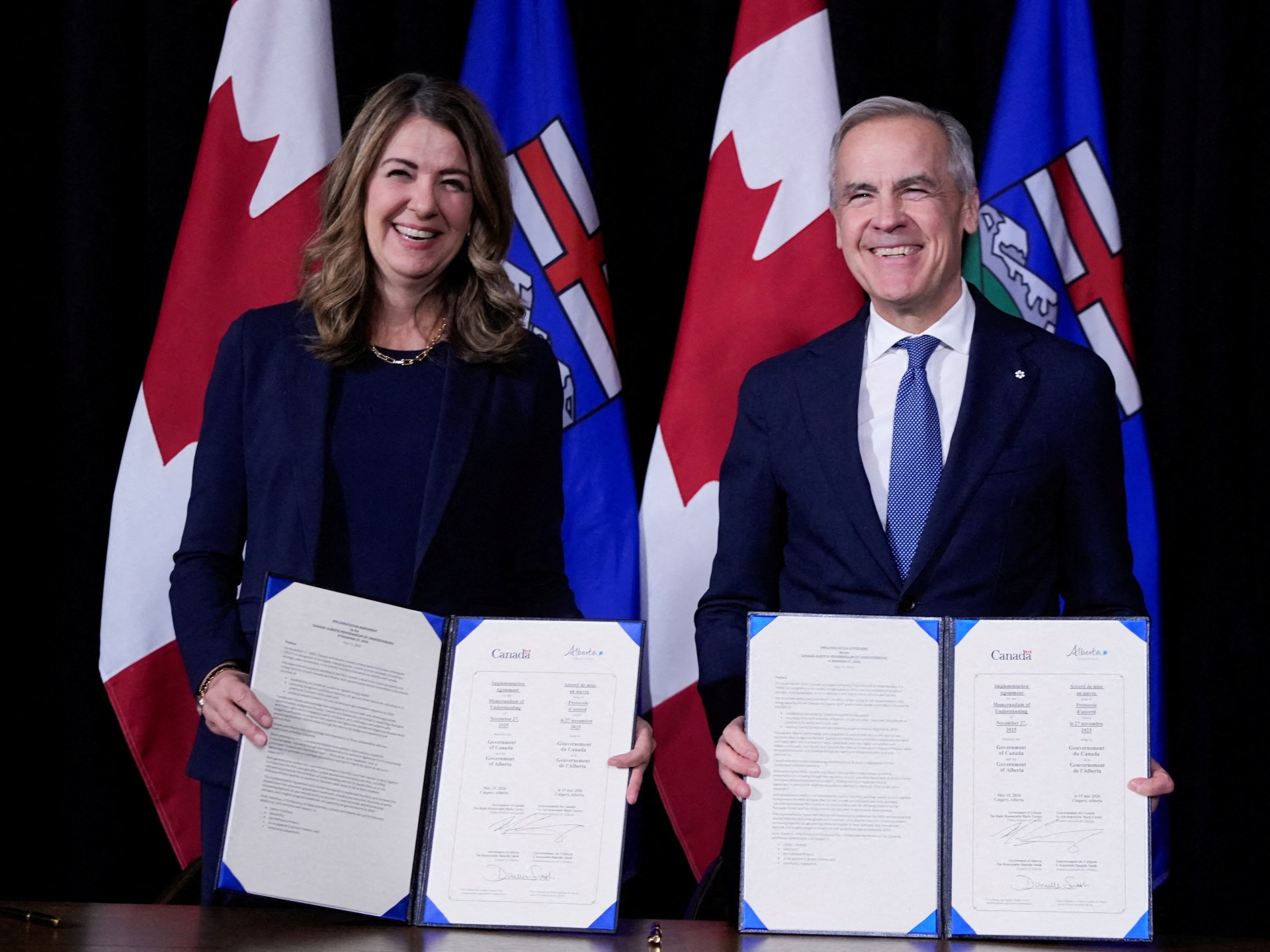
The Canadian prime minister highlighted his recent visit to the province’s largest city, Calgary, where he announced several agreements, including an effort to fast-track an oil pipeline from Alberta to the West Coast.
“We’re renovating the country as we go, and Alberta being at the centre of that is essential,” Carney said on Friday.
A referendum on a referendum
Late on Thursday, Alberta Premier Danielle Smith announced that the province would hold a referendum on whether to hold a separation vote.
The decision came after a court blocked a petition to hold a vote on separation, citing lack of consultation with Indigenous groups that would be affected by the referendum.
Smith emphasised that she opposes separation, but she rejected the judicial ruling.
“Despite my personal support for remaining in Canada, I am deeply troubled by an erroneous court decision that interferes with the democratic rights of hundreds of thousands of Albertans,” she said in a video message.
A group that calls itself Stay Free Alberta says it gathered more than 300,000 signatures to trigger a separation vote.
Advertisement
A competing group called Forever Canada also says its petition to remain part of the country has garnered more than 400,000 signatures.
Smith said her government would respect the results of the referendum, as well as other questions that will be put directly to voters on October 19.
But it is unclear whether the province can go forward with a separation referendum amid the judicial block.
The question on the ballot will be: “Should Alberta remain a province of Canada or should the government of Alberta commence the legal process required under the Canadian Constitution to hold a binding provincial referendum on whether or not Alberta should separate from Canada?”
Several polls have shown that a majority of Albertans do not support independence for the province.
While the vote will not immediately lead to Alberta’s separation, it could deepen political polarisation in Canada, creating a major challenge for Carney.
The conservative-dominated province of five million people has long viewed the Liberal federal governments of Carney and his predecessor Justin Trudeau with scepticism, namely over environmental regulations.
Carney has appeared to be willing to ease environmental policies amid tensions with the administration of President Donald Trump in the United States and a global energy crisis due to the war with Iran.
Simultaneously his government has also touted a carbon capture project that aims to offset greenhouse gas emissions from the oil industry.
Radio-Canada reported on Friday that 14 Liberal members of Parliament had penned a letter to Carney warning him against making major environmental concessions to Alberta, emphasising that “climate change remains the greatest threat of our time”.
‘National crisis’
On Thursday, Smith, a member of the United Conservative Party, which is aligned with the federal Conservative Party, decried Trudeau’s policies and stressed the importance of decentralised governance in Canada.
But she credited Carney with doing away with some of his Liberal predecessor’s policies, especially around energy production.
“Prime Minister Mark Carney, adopted most of Alberta’s positions on energy and resource development. In fact, the current prime minister has worked very constructively with our government to craft an Alberta-Ottawa energy agreement,” Smith said.
She paid a nod people in the province who she said feel like the federal government has “taken advantage” of Alberta, but she said the situation is a “world of difference” better under Carney than Trudeau.
Advertisement
“Do we in Alberta still have our differences with the federal Liberal government? Obviously, and make no mistake, we will relentlessly challenge them to respect our provincial rights and jurisdiction every time they step over the line,” she said.
Conservative Party Leader Pierre Poilievre, who holds a parliament seat in Alberta, said he would push against separation.
“I will be campaigning across the province, encouraging Albertans to stay as part of the Canadian family,” Poilievre told reporters on Thursday.
But some Liberals have blamed conservatives for stoking Alberta separatist sentiment for political gains.
Corey Hogan, one of two Liberal MPs from Alberta, blasted Smith for going forward with the referendum, accusing her of appeasing separatists who “threatened to bring her down” and turning her political problems into a “national crisis”.
“This baffling, referendum-on-a-referendum question will do nothing to settle anything,” Hogan said.
“It adds another layer of confusion. It will divide. It will distract. It will damage. I hope her government will consider how to step back from this madness before the damage to our province’s social fabric and economy is too great.”
Related News
Iran war live: Trump threatens Tehran; Saudi, UAE report drone attacks

Mexican officials announce 10 dead in early-morning shooting in Tehuitzingo
Cuba says it has ‘legitimate’ right to defend itself amid US threats