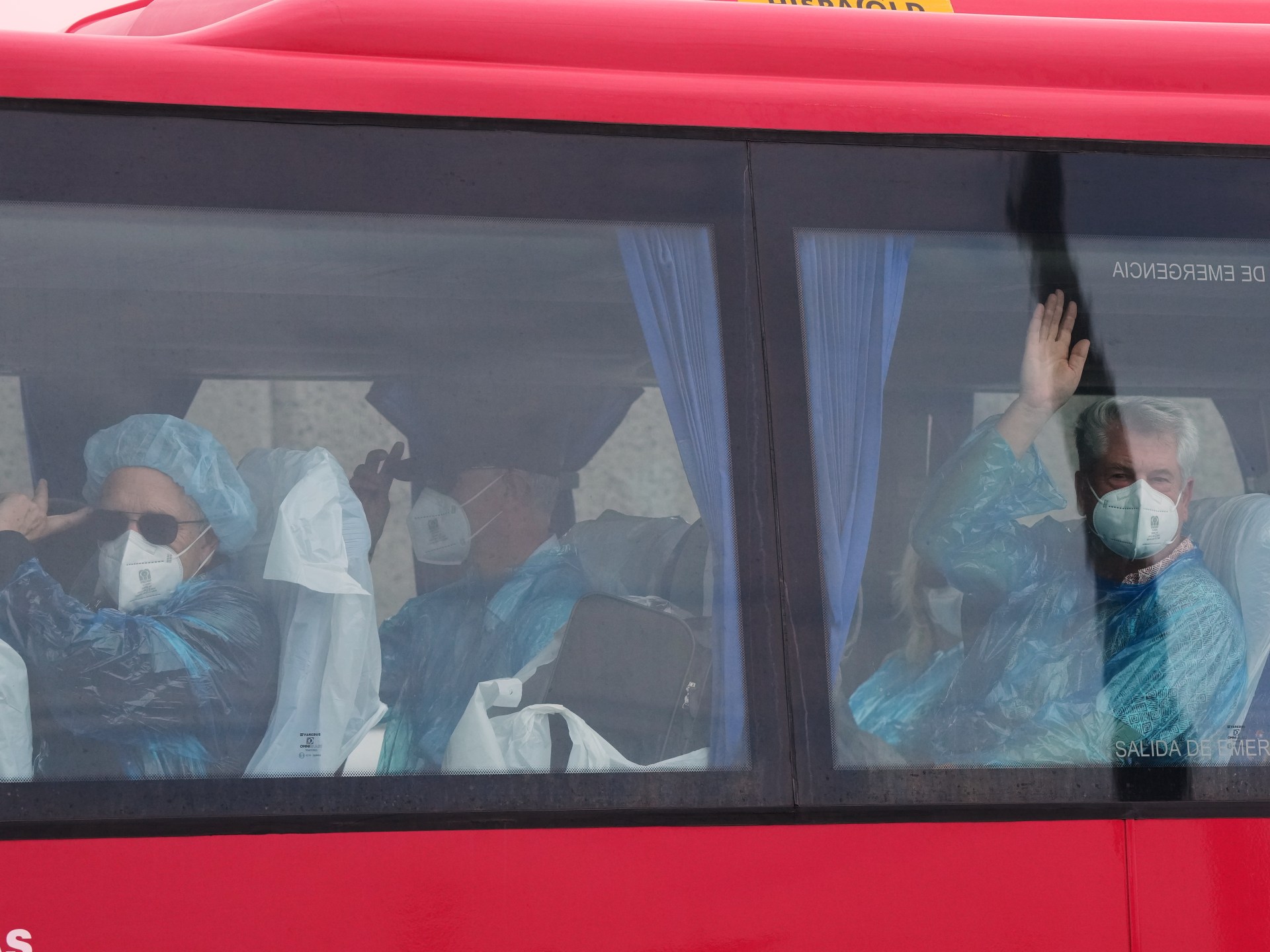

A United States citizen who was on the hantavirus-hit MV Hondius cruise ship is the latest to test positive for the virus while a French traveller has developed symptoms as the ship is being evacuated and passengers are returning to their home countries.
Passengers began flying home on military and government planes after the ship anchored near Tenerife, the largest of Spain’s Canary Islands, on Sunday.
- list 1 of 3Hantavirus cruise ship evacuations under way in Spain’s Canary Islands
- list 2 of 3Passengers from Hantavirus-hit cruise begin disembarking ship
- list 3 of 3Two more cruise ship passengers test positive for hantavirus
end of list
At least eight people who were on board the ship had earlier been confirmed or were suspected of having contracted the hantavirus. Three people have died while at least one person is in intensive care.
Previously, officials from the Spanish Ministry of Health, the World Health Organization (WHO) and the cruise company Oceanwide Expeditions had said none of the more than 140 people who had been on board the MV Hondius was showing symptoms of the virus, but that has since changed.
As passengers are being flown home for testing and monitoring, health officials are racing to determine where and how the outbreak may have started.
There are no conclusive answers yet, but the trail has led investigators to Argentina, from which the MV Hondius departed on April 1.
Here’s what we know so far:

What happened on the ship?
Passengers on the MV Hondius anchored at Tenerife were evacuated and escorted to shore by officials in full protective gear on small boats on Sunday. They were then put on planes that began to fly to several destinations on Sunday and Monday.
Advertisement
WHO Director-General Tedros Adhanom Ghebreyesus was present to oversee the process and to reiterate that people on Tenerife as well as the general public were at low risk of contracting hantavirus.
Maria Van Kerkhove, WHO’s top epidemiologist, said at a news conference on Saturday that the agency recommended to all governments involved that passengers be tested and monitored for at least 42 days after suspected exposure to the virus.
Where have passengers been evacuated to?
Planes flying out of Tenerife carried passengers from more than 20 countries. Spanish passengers were the first to be evacuated to a military hospital in Madrid while Norway sent an ambulance plane for its citizens.
At least one of the 17 American passengers evacuated has tested positive for the virus but was not showing symptoms, US health officials said. A plane carrying US passengers was due on Monday to arrive in Omaha, Nebraska, where they were to be quarantined.
French Health Minister Stephanie Rist revealed on Sunday that one of five French passengers had developed symptoms on a flight home to France on Sunday. The woman’s condition has rapidly deteriorated in Paris since then. Earlier, Prime Minister Sebastien Lecornu said all five were being put into isolation “until further notice”.
A Japanese national travelled to the UK on a flight arranged by the British government and will be monitored for up to 45 days, Japan’s Ministry of Foreign Affairs said. Authorities in the United Kingdom said passengers would be quarantined in hospital for 72 hours, followed by six weeks of self-isolation.
In the Netherlands, an evacuation plane carrying 26 people from different countries landed in the city of Eindhoven on Sunday evening. Dutch citizens were being put into a six-week self-quarantine at their homes.
Others from Germany, Greece, India, Portugal, Argentina, Belgium, Ukraine, Guatemala, the Philippines and Montenegro were set to be quarantined by local officials or transported home.
On Monday, German authorities reported that four Germans had been transported from the Netherlands to Frankfurt University Hospital, from which they will be taken to their home cities and quarantined. None has tested positive.
Australian authorities, meanwhile, sent an evacuation plane due to arrive on Monday to transport nationals from Australia, New Zealand and some Asian countries.

Where are the other passengers who left the ship earlier?
At least 34 passengers and crew had already disembarked from the ship by May 2, the day the WHO first received reports of an outbreak of severe respiratory illnesses on the ship as it was docked off Cape Verde.
Advertisement
Some got off at their own stops while some were evacuated because they had become unwell.
Six British army medics parachuted onto the remote South Atlantic British territory of Tristan da Cunha on Saturday, where one passenger had disembarked on April 14. The passenger is now suspected of having the virus, and the soldiers were delivering medical personnel with supplies and oxygen.
Four other people are currently hospitalised: One is in intensive care in Johannesburg, South Africa; two are in the Netherlands; and one is in Switzerland. They include a doctor on the ship and a crew member.
Three people have died – one died on board the ship and a close contact of theirs later died in hospital. It is unclear at which point the third person died.
Where did the hantavirus outbreak start, and where has it spread?
Hantavirus infects humans who breathe in air contaminated with virus particles from infected rodents’ urine, droppings or saliva.
The current outbreak is linked to the Andes strain, which is endemic in rural parts of South America. It is the only form known to spread between humans.
It is not yet known where the initial contamination took place. Health officials are currently tracing the outbreak in Argentina, from which the ship departed.
The first people to develop symptoms were an elderly Dutch couple on the cruise ship, and they are among the three fatalities. It is not known if they were the first to contract hantavirus, however.
Local media in Argentina reported that the couple had visited a landfill site in Ushuaia, a popular tourist spot in southern Argentina’s Patagonia region, in search of a rare bird. There has been speculation that one person in the couple could have been exposed to rodent droppings there.
However, local health officials in Ushuaia said this is unlikely, telling reporters that the area has not recorded a hantavirus case since 1996.
However, some experts said examinations in the area are required to be certain of this because sometimes ecosystems change and vectors can move locations.
The resulting negative attention on Ushuaia has cast a shadow on local businesses, according to local media reports. The city is considered the “gateway to Antarctica” with most shipping expeditions departing from there. There is now a concern that the outbreak could reduce tourist numbers.
Last week, Argentinian health officials were deployed to the site with plans to take samples of rats in the area of the landfill and examine them for hantavirus.
Where else could the virus have come from?
There have also been suggestions that the couple, who had been travelling in the region for several months, may have been exposed to the virus in Chile or in other parts of Argentina where the Andean strain is endemic.
Argentinian media have reported that the couple arrived in Argentina on November 27. They then crossed into southern Chile and went on to Uruguay by car and remained there from March 13 to 27 when they returned to Argentina.
Hantavirus is endemic across most of Chile except in the country’s far north. The Andes strain, in particular, is endemic in Chile’s Aysen region. Chile shares a long border with Argentina.
Advertisement
Chilean health authorities last week confirmed the couple’s presence in the country but said they travelled “during a period that does not correspond to the incubation period, so the exposure to the virus would not have occurred in our country”.
The last similar transmission of the hantavirus from human to human was recorded in Chile in 2019, authorities added.
Uruguay’s Ministry of Public Health said last week that there is no risk of transmission associated with the couple in the country as their symptoms began several days after they left the country, meaning they were not symptomatic during their stay in Uruguay.
Related News

Riots erupt over Australian Aboriginal girl’s murder as suspect arrested

Accused shooter was targeting Trump and US officials, authorities say
Nearly eight million people in South Sudan at risk of acute hunger: NGOs