

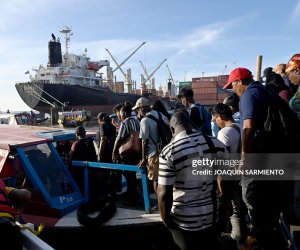


NEWS AMERICAS, NY, NY, Thurs. Sept. 24, 2026: The CARICOM South American nation of Guyana has numbers most developing countries could only dream of. The country’s economy has expanded at extraordinary rates since offshore oil production began. World Bank data put nominal GDP per capita at an estimated US$31,603.90 in 2025, up from just US$6,405.60 in 2019. Real GDP growth was estimated at 15.4% in 2025 after expanding 43.8% in 2024.
On paper, Guyana is booming. Yet the daily experience for many Guyanese remains far more complicated.
A News Americas analysis of Caribbean wages earlier this year found Guyana’s statutory minimum wage at approximately US$1.66 an hour, or roughly US$285 a month – placing its lowest-paid workers near the bottom of the Caribbean wage table even as the country experiences an unprecedented oil boom.
That contrast raises a question increasingly difficult to ignore: when does extraordinary economic growth become extraordinary development?

The wage numbers become even more striking when measured against the cost of everyday life. According to crowd-sourced cost-of-living database Expatistan, estimated monthly expenses for a single person in Guyana are G$271,720, while estimated costs for a family of four are G$613,266 per month.
Housing alone can consume a substantial portion of income. Expatistan estimates monthly rent for a furnished studio in a normal area at G$65,000, while an 85-square-meter furnished home in a normal area averages G$136,983 per month, before utilities.
The Expatistan figures are user-contributed estimates rather than official household-expenditure statistics, but they help illustrate the affordability pressures confronting workers at the lower end of Guyana’s wage scale. News Americas has raised the broader issue before: as oil production and national wealth surge, the central question is increasingly not whether Guyana is becoming richer, but how much of that wealth is translating into broad-based prosperity for Guyanese themselves.
Guyana’s poverty statistics reveal another major gap in understanding who is benefiting from the oil boom. An Inter-American Development Bank poverty study, using Guyana’s 2021 Labor Force Survey, estimated that 58% of the population lived in poverty, including 32% in extreme poverty.
That figure should not be interpreted as a 2025 poverty rate. It reflects 2021 data. The World Bank’s most recent comparable poverty estimate is even older. It reported that 48.4% of Guyanese lived below the upper-middle-income poverty line in 2019, down from 60.9% in 2006.
That means one of the world’s fastest-growing economies still lacks sufficiently current national poverty data to show precisely how much the oil boom has reduced deprivation. And that itself is significant. If economic growth is transforming Guyana at unprecedented speed, then measuring whether that transformation is reaching households should be equally urgent.
Electricity remains one of the most visible tests. Guyana Power and Light, (GPL), acknowledged this month that rising electricity demand and pressure on the distribution network were contributing to recent outages. Peak demand had increased from 221 megawatts in 2025 to approximately 257 megawatts, with the highest demand generally occurring between 7 and 9 p.m.
GPL says households’ simultaneous use of air-conditioning units, fans, lights and other appliances during those hours is contributing to the increased demand. The explanation, however, highlights the larger infrastructure challenge.
For households, unreliable electricity means disruption and inconvenience. For businesses and investors, it means something more serious. Reliable electricity is fundamental to manufacturing, retail, healthcare, hospitality, data services and virtually every modern commercial activity. Guyana’s economic expansion is creating demand faster than parts of its basic infrastructure can accommodate.
Water infrastructure presents another challenge. The Guyana Water Inc., (GWI), says it has been investing heavily in treatment plants and distribution systems, but water-quality concerns remain in several areas.
But a 2025 Public Utilities Commission report flagged problems involving color, turbidity and iron levels at treatment facilities in Regions 4, 7 and 10. GWI has disputed suggestions that these findings mean the water is unsafe, arguing that the issues relate principally to appearance, taste and operational standards rather than public-health parameters.
That distinction matters. But so does the broader point: in an economy generating extraordinary new national wealth, citizens increasingly expect basic public services to improve visibly alongside the macroeconomic indicators.
Guyana’s fiscal position remains substantially stronger than many Caribbean economies.
The IDB’s latest Caribbean Economics Quarterly says the country’s overall debt levels remain “highly sustainable.” But it also reports that Guyana’s total debt ratio increased from 24.3% of GDP in 2024 to 28.6% in 2025, as external debt increased.
At the same time, the actual dollar amount of public debt is climbing sharply. Senior Finance Minister Dr. Ashni Singh announced earlier this year that total Public and Publicly Guaranteed debt had reached US$7.7 billion at the end of 2025, up from US$5.993 billion a year earlier. Kaieteur News has reported that government borrowing planned for 2026 could push Guyana’s public debt to approximately US$10.3 billion by year-end.
That apparent contradiction is possible because Guyana’s economy is expanding so rapidly that debt can increase substantially in dollar terms while remaining relatively modest as a percentage of GDP.
Borrowing can be entirely sustainable if those funds are converted into productive infrastructure and long-term economic capacity. Indeed, the IDB notes that Guyana has dramatically increased capital expenditure since oil production began as the government seeks to address the country’s infrastructure deficit. The real issue, then, is not simply how much Guyana borrows. It is what Guyana receives in return.
Guyana has moved from relative obscurity in global energy markets to one of the world’s most closely watched oil economies in only a few years.
Roads are being built. Hospitals and schools are being expanded. New hotels, businesses and housing developments are appearing. Infrastructure spending is occurring on a scale Guyana could scarcely have contemplated before oil. That investment matters. So does the enormous challenge of upgrading systems built for a much smaller economy while demand is expanding at extraordinary speed.
But GDP alone cannot be the final measure of success. The ultimate test will be whether Guyanese can feel the boom – in reliable electricity, clean and dependable water, affordable living costs, better healthcare, stronger schools, improved communities, higher household incomes and a measurable reduction in poverty.
Guyana’s economic boom is unquestionably real. The next question is whether it becomes something even more consequential:a development boom.
Related News

Digital Trade Nears $90 Billion In Latin America And Caribbean As Online Exports Surge

Sandals Sells Half of Itself to Royal Caribbean In $3 Billion Deal – What It Means for t...
After Guyana, Now Trinidad And Tobago: ExxonMobil’s First Real Signal Arrives By End Of ...
