From Barbados To Charleston: The Caribbean Roots Hidden In South Carolina’s Founding
 14 August 2026


News Americas, CHARLESTON, S.C., Fri. Aug. 14, 2026: Long before Charleston, South Carolina became one of America’s most visited cities, it was, in a very real sense, a Barbadian project. That history is a reminder that Caribbean roots run far deeper in the United States than many Americans realize.

The English settlers who founded the Carolina colony in 1670 didn’t sail directly from England; they came via Barbados, and what they learned there shaped the city that exists today. The shared history of Charleston and Barbados can be traced back more than three centuries, when, in 1670, a boat of white settlers and enslaved African-Americans set sail from Speightstown in Barbados, and landed at Albemarle point in the Carolina Colony. Over the next three years, over half of the settlers and slaves that arrived in the new colony came from Barbados.
“We were settled in 1670 by a group of English settlers that came via Barbados,” David Baker, park manager at Charles Towne Landing State Historic Site, the marshy point off the Ashley River where the settlers first landed and lived for about a decade, told me recently, during a visit to the “Holy City.”
The site is where Charleston and the state of South Carolina began. By the late 1600s, Barbados had already developed a lucrative plantation economy, but land on the small island had become increasingly scarce. English settlers who came to Carolina via Barbados brought with them the plantation model, knowledge and practices that had taken root on the island.
The fingerprints of that connection are still on the map. The Ashley and Cooper Rivers, which frame the Charleston peninsula, are both named for Lord Anthony Ashley Cooper, head of the Lords Proprietors who backed the colony, and a man whose family held plantations in Barbados. Cooper was the colony’s chief correspondent, receiving regular updates from Carolina’s governor on which crops were succeeding and which were failing. Other Lords Proprietors, including the Colleton family, also held Barbadian plantations, and their surnames remain common across the Charleston area today. John’s Island and James Island, both near Charleston, were named after St. John and St. James in Barbados.
The first planters tried several crops, initially attempting sugar cane, following the Barbados model, but it failed. “They grew a bunch of different things…. Other stuff they tried was indigo, rice was first dry cultivated in 1672,” said Baker.
Rhoda Green, founder and CEO of the Barbados Carolinas Legacy Foundation, said the role Barbados played in shaping the colony runs deeper than geography. Barbados was first settled by the English in 1625, and by 1640 sugar cane was introduced to the colony and it soon became heavily dependent on slave labor to keep the blossoming industry alive. Barbados acquired the nickname “Little England” because, through the centuries, it has remained the most British of the Caribbean islands. Since wind currents made it relatively difficult to reach under sail, it was not conquered and reconquered like most of its Caribbean neighbors. British control over Barbados lasted from 1625 until its independence in 1966.

“It transitions from the plantation system…what they learned in Barbados was so very important to be able to get off the ground running once they got here,” said Green as we stood in the Charles Towne Landing State Historic Site museum. “The transition is so very important and the role Barbados played was very important.”
Baker added: “Barbados was such a successful colony at that time for sugar production that the Lord Proprietors basically mandated the colonists to stop by Barbados and learn everything they could possibly learn about the plantation model and try to see how that can fit in the new Carolina colony.”

The first English settlement in what is now called South Carolina was made in 1670, when William Sayle sailed up the Ashley River with three shiploads of English emigrants from Barbados and Bermuda. These settlers pitched their tents on its banks and built a town, which has since wholly disappeared.
The first ship to land in the second Charles Town was the Carolina, which landed in April of 1670. It was followed shortly by the Port Royal and the Three Brothers. These three ships had left Barbados with 150 people on board; two died enroute. The original destination for the ships was Port Royal, further to the south. The Kiawah Indians in that area convinced the settlers that Charles Town was a better choice for farming, and the settlers observed that Charles Town was further away from the Spanish settlement of St. Augustine.
The Carolina reached land and anchored at Sewee Bay/Bull’s Island on March 17; Port Royal about March 21 and stayed 2 days; then to St. Helena; then to Kiawah, Ashley River, arriving early in April. One of the clearest imprints came through Sir John Yeamans, one of the Carolinas earliest governors, who held a plantation at Barbados’ St. Nicholas Abbey. In 1671, Sir John, the governor of the first Charles Town along the Cape Fear just four short years earlier, joined the second Charles Town colony, bringing with him about two hundred African slaves, some already forced laborers for years, others newly trafficked across the Atlantic. He and others introduced the brutal “Barbados Model” of chattel slavery to the new Carolina colony, shaping its plantation economy, labor practices, and foundational culture. Green said that group of slaves effectively became the first labor force that got the Carolinas plantation economy operating.
“Some were first generation while others were newly brought across the Atlantic from Africa,” said Green.

“The reason why South Carolina was such a pivotal spot was because of the agricultural system,” added Green. “Barbados became the model, but the other islands got pulled in. They experimented with a lot of crops much like they did in Barbados. It wasn’t until the 1720s that they realized this was the right terrain for rice. And it was at that time they began importing a lot of Africans from what became known as the Gold Rice Coast.”
South Carolina’s early planters experimented widely before finding what worked. Sugar cane, the crop that had made Barbados so profitable, failed in Carolina’s climate. Indigo and silk were tried as well. It was rice, dry-cultivated as early as 1672 and later grown at scale from the early 1700s onward, that ultimately built Carolina’s fortune, a crop successful in large part because enslaved Africans brought to the colony already possessed generations of rice-growing knowledge from West Africa.
Since the Barbadians had been in the “plantation” business for decades, they brought this concept and its associated culture to the second Charles Town in the 1670s, where it flourished. Charles Town was launched under completely different circumstances than the Albemarle region in the northern part of Carolina, which was settled slowly by the early Virginians. These two quite-different cultures never really got along with each other. Each were convinced that their “way of looking at things” was better than the other’s.

Green describes Barbados’ role in the broader story of slavery in the Americas as something like an experimental ground. Barbados remained firmly under British rule while other Caribbean islands were contested by France and Spain, it became, according to Green, the place where the British worked out the laws and systems for managing an enslaved population that came to vastly outnumber colonial settlers, a model then exported to the Carolinas and beyond.
The Barbadian slaves were forced to clear wilderness, build fortifications, and establish plantations. Their labor and agricultural knowledge laid the foundation for South Carolina’s plantation economy, and their harsh legal codes were directly copied from Barbados. Enslaved people cut down forests and built the initial stockade and dwellings at Albemarle Point and their agricultural expertise from the West Indies to grow early crops and later cultivate rice, which became the colony’s great cash crop.
Rice arrived in the colony as early as 1672, but it was the well-known 1685 exchange, in which a Madagascar-bound ship’s captain gave planter Henry Woodward a barrel of rice seed, that’s most often credited with establishing it in the Carolinas.
By the 1690s, colonists were growing it successfully. Baker, however, said it wasn’t until the 1700s, when rice plantations began growing at scale, that the enslaved population brought from Africa grew significantly. By the 1720s, rice exports had climbed into the millions of pounds annually, reaching roughly 20 million pounds by 1730. Enslaved individuals cleared dense timber, dug ditches by hand, and built primitive banks to manually control water levels. This expansion cemented rice as “Carolina Gold,” making Charleston one of the wealthiest ports in the North American colonies.
South Carolina adopted the 1661 Barbados slave code, creating one of the most violent and restrictive legal systems against Black people in North America. The “plantation lifestyle” certainly insisted on the use of slavery, and Charles Town quickly became the port-of-entry for the majority of all black slaves into the English colonies. Indian slavery grew, as well, thanks to the many warring tribes within the southern part of Carolina. The English quickly took advantage of these warring groups and convinced many tribes to “turn over” their captured enemies to the colonists so they could be added to the growing black slave population.
Colonists continued trading back and forth, bringing sugar and rum from Barbados and taking rice and cattle in return. That connection also runs through bloodlines still traceable in the region today, said Green, including Irish and Scottish indentured servants from Barbados, historically known as “Red Legs,” some of whose descendants became part of the Carolinas early population, after completing their indenture. Although the South Carolina culture was firstly based on the Barbadian system, of course it evolved and began to diverge from the “island colony” cultures that continued in the English Caribbean.
Charles Town would remain the name of the city until 1783, when, after the Revolutionary War, the name became Charleston. The city would go on to become a major port of entry for enslaved Africans, spark the Civil War and later launch a historic preservation movement to transform it into the tourism destination it is today.
Charleston’s Caribbean population today is far smaller than its founding history might suggest, but it’s still woven into the city’s modern character. Per Census-derived data compiled by Charleston Business Magazine and Stacker, Cuba is the largest Caribbean source of Charleston’s foreign-born residents at 699 people (1.29% of the foreign-born population), followed by a tie between the Dominican Republic and Jamaica at 683 residents each (1.26%), and Guyana at 283 residents (0.52%).

The economy that rice and enslaved labor once built has long since given way to different engines. Tourism is now Charleston’s dominant economic force, generating an estimated $14.3 billion in economic impact in 2025 from nearly 7.9 million visitors, according to the College of Charleston’s Office of Tourism Analysis, accounting for close to a quarter of all regional sales. The Port of Charleston, meanwhile, anchors an even larger footprint: the South Carolina Ports Authority drives an estimated $87 billion in annual economic activity statewide and supports roughly 260,000 jobs, making it the state’s largest overall economic driver. Where rice and cotton once moved through Charleston’s harbor on the backs of enslaved labor, it’s now shipping containers and cruise passengers keeping the local economy turning.
The Caribbean influence didn’t end with Charles Towne Landing’s brief decade as a settlement before the colony relocated to the current downtown peninsula around 1680. At nearby Middleton Place, one of the Carolinas most prominent planter families, the Middletons, first settled in Barbados themselves in the 1660s, entering the mercantile business, including the trade of enslaved people, before eventually acquiring land near present-day Charleston in 1670.
Architecturally, the Caribbean influence is visible across Charleston today in the city’s distinctive older single-sided “porch houses,” designed specifically to catch sea breezes, a style historians trace directly back to Barbados and the West Indies. Even Charleston’s famous Rainbow Row is described by local historians as carrying Caribbean architectural influence.
For visitors tracing this history today, the Barbados Carolinas Legacy Foundation offers the most direct route into the connection, while sites including Charles Towne Landing and Middleton Place continue building out exhibits and archaeological research into exactly how deep, and how consequential, that first stop in Barbados turned out to be for the city Charleston eventually became.
The English settlers who founded Charleston in 1670 left England the year before and stopped in Barbados en route, specifically to study the island’s plantation model. That history comes alive at Charles Towne Landing State Historic Site, the marshy point off the Ashley River where the colony was first established. Here you can walk through the ten-year story of the original settlement, including the English Barbadian planters who financed and staffed it.
The site today includes a 12-room interactive exhibit hall, a walkable history trail, and the Adventure, a replica 17th-century sailing ship visitors can board and get a feel of what it was like for colonists trading between Barbados and Charles Towne back in the 17th century. The Animal Forest natural habitat zoo, the only zoo in the Charleston area, includes black-bellied sheep brought directly from Barbados. Eighty acres of gardens round out the grounds, including the Legare Waring House, a popular wedding venue.
Tickets and details: southcarolinaparks.com/charles-towne-landing

About 16 miles northwest of downtown Charleston sits Middleton Place, home to one of the Carolinas’ most prominent planter families. The Middletons, like so many of Carolina’s founding families, first settled in Barbados in the 1660s before relocating to the Carolina colony. In 1678 Edward Middleton emigrated from Barbados to the Carolina colony. In Barbados he had acquired land holdings – such as parts of the Fort Plantation or Middleton’s Mount – in parishes like St. James, Barbados, participating in the island’s early sugar boom and slave-based plantation economy. In the Carolinas he was appointed as a proprietary deputy and an associate justice.
Having been a widower for an extended period, Middleton married Sarah Fowell in 1680. The following year, Sarah gave birth to their only child, Arthur, who served as governor of South Carolina from 1725 – 1730. Arthur Middleton’s son, Henry, was born in the colony at The Oaks, the family’s plantation in St. James Goose Creek Parish. When Arthur Middleton died in 1737, Henry inherited land in England, Barbados and South Carolina. In 1741 Henry married Mary Williams, whose dowry included the plantation property that would become Middleton Place.
The plantation’s rice fields, still visible today alongside a small demonstration plot of Carolina Gold rice, made the family enormous wealth built on the labor and rice-cultivation knowledge enslaved Africans brought with them from West Africa’s rice coast.
“Middleton Place is also on the Ashley River, and so Charles Towne Landing 1670, and we know this site where Middleton Place now stands was settled in 1675, but the Middletons acquired the land in 1741 and are a major planter family in the Carolina colony. By 1741 rice had become the major cash crop,” said George McDaniel, Director of Interpretation & Education at Middleton Place Foundation. “They tried sugar and also tried silk worms.”
On the grounds, visitors can get a sense of what the plantation may have looked like in the 1700s. Eliza’s House is a museum today where you can see the names of more than 1,300 enslaved people owned by the Middleton’s across their multiple plantations. Carriages, the stable, the blacksmith shop, the laundry, and cooking iron pots are still there to view, alongside plants from the era, including okra brought over by Africans, pigeon peas and a Barbadian pepper variety, in the garden, plus a demonstration rice field and animals from the era, including water buffalo.

“Rice was sold for vast amounts of money and made the planters very wealthy,” said McDaniel. “You have the triangular slave trade where goods are being brought down to the West coast of Africa, exchanged for enslaved Africans, who were then brought to the Carolina coast and brought to plantations as labor force.”
Middleton Place was a 6,000-acre plantation, worked by enslaved people “who set up the irrigation system for the rice fields by hand, irrigating the fields, then the water being drained and diverted to irrigate the formal gardens, a symbiotic relationship between the fields and the pleasure gardens, all tended by the enslaved,” said McDaniel. “They were not just laboring in the fields. They were incredibly gifted horticulturists.”
There were about 150-200 enslaved people at the plantation at the time Henry Middleton acquired the property through marriage to Mary Williams, whose dowry he received. He enslaved about 800 people across multiple plantations, said McDaniel, though he noted it is hard to pin down an exact number at any given time, since enslaved people were moved around between plantations depending on what needed to be done.
Those brought to Middleton Place came from the western coast of Africa, including Senegal, Benin and Ghana, said McDaniel, specifically because they carried generations of rice-growing knowledge with them. The plantation’s fields are cut at a slight angle, a technique traced directly to generations of rice cultivation in West Africa.
“The first Middletons come from Barbados…they go to Barbados from Britain,” said McDaniel, noting there wasn’t much arable land left on the island by the time they arrived. “They enter the mercantile business, which is also the trading of human beings. So they are engaged in the slave trade from the outset. And then in the 1670s Charles Towne Landing is established and the Carolinas opens up, and for the British, all this land opens up. And they leave Barbados, come to the Carolina colony, and acquire land up near Goose Creek. They brought slaves as well and are trading, and part of all that trading is humans. We know there were lots early on that came.”
Post-slavery
Phosphate mining also took place at Middleton. “A lot of the formerly enslaved men worked in the phosphate mines,” said McDaniel. “They found phosphate in vast quantities along these river banks in the Lowcountry, and phosphate in the late 19th century was such a capital producer because fertilizer was in high demand, because in the mid-19th century the West had opened up, Alabama and Mississippi, and they were growing cotton and the soil is depleted and needs fertilizer.”
Barbados’ limited farmland shaped the Carolinas’ early economy in another way, too. “Barbados being a small island, all of their arable land was taken by sugar. The first thing the first planters did when they came to the Carolinas was bring cattle who fed on the grasslands, and they then slaughtered the cattle and sent it to Barbados and other points as salted beef. And this gave them some money and capital to then experiment and find the cash crop,” McDaniel said. “Peas and rice and pork…that’s actively participating in historical lineage that dates back hundreds of years in South Carolina and millennia to West Africa. History in a bowl.”
Eliza’s House

Dating to the 1870s Reconstruction era, and likely constructed for phosphate labor, Eliza’s House is today home to the Beyond the Fields exhibit at Middleton Planation, where the first names of over 3,000 individuals enslaved across 19 properties owned by the Middleton family are listed in black and white in the House.
“In holding on to names, it was a form of resistance,” McDaniel said. “Just like with holding on to the food. Seeds…or somehow they arrived and they grew small vegetable gardens which allowed them to supplement whatever nutrition and meager rations they were given…it is also nutrition for the soul, because it’s a piece of home. With names, the foods, the traditions like sweetgrass basket weaving, all of these things are things they are holding on to. In reading these names, speaking these names, acknowledging these names, we have restored humanity to these people who spent their lives under an institution that was designed to strip them of humanity and treat them as a commodity to be bought and sold.”

The Middleton Place Foundation was founded in 1974 by Charles H.P. Duell, a descendant of the Middleton family who inherited and later transitioned the property to the foundation, to preserve the historic landmark. It is now a National Historic Landmark District and is used as a museum while being home to the oldest landscaped gardens in the United States. The organization is led by President and CEO Dana Hand Evans.
General admission: $35 for adults (14+), with discounts for seniors, military and students. middletonplace.org

No trip to Charleston is complete without the International African American Museum, built by lead design architect Henry N. Cobb of Pei Cobb Freed & Partners in collaboration with executive architect Moody Nolan. It is located at Gadsden’s Wharf, one of the US’ most significant sites in the history of the transatlantic slave trade where an estimated 40% of enslaved Africans brought to what became the United States passed through Charleston, many arriving at this very wharf.

The experience begins before you enter the museum. Outside, a black granite wall is inscribed with words from Maya Angelou’s Still I Rise, while sculptural figures honor the memory of enslaved Africans who arrived at Gadsden’s Wharf. An outdoor soundscape carries Angelou’s voice alongside historical African and African American voices, setting the tone for what lies ahead.
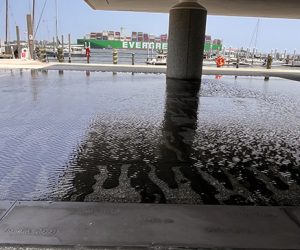
At the heart of the African Ancestors Memorial Garden is a striking tidal reflecting pool designed by the Henry N. Cobb Design Studio. Positioned beneath the elevated museum, the shallow pool rises and falls with Charleston Harbor’s tides. Human figures embedded beneath the water evoke the tightly packed bodies depicted in diagrams of the Middle Passage, transforming the landscape itself into a memorial to those who survived the crossing – and those who did not.
The surrounding garden incorporates West African palms, sweetgrass and other plantings that connect Africa, the Lowcountry and the generations that followed. Even the museum’s architecture acknowledges the sacred nature of the site: the main building is elevated 13 feet above the ground on 18 cylindrical pillars rather than resting directly upon the historic landscape.
Inside, the museum traces the African American journey from West Africa through the Caribbean and into the Americas, with galleries exploring the transatlantic slave trade, Lowcountry life and Gullah Geechee history and culture. The permanent exhibitions feature more than 150 historical objects, more than 30 works of art including from Caribbean artists like Claude Dambreville and Andre Eugene of Haiti and Adiante Franszone of Suriname; films, and digital interactive experiences that bring Black history to life. For Caribbean visitors, one particularly compelling connection is Denmark Vesey. Likely born enslaved in St. Thomas in the U.S. Virgin Islands, Vesey was brought to Charleston, later purchased his freedom and became a key figure in the city’s Black religious and resistance history. He helped establish the African Methodist Episcopal congregation that became today’s Mother Emanuel AME Church – providing a natural bridge from the museum to the next stop on this Caribbean journey through Charleston.
Admission: $25 | 14 Wharfside St. | iaamuseum.org

A stop at the Emanuel African Methodist Episcopal Church, better known as Mother Emanuel, one of the most important Black churches in American history is also a must. Founded in 1817, the Charleston church has a remarkable Caribbean connection through Vesey, who was likely born enslaved in St. Thomas in the U.S. Virgin Islands.
Vesey was enslaved by Captain Joseph Vesey and spent time in Bermuda before being brought to Charleston. After winning a lottery, he purchased his freedom around the age of 32 and established himself as a successful carpenter. Despite his own freedom, he was unable to purchase the freedom of his first wife, Beck, and their children.

Vesey became active in Charleston’s Black religious community and helped establish an independent African Methodist Episcopal congregation, which became today’s Mother Emanuel. The congregation grew rapidly, drawing more than 1,800 members and becoming one of the largest AME congregations in the country.
Vesey later emerged as the central figure in an alleged 1822 uprising planned by enslaved and free Black people in Charleston. Drawing in part on the biblical story of Exodus, the plan reportedly called for participants to seize control of Charleston before escaping by sea to Haiti. The planned uprising was exposed before it could take place. Charleston authorities ultimately arrested and tried scores of men; Vesey and dozens of others were executed. Authorities subsequently destroyed the congregation’s church building, but the congregation survived – an institution whose history remains intertwined with Black faith, resistance and the long struggle for freedom.
More than two centuries later, Mother Emanuel again became the site of tragedy when a white supremacist murdered nine worshippers during Bible study on June 17, 2015. Today, tours are available by appointment Tuesday through Saturday from 10 a.m. to 3 p.m., with Lee Bennett Jr. serving as the primary presenter. Group tours require at least 10 people; individual tours are not offered, and group tours are unavailable on the first Saturday of each month.
Learn more at: motheremanuel.com/group-tours | 110 Calhoun St., Charleston, SC 29401

A visit to the historic Charleston City Market at 188 Meeting Street, where Gullah Geechee artisans continue the centuries-old tradition of weaving intricate baskets from sweetgrass should also be on your agenda for any visit to Charleston. One of the oldest public markets in the United States, the market has been a center of Charleston life for more than 200 years and today features local artisans, food and Lowcountry specialties.Open daily from 9:30 a.m. to 5 p.m., it’s an easy stop while exploring downtown Charleston. And don’t leave without trying a pimento cheese biscuit.
For a centrally located base, the historic Francis Marion Hotel sits on King Street across from Marion Square, within easy walking distance of Charleston’s shopping district on King Street, Mother Emanuel AME Church and the Visitor Center is a good choice.
Opened in 1924 and restored in the 1990s, the 235-room hotel retains much of its 1920s grandeur while offering modern comforts, including a complimentary Thursday cocktail hour and turndown chocolates. Rooms are clean and comfortable, though some bathrooms run small but some rooms can come with two bathrooms which gives you double to space. Ask for a room on a higher floor for some of the best views across Charleston and be patient as the elevator can be a bit slow. For reservations and more information, visit francismarionhotel.com
- Fleet Landing Restaurant (186 Concord St.): A downtown favorite for waterfront dining, Fleet Landing’s standouts for me were the fried green tomatoes topped with tarragon crab salad and the Carolina lump crab cakes. There is also the sea food tower to choose from as well as fried shrimp with red rice and collard greens s well as a raw bar available between lunch and dinner service. Reservations are highly recommended as it can get crowded. Log on to fleetlanding.net.

- Magnolias Restaurant: A longtime Charleston institution for upscale Southern cuisine, the standouts for me included the new appetizer – mussels in a delicious garlic and tomato based sauce as well as the Parmesan-crusted halibut with creek shrimp and jasmine rice pilau for the main course. There is also buttermilk fried chicken on the menu and a host of other delicious choices. For dessert I had the rum butterscotch bread pudding which is definitely worth saving room for. Upscale casual dress; reservations recommended at magnoliascharleston.com.

- Middleton Place Restaurant: This restaurant, located in the Middleton Place plantation, is about 40 minutes from the downtown area and can be hard to find, even for an Uber. But it is worth making time for during a visit. Try the fried okra and honey-fried chicken while taking in views of the Azalea Hillside and Mill Pond. Make your reservation at middletonplace.org/explore/restaurant.

- Swamp Fox Restaurant & Bar: Located inside the Francis Marion Hotel, the Swamp Fox serves a she-crab soup worth returning for – paired with some seriously delicious mocktails. Breakfast is also daily as a buffet off the menu. Check out all options at https://www.francismarionhotel.com/dining.
A Cruise: A sunset Charleston Harbor cruise aboard the Carolina Belle offers a 90-minute narrated tour past more than 75 landmarks, including Fort Sumter and the Arthur Ravenel Jr. Bridge. Adult tickets typically range from $42 to $52 depending on the sailing.

A City Tour: Beyond the major historic sites, explore Charleston’s Gullah Geechee heritage and the surrounding Sea Islands. Shaped by generations of enslaved Barbadian, West and Central Africans and their descendants, Gullah Geechee culture preserves distinctive traditions in language, food, music, craftsmanship and spirituality. It adds another important dimension to Charleston’s deep historical connections with Africa, Barbados and the wider Caribbean. Visitors and linguists often note that the Gullah Geechee language sounds remarkably similar to Bajan, the Creole language of Barbados, sharing cadence and structural features. Recent genetic updates from ancestry platforms like 23andMe frequently link Gullah Geechee individuals to regional communities in Barbados, confirming long-held migration and trade paths. And in 2019 there was a Gullah/Geechee Homecoming Libation Ceremony at Newton African Burial Ground in Barbados. Sites and Insights Tours offers a two hour city tour that points out many of the historical sites in the city and up to Johns Island.


Upcoming Caribbean and island-themed events in the Charleston area this fall include the Island Vibez Reggae Block Party on September 26, 2026, in North Charleston, and the annual Latin American Festival, celebrating Caribbean and Latin American cultures, on October 4, 2026.
Charleston Carifest, the city’s Caribbean carnival, marks Caribbean American Heritage Month with events that include a symposium and reception was held on June 25, while the full carnival celebration – complete with mas bands, soca and calypso – is currently slated to take over the city on September 12, 2026. Find details at Charleston Carifest.
For Caribbean travelers, timing a Charleston visit around one of these events puts the city’s living connection to the islands on colorful display – not simply its 356-year-old Caribbean roots. And for help planning a Charleston visit, check Explore Charleston, where the Convention and Visitors Bureau staff are happy to offer information on accommodations, attractions, dining and upcoming events.
Getting to Charleston from South Florida is very easy. Fly Breeze from Fort Lauderdale as well as American Airlines from Miami directly to the Charleston International Airport. Delta, JetBlue, Southwest and United also fly there directly from numerous other cities.
Charleston, for me, was one of those places I will remember for a long time – and one I definitely hope to visit again.
Related News
US Raises Advisory For These Two Caribbean Travel Destinations
The Best Host Cities To Visit During FIFA World Cup 2026

Contour Airlines Announces New Non-stop Service Between Dominica and Trinidad & Tobago