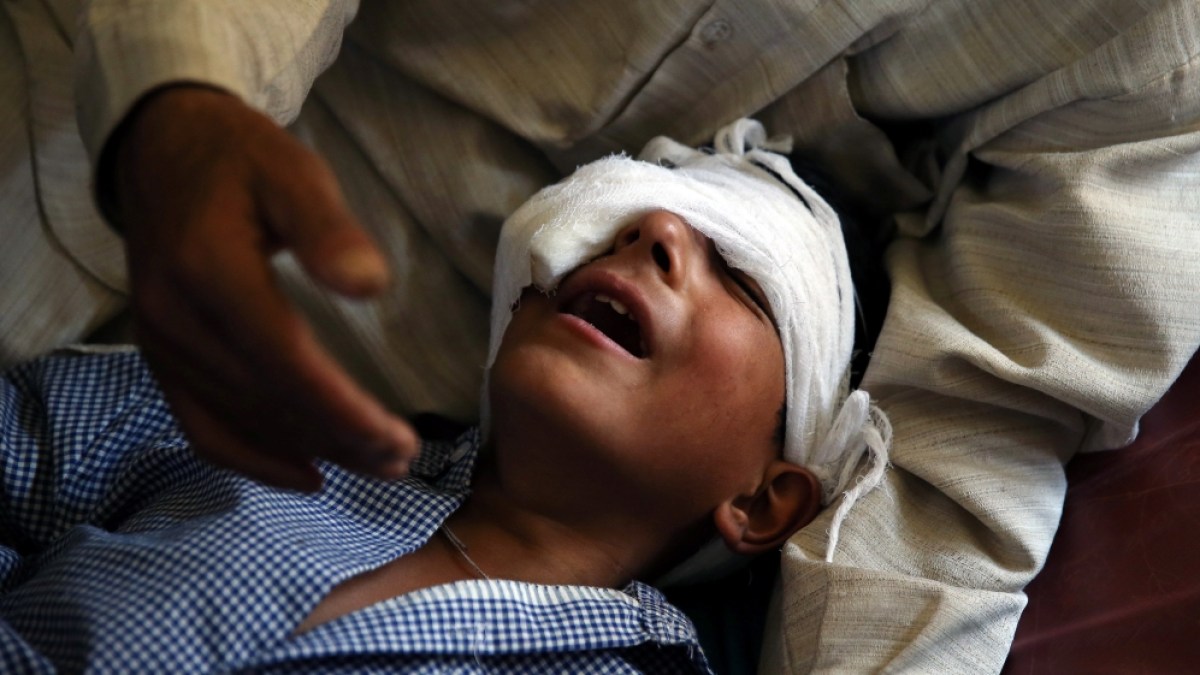

Feroz Aslam* sports an abashed smile whenever he hears the clink of a teacup on a saucer. He cannot see, but he knows it is his father.
“For the past 10 years, it has been my parents – ailing themselves – who have been serving me food,” the 28-year-old told Al Jazeera. “Being their eldest son, it embarrasses me extremely.”
- list 1 of 4The dangerous ‘truth’ of The Kashmir Files
- list 2 of 4Why a Bollywood spy film sparked a political storm in India and Pakistan
- list 3 of 4Bollywood ‘takeover’: Pro-Modi films swamp Indian voters ahead of election
- list 4 of 4Kashmiri rights activist wins partial court victory but remains behind bars
end of list
Aslam was not born blind.
He lost his vision a decade ago when, while running an errand to a fruit shop in Sopore, a town in Indian-administered Kashmir, he was hit by a rushing stream of shotgun pellets fired by Indian security forces during an antigovernment protest.
Aslam remembers falling onto the ground as the hot projectiles seared into his skin. “Seven pellets went into my right eye and six into the left,” he said, adding, “and more than 300 hit my chest.”
Upon being fired, pellet guns release hundreds of tiny iron balls that tear into the flesh and stay buried deep inside the tissues, from where it is nearly impossible to remove them.
The pellets burned through Aslam’s cornea – the glazed coating that protects the eye’s sensitive parts – impairing his vision forever.
‘Blood-soaked eyes’
Aslam is among more than 1,000 Kashmiris who have lost their vision, partially or completely, since New Delhi introduced pellet guns in 2010 to quell street protests in the disputed Muslim-majority region, controlled by India and Pakistan in parts and claimed by both in full.
Now, teasers of a Bollywood film, scheduled for an October 2027 release, have reopened those wounds in Kashmir.
Advertisement
Chauhaan features actor Ajay Devgn playing an Indian security official, who is arrayed against hundreds of stone-throwing protesters in Kashmir amid burning cars and pitched street battles.
Devgn’s voice in the background appears to mock the past Indian governments for having “pandered to the enemy” by refusing to be tougher on the protesters. It laments the alleged ineffectiveness of security measures deployed by Indian forces.
A mask to stay safe during a tear gas attack can be bought online, it says, while a pellet gun only inflicts “limited damage”.
The trailer of the “action entertainer” ends with Devgn, wearing a skull mask and walking towards a protesting crowd with a wheeled boombox blaring “Jumma chumma de de” – a popular film song from the 1990s, in which a lover is demanding his betrothed to meet him on a Friday so they can kiss.
Most street protests against India’s rule in Kashmir used to take place on Fridays.
Aslam cannot watch Chauhaan’s teaser, but he calls the upcoming film unfortunate. “If the makers blindfold their eyes only for a day, they would know what it feels like not being able to see,” he told Al Jazeera.

India’s use of pellet guns in Kashmir crescendoed in 2016 when huge rallies were held during protests against the killing of Burhan Wani, a 22-year-old rebel commander of the regional armed group Hizbul Mujahideen.
Wani was shot dead along with two other rebels on July 8, 2016, by Indian security forces and police in Anantnag district’s Bundoora village, about 85km (53 miles) from the region’s main city of Srinagar.
Wani’s killing threw the valley into weeks of mourning and angry protests, resulting in the deaths of dozens of people and the blinding of hundreds of others, including women and children, some as young as 18 months old. Or, 14-year-old Insha Mushtaq, whose face was so badly disfigured by the pellets that it took plastic surgeons weeks to stitch it back together.

An estimated 14 percent of Kashmir’s pellet victims are children below the age of 15.
Saiba Varma, a medical anthropologist at the University of California San Diego whose work focuses on Kashmir, argues that Chauhaan’s political messaging signals how Indian public discourse has grown “increasingly pernicious as well as less heedful of the questions of morality surrounding the police excesses” in Kashmir.
Advertisement
“When pellet guns were first introduced as a crowd control measure, the state justified them as a more humanitarian, less lethal alternative to bullets. The use of pellet guns was meant to shore up the state as a humanitarian actor,” she told Al Jazeera.
“But now those narratives appear to have fallen away. The state no longer even needs these justifications.”
Varma said the depictions of Kashmiri pellet victims in the film’s trailer were laced with popular political tropes about the Kashmiri people.
“The images of men with blood-soaked eyes voicing animalistic screams reinforce the tropes of Kashmiris as dangerous figures that require taming,” she said.
‘Bleeding through my eyes’
India’s use of pellet guns in Kashmir has attracted widespread condemnation from rights groups and even the United Nations, which accused India of “grave violations” against children.
“I call upon the government to take preventive measures to protect children, including by ending the use of pellets against children, ensuring that children are not associated in any way with security forces, and endorsing the Safe Schools Declaration and the Vancouver Principles,” UN Secretary-General Antonio Guterres said in a report in 2021.
In 2016, when the use of pellet guns by Indian forces was at its peak, the Supreme Court of India cautioned against their “indiscriminate” use, arguing that they must be deployed sparingly and after “proper application of mind” by the authorities.
But the Indian government defended their use as a nonlethal alternative to bullets.
A decade later, however, Aslam still experiences agonising pain in his eyes “to the point that I sometimes wish I were dead instead”. Unable to work, he says he is not able to come to terms with the fact that his ageing father still works as a tailor to support the family.
Nearly 40km (25 miles) from his house lives Masroor Khalid*, another man blinded by pellets in 2016.
At his home in Budgam district, Khalid caresses a photograph of himself from his younger days. It shows a man in his late teens, his arms beefed up with muscles, staring into the camera, a smile flickering across his face.

Khalid was 20 when he was hit by shotgun pellets while distributing the sacrificial meat during the Eid al-Adha festivities.
“When I turned a corner, there was a stampede,” he recounted to Al Jazeera. “I don’t remember anything except that I was bleeding through my eyes. Later, I fell into a coma for four days.”
His parents spent 2 million rupees ($21,000) on his surgeries, but Khalid’s vision could not be restored. He still has more than 300 pellets lodged in his face.
“Doctors told me removing the pellets would mean getting 9-10 stitches. That would mean disfiguring my face entirely,” he said.
In the process of his expensive treatment, Khalid’s family was reduced to penury.
Advertisement
“My father has aged, but he still works as a mason so that the family doesn’t end up starving,” he said as he broke down. “We wouldn’t even wish upon our enemies what has befallen us.”
‘Mocking the victims’
Political analysts say Chauhaan is the latest Bollywood act of “pouring scorn” on the pellet victims in Kashmir.
“Ever since [Narendra] Modi took over as Indian prime minister in 2014, hate itself has become a commodity and many Bollywood directors have latched on to it,” Rakib Hameed Naik, who heads the United States-based Center for the Study of Organized Hate (CSOH), told Al Jazeera.
“They know such movies will sell and they will also get patronage,” he said. “So it’s effectively a business model. Feeling qualms over mocking the victims is the least of their concerns.”
For years now, a section of filmmakers in Bollywood has been accused of churning out a flurry of propaganda films that feed into the policies and programmes promoted by Modi’s right-wing Bharatiya Janata Party (BJP). Such films target India’s 200 million Muslims by using sensitive issues, including Kashmir and India’s historic rivalry with neighbouring Muslim-majority Pakistan.
In 2019, Modi’s nationalist government revoked Kashmir’s semi-autonomous status and split the region into two federally governed territories. The deeply unpopular move was implemented through a months-long military lockdown and internet shutdown, while hundreds of Kashmiris were imprisoned.
Since then, said Naik, Bollywood has produced a series of films – Article 370, Baramulla and Kashmir Files – to rationalise the government’s moves, using familiar Islamophobic tropes and reducing Kashmiri Muslims to caricatures.
He said such movies are made to justify the BJP’s policies. “It can brush aside criticisms of abysmal human rights record and invert the reality, projecting the regime as the victim and the Kashmiri people as aggressors,” Naik said.
Ather Zia, a Kashmiri political anthropologist and poet, said Bollywood has historically treated Kashmir “either as a silent backdrop for its own stories, or Kashmiris are objectified as black-and-white caricatures”.
“They are shown as either perpetually servile hosts for tourists or as raging mindless terrorists,” Zia told Al Jazeera.
“Infantilising, patronising, invisibilising and weaponising Kashmiris is a dependable formula for many blockbusters. This also reflects the audiences who continue to consume such content voraciously and remain chronically insensitive to Kashmiris, their history, politics and suffering,” she said.
*Names of pellet victims have been changed on their request.
Related News
Observers say Zambia’s election marred by reports of intimidation, violence
Indian activist Wangchuk ends 26-day hunger strike over exam paper leaks
Sudan war threatens ancient Meroe pyramids, a UNESCO Heritage Site