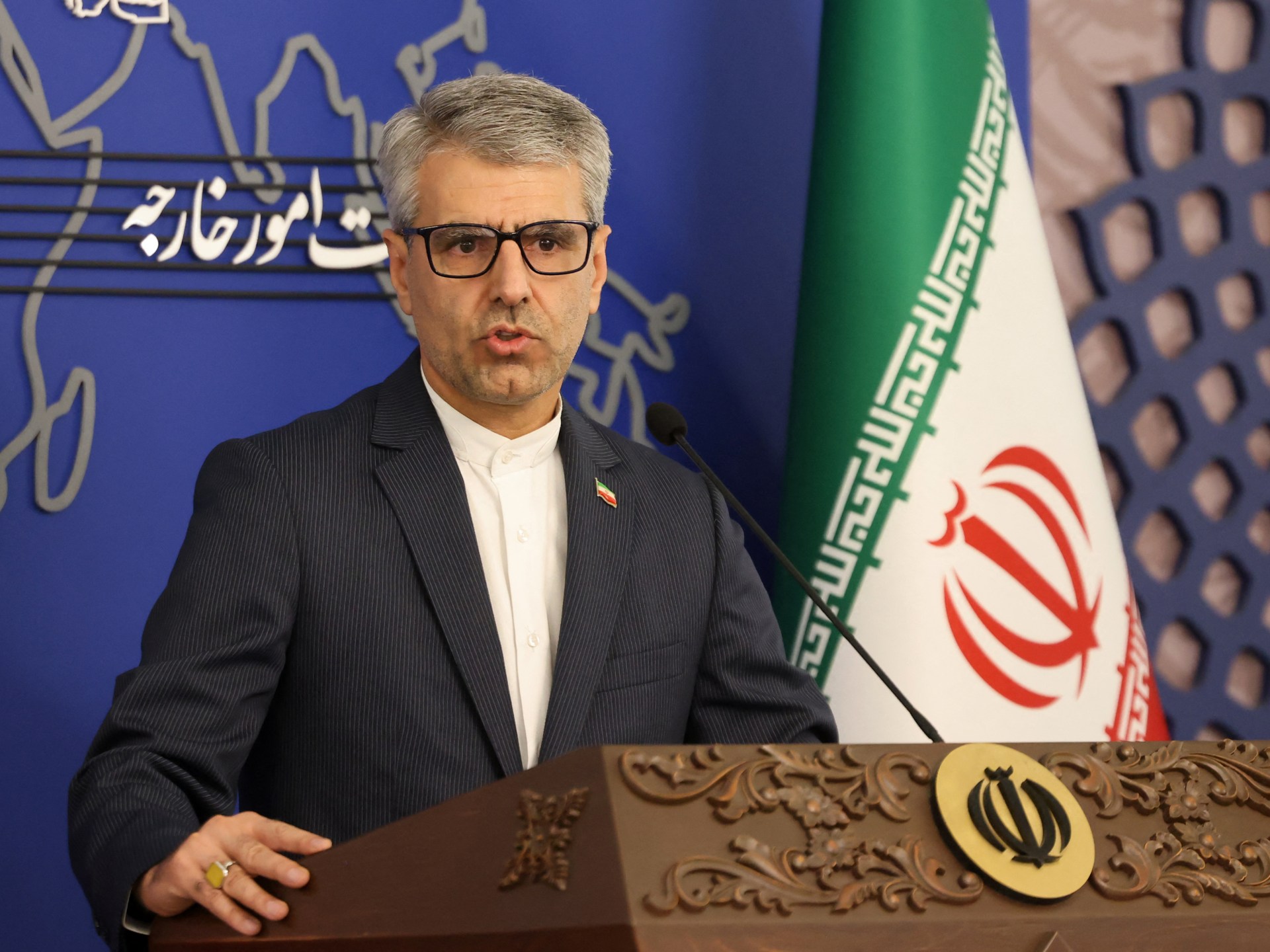

Iran’s foreign ministry spokesman has accused the United States of presenting “unreasonable” and “one-sided” demands in negotiations aimed at ending the war, as the two sides maintain a fragile ceasefire.
Iran submitted a response to a US proposal to end the two-month war via Pakistan on Sunday, Iranian state media reported, with US President Donald Trump branding Iran’s terms as “totally unacceptable”.
- list 1 of 4Trump calls Iran response “totally unacceptable”
- list 2 of 4Iran may ‘give assurances on the use of nuclear facilities’
- list 3 of 4Trump says US will not allow Iran to reach enriched uranium
- list 4 of 4Iran war day 73: Trump and Tehran clash over latest peace proposals
end of list
At a press conference on Monday, Iranian Foreign Ministry spokesman Esmaeil Baghaei insisted that Iran’s proposal to end the conflict and unblock the Strait of Hormuz was legitimate and generous.
He called for an end to the war across the region and the release of frozen assets abroad in response to the latest US proposal.
“We did not demand any concessions. Our demand is legitimate: demanding an end to the war, lifting the [US] blockade and piracy, and releasing Iranian assets that have been unjustly frozen in banks due to US pressure,” he said.
“Safe passage through the Strait of Hormuz and establishing security in the region and Lebanon were other demands of Iran, which are considered a generous and responsible offer for regional security.”
Trump made clear in a post on his Truth Social platform on Sunday that he would reject Tehran’s counterproposal, though he did not offer details on its contents.
“I have just read the response from Iran’s so-called ‘Representatives.’ I don’t like it — TOTALLY UNACCEPTABLE!” he said.
Andrea Dessi of the American University of Rome said the two sides appeared to be digging in on their respective positions.
Advertisement
“The news of Monday is rather negative news … because we are seeing both sides continuously stick to rather maximalist positions,” he said.
“And in this impasse, the real casualty remains the international economy and the populations of the Gulf and the broader Middle East,” the analyst added.
Trump’s social media post unnerved global energy markets, with international benchmark Brent crude prices rising 4.65 percent to $99.95 a barrel during Monday morning trade in Asia.
Benchmark US oil contract West Texas Intermediate (WTI) also surged by just over four percent to $105.5 a barrel, as investors braced for further disruptions to supplies through the strait, where Tehran has imposed a partial blockade.
Baghaei also addressed plans by European countries to deploy warships to the region to ensure safe navigation of the Strait of Hormuz, which Iran has effectively blocked since March.
French President Emmanuel Macron and British Prime Minister Keir Starmer are heading a coalition of more than 50 countries they say will work to help enable the resumption of maritime transit in the region after the war.
Baghaei said that Iran had “clearly said to the Europeans that they shouldn’t succumb to the US and Israeli hubris acts”.
“They should refrain from making any move that would undermine their interests. As I’ve said, this war is not only unethical but it is also unlawful,” he said.
The spokesman added: “The US and Israel started their aggression against Iran. These European countries shouldn’t be fooled in order to get into this matter.”
The UK and France will host a multinational meeting of defence ministers on Tuesday on plans to restore trade flows through the Strait of Hormuz, according to the government in London.
The virtual meeting will follow a two-day gathering in London of military planners in April.
“Any intervention in the Strait of Hormuz or the Persian Gulf would bring about further complications,” Baghaei said.
“They would rather exacerbate the prices. We look forward to the world countries acting responsibly.”
Related News
Iran war live: Trump says reviewing 14-point plan; Israel pounds Lebanon

Thai police arrest Indonesian wanted for $10m cyberfraud
Senators press US military on Israel’s displacement campaign in Lebanon