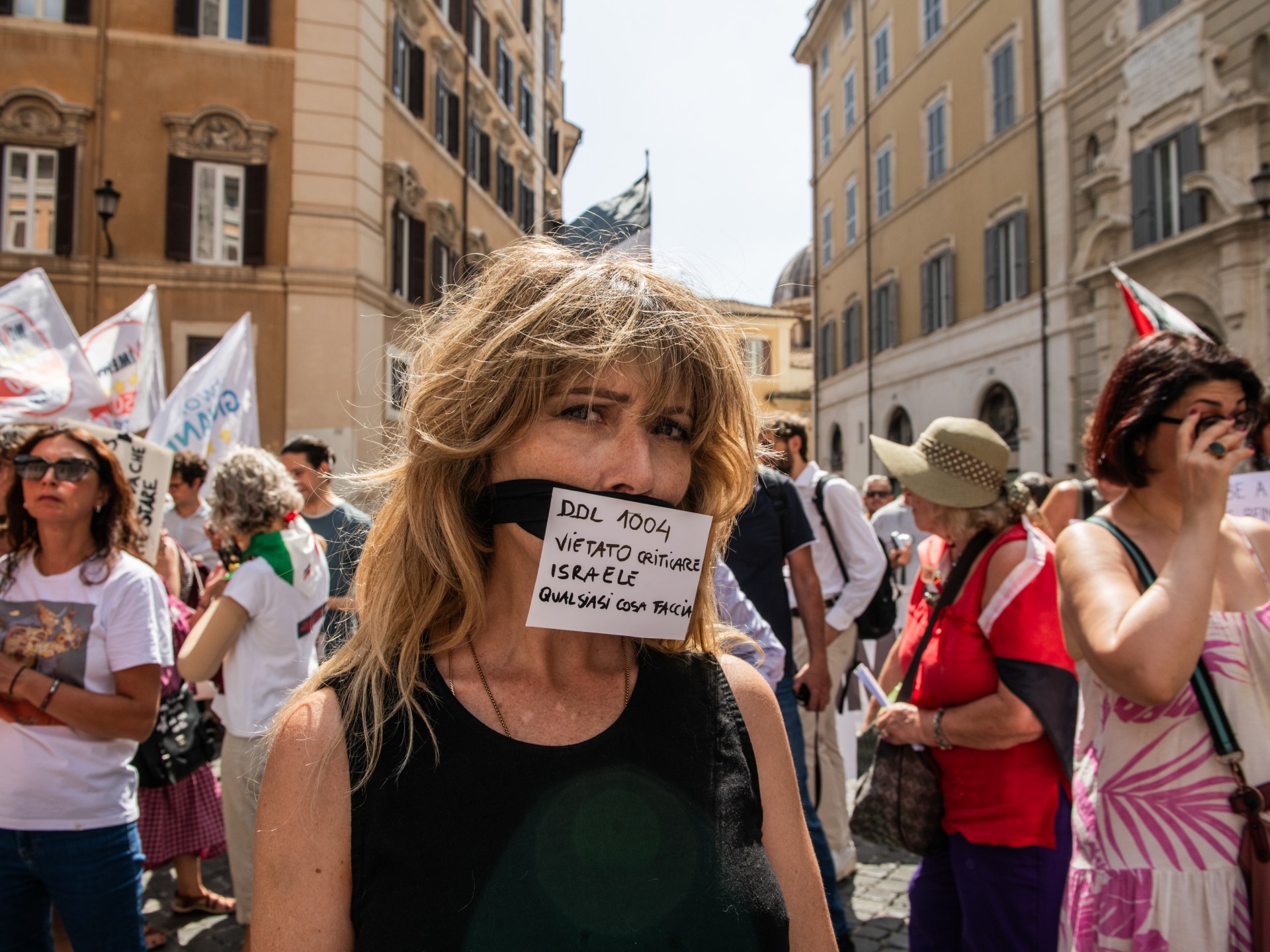

Rome, Italy – “Anti-Zionism is not anti-Semitism”, read the black-and-yellow signs distributed by Amnesty International outside the Italian parliament on Wednesday afternoon.
Hundreds gathered in front of Montecitorio Square in Rome to oppose Italy’s so-called anti-Semitism bill.
The demonstration was organised to coincide with a meeting of the Chamber of Deputies’ Constitutional Affairs Committee, which is examining legislation approved by the Senate on March 4 by a large majority. Under Italy’s constitutional system, a bill must be approved by both chambers in the same text before it can become law.
“We are tired of seeing anti-Semitism instrumentalised to promote censorship of any kind of criticism of the State of Israel and its criminal policies,” said Daniel Calo, of Tikkun, a group of Italian Jewish antiracism activists.
“In the face of this shameful bill, we reiterate once again, forcefully, that opposing Zionism is not anti-Semitism.”
At the centre of the controversy is the possible adoption into national law of the International Holocaust Remembrance Alliance’s (IHRA) definition of anti-Semitism, which critics argue conflates anti-Semitism with criticism of Israel.
According to the IHRA, “denying the Jewish people their right to self-determination, eg, by claiming that the existence of a State of Israel is a racist endeavor”, is anti-Semitic, as is “drawing comparisons of contemporary Israeli policy to that of the Nazis”.
Anneliese Baldaccini of Amnesty International Italy said the bill, if adopted, would apply across schools, universities, social platforms and cultural associations.
Advertisement
The proposed law is “based on a definition that censors political criticism”, she said.
Activists argue that existing legislation already provides the tools to combat hate crimes.
They are instead calling for the adoption of the Jerusalem Declaration on Antisemitism, a non-binding set of guidelines that seeks to combat anti-Semitism while protecting freedom of expression that was developed in response to the IHRA definition.
Speaking to Al Jazeera, Francesca Albanese, the Italian legal scholar and UN special rapporteur on the situation of human rights in the occupied Palestinian territory, said legislation equating criticism of a state with anti-Semitism risked restricting freedom of expression.
“Any piece of legislation that directly or indirectly equates criticism of a state with anti-Semitism is problematic and risks creating more problems than it seeks to solve,” Albanese said.
She argued that the bill could limit the ability to analyse, document and criticise the “apartheid state of Israel”, and accused Italy of prioritising the protection of Israel over accountability.
“The need to protect the State of Israel from criticism is stronger than the need to do justice,” she said. “It is extremely dangerous because every Jewish person in the world risks being seen as a kind of emissary of Israel.”
She described Italy, under the current government, as one of Europe’s strongest defenders of Israel.

Tony La Piccirella, a Palestine solidarity activist who was part of the Global Sumud Flotilla, said he worried that the bill “provides a legal instrument to attack newsrooms, online information platforms and social media, in order to silence anyone who denounces the genocide and the entire economic system that sustains it”.
But the legislation has received strong backing from Italy’s Jewish institutional leadership.
Noemi Di Segni, president of the Union of Italian Jewish Communities (UCEI), was heard by the Senate’s Constitutional Affairs Committee in January and described legislative action against anti-Semitism as “urgent and unavoidable”.
Di Segni, who was born in Jerusalem and has served in the Israeli military, has repeatedly rejected describing Israel’s war in Gaza as genocide.
In January 2025, she called such accusations “unacceptable”, arguing that terms including “genocide”, “concentration camp”, “starve”, “Nazi” and “apartheid” should not be used to describe Israel’s conduct.
Advertisement
The bill has exposed divisions that cut across the government-opposition divide.
It was approved by the Senate by a large majority that included much of the opposition. Six Democratic Party senators voted in favour, while the party as a whole abstained, and those divisions have continued in the Chamber.
Among the bill’s most outspoken opponents is Stefania Ascari, of the Five Star Movement, who addressed protesters before entering parliament.
“The greatest danger to Jews and to the entire world is the terrorist state of Israel,” Ascari said. She accused the bill of targeting “freedom of expression, the autonomy of universities, [and] the work of associations and NGOs”.
The committee’s sitting ended without a vote or substantive examination.
Its work is expected to resume next week, although the timetable remains uncertain. The Chamber has scheduled a final plenary vote for October 2, leaving parliament a narrow window to complete the committee stage.
In the meantime, outside parliament and on the streets, the mobilisation is set to continue.
Related News

US reading scores hit near-25-year low in latest global assessment

‘Totally reliant on Mother Nature’: UK drought raises water security fears

Brazil sues chat platform Discord over failure to protect child users