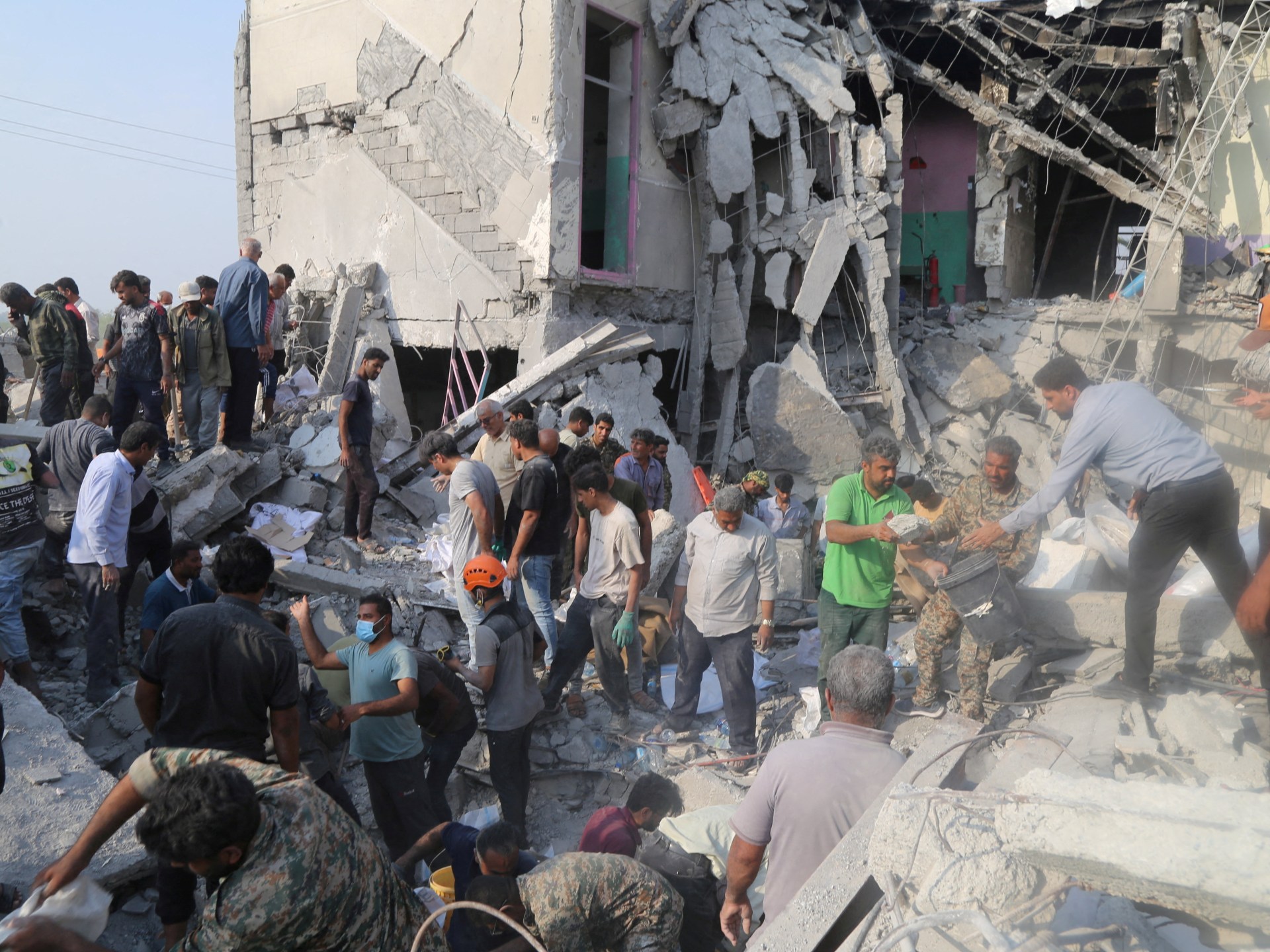

On Saturday morning, February 28, 2026, dozens of girls gathered at the “Shajareh Tayyebeh” (The Good Tree) school in the city of Minab in southern Iran when Israel and the United States began initial strikes on the country.
As the students began their studies, missiles struck the school, destroying the building and causing the roof to collapse on top of the children and their teachers.
Iranian authorities have put the final death toll at 165 people, most of them girls aged between 7 and 12. At least 95 other people were wounded in the attack.
As the images of the carnage spread on social media platforms, Israeli and US authorities sought to distance themselves from the attack.
Spokespeople for the US Department of Defense and the Israeli army told Time magazine and The Associated Press news agency that they were unaware that a school had been hit.
Some websites and social media accounts linked to Israel claimed the site was “part of an Islamic Revolutionary Guard Corps base”.
However, an analysis by Al Jazeera’s digital investigations unit of satellite imagery compiled over more than a decade, as well as recent video clips, published news reports and statements from official Iranian sources, tells a very different story.
The findings reveal that the school had been clearly separate from an adjacent military site for at least 10 years.
The investigation also shows that the strike pattern raises fundamental questions about the accuracy of intelligence information on which the bombing was based.
Advertisement
It may even raise questions about whether the strike was a deliberate targeting of the school.
The importance of Minab and the targeted military square
To understand the motives for including Minab in the first US-Israeli targets, the city must be placed within its broader geostrategic context.
Minab is located in Hormozgan in southeastern Iran, a province of enormous military importance as it directly overlooks the Strait of Hormuz and Gulf waters, making it a key hub for the operations of Iran’s Revolutionary Guard Corps (IRGC) naval forces, NEDSA.
The IRGC Navy embraces what is known as an “asymmetric warfare” strategy that relies on deploying fast boats, drones, and coastal missile platforms capable of disrupting shipping or targeting hostile naval vessels.
In this context, the “Sayyid al-Shuhada” military complex in Minab stands out; it includes key headquarters, most notably that of the “Asif Brigade”.
The Asif missile brigade is considered one of the most important strike arms of the IRGC Navy. By reviewing open sources and tracking official Iranian records, important details emerge about the school itself: The Shajareh Tayyebeh school in Minab is part of a broad network of schools structurally and administratively affiliated with the IRGC Navy.
These schools are classified as nonprofit institutions and are primarily intended to provide educational services to the sons and daughters of members of the IRGC Navy.
Registration messages posted on the channel on the Iranian messaging app, “Baleh”- a channel dedicated to communicating with parents of pre-school children at one school in the Shajareh Tayyebeh network – show that admission procedures give priority to the children of military personnel.
In more than one announcement, the children of IRGC Navy members are explicitly invited to attend on specific days to complete first-grade enrolment, with another notice stating that registration for children of non-members opens on different days.
However, this administrative link (to the IRGC) or the identity of the parents does not change the schools’ legal status as civilian facilities under international humanitarian law, unless they were being used in military operations.
And the children who attend them – whether they are the children of military personnel or civilians – remain protected people with special protection in armed conflicts, including the prohibition on intentionally targeting them or carrying out attacks that could harm them.
The Euro-Med Human Rights Monitor has called the bombing of the school as a “horrific crime and a consolidation of the collapse of civilian protection”, stressing in a statement that the mere presence of military facilities or bases nearby does not change the school’s civilian character, and does not absolve US and Israeli forces of their legal obligation to carefully verify the nature of the target before striking it.
Advertisement
The Monitor emphasised that children and teaching staff remain, in all circumstances, “protected persons” under international humanitarian law, and that any attack that fails to distinguish between them and potential military targets constitutes a serious violation.
On Saturday morning, the first day of the school week in Iran, US-Israeli strikes began on the country. Air raids started hitting various sites in the city of Minab and Hormozgan province.
But life in general was proceeding in a near-normal manner; children went to their schools, and photos and videos showed almost normal traffic on the roads surrounding the school.
Documented satellite images from that day show that the school building was still completely intact and had not been hit by any strike until 10:23am local time (06:53 GMT).

Local and official Iranian sources say that by 10:45am (07:15 GMT), the school was directly hit by a guided missile.
To verify the scope and nature of the strike, Al Jazeera’s Digital Investigations Unit analysed two video clips posted on Telegram shortly after the bombing, and precisely geolocated each by matching visible landmarks with satellite imagery.
The first clip was filmed from a point southwest of the complex (at coordinates: 27°06’28.43″ N, 57°04’26.17″ E) and documents the first moments of smoke rising from inside the military block affiliated with the Sayyid al-Shuhada base (Asif Brigade), proving that the military base was indeed among the targets hit.
The second clip, however, the most indicative in this investigation, was filmed from a point southeast of the complex (at coordinates: 27°06’23.77″ N, 57°05’05.97″ E) and provides a wide viewing angle encompassing the entire complex.

This clip clearly shows two separate columns of thick black smoke rising simultaneously: The first from deep inside the military base, and the second from the geographically independent site of the girls’ school.
The visible distance between the two columns matches the distance separating the two areas as shown by the satellite imagery. This refutes any claim that the damage to the school was caused by shrapnel flying from the adjacent base, and strongly indicates that the school building was subjected to a direct, separate strike.
To establish the architectural separation and rebut claims that the bombed building was an active barracks, the investigation team conducted a historical trace of archived satellite images via Google Earth covering the period from 2013 up to just before the 2026 attack. The school site coordinates are (27°06’35.4″N 57°05’05.1″E).
The chronological review reveals deliberate engineering to separate this part of the military complex and convert it entirely to civilian use over the past 10 years.

The images show that the school building and its surrounding area were a connected, integrated part of the main military complex. The outer perimeter wall was unbroken, and the complex was surrounded by five security watchtowers positioned around the corners of the entire compound. There was only one main entry gate serving the whole complex, and the internal road network connected all buildings without barriers.
Advertisement
It can be said with a degree of confidence that, in 2013, the site was used exclusively as a military barracks with a strict security character, as there was no indication of an independent civilian use of any part of the complex.
But this changed radically in 2016. Satellite images dated September 6, 2016 capture the main turning point, when new internal walls were created and built, fully and tightly separating the school building area from the rest of the military block.
At the same time, two of the watch towers overseeing this block were dismantled and removed. Most importantly, three new external gates were opened directly onto the public street to serve students’ and staff entry and exit.

This radical modification documents the construction process and the official removal of the building from the military barracks system, converting it to an independent civilian purpose with dedicated entrances that do not pass through military checkpoints and are 200 to 300 metres (650 to 1000ft) away.
The civilian use becomes clearer over time. Images taken on May 5, 2018 show intense civilian activity: Civilian cars can be seen lined up at the new external entrances. The internal courtyard was also equipped with a children’s sports field, and the internal walls were painted in multiple colours with bright mural drawings appropriate to the students’ age group.

This documentation can be regarded as definitive visual confirmation that the building was operating at full capacity as a primary school. These features (such as the playground, wall drawings, and the presence of civilian cars) are the same ones that later appeared in videos documenting residents storming the school on the day of the tragedy to search for their daughters.
The Martyr Absalan clinic as corroborating evidence
To prove that the attacking party was (or should have been) precisely aware of the site’s updated layout, we traced the newest construction projects in the same area.
On January 14, 2025 (just one year before the attack), the commander-in-chief of Iran’s Islamic Revolutionary Guard Corps, Major-General Hossein Salami, visited the city of Minab to inaugurate the Martyr Absalan Specialised Clinic.
The clinic, which cost 100 billion Iranian tomans (about $2m), was built on an area of 5,700 square metres (61,354 square feet) at another corner of the same original military complex – specifically on Resalat Street – to serve residents of eastern Hormozgan province.
Reports published to cover the clinic’s opening indicate it was equipped with the latest CT imaging devices, ultrasound equipment, and laboratories, and that it offered civilian medical specialities such as paediatrics, obstetrics and gynaecology, and dentistry – confirming its civilian nature.

As with the school years earlier, building the clinic required spatial separation from the military base. After the Martyr Absalan clinic opened in January 2025, a separate gate was opened to connect it directly to the external street to receive civilian patients, and a dedicated car park was established – measures mirroring what the school underwent when it was separated from the complex and given three independent gates.
Advertisement
Thus, what had been a single unified military complex became three independent sectors, clearly distinguishable in satellite imagery: The Shajareh Tayyebeh girls’ school, separated since 2016 with its own walls and gates; the Martyr Absalan Specialised Clinic, separated since early 2025 with an independent civilian entrance; and the Sayyid al-Shuhada military complex, which remained a closed and active site.
When the US-Israeli attack began on the morning of February 28, 2026, analysis of the strike locations revealed an odd pattern: Missiles hit the military base and the school, but bypassed the specialised clinic complex located between the two without touching it.
This exclusion cannot be explained as a coincidence; it strongly indicates that the executing party was operating with coordinates and maps that distinguished between the complex’s different facilities.

Here lies the fundamental contradiction exposed by this investigation: If the intelligence was up to date enough to spare a clinic that had been open for only one year, how did it fail to identify an elementary school that had been separated from the military complex and had become a clearly defined civilian institution for more than 10 years?
This contradiction leaves only two possibilities: Either the bombing of the school was the result of a grave intelligence failure caused by reliance on outdated databases that did not keep pace with successive changes in the complex’s layout, or it was a deliberate strike based on a linkage that treats the school as part of the military system.
Misleading claims
No sooner than when plumes of smoke began to rise from the school’s rubble than accounts on the X platform affiliated with, or sympathetic to, Israeli parties began circulating videos and images claiming the school had not been struck from the outside, but was destroyed after an Iranian air defence missile missed its target and fell back to the ground.
This narrative replicates the same tactic used during the bombing of al-Ahli Arab Hospital in Gaza in October 2023, when Israel rushed to accuse the Palestinian resistance of responsibility for the massacre via a rocket that missed its target.
https://x.com/ChayasClan/status/2027742261480452476
However, open-source verification tools – specifically reverse image searches and geolocation using visual landmarks – quickly revealed that the most widely shared image in this campaign, which is claimed to show the impact of a failed Iranian missile that fell on the school, has nothing to do with the city of Minab in the first place.
By matching the terrain and landmarks visible in the image – especially the snow-covered mountains in the background – with satellite imagery, it became clear that it relates to an incident that occurred on the outskirts of Zanjan in northwestern Iran, about 1,300km (808 miles) from Minab.
The irony is that the nature of the two locations alone is enough to refute the claim: Minab is a coastal city in the far southeast overlooking the Gulf of Oman and the Strait of Hormuz, with a tropical climate and no snowfall, while Zanjan is a mountainous city in the northwest that is covered with snow in winter.
Iranian sources said what happened in Zanjan that day was a successful interception operation carried out by air defence units affiliated with the Islamic Revolutionary Guard Corps, during which two hostile drones were shot down. It was not possible to independently verify this information.
The Minab school incident is not an exception in the record of civilian facilities being targeted by the US and Israeli militaries; rather, it falls within a documented pattern stretching across decades of military operations and attacks, in which the same scene recurs: Strikes hit schools, hospitals, and civilian shelters, followed by immediate denial or shifting of blame to the other side, before independent investigations later reveal the falsity of official claims.
In April 1970, Israeli Phantom fighter jets bombed the Bahr al-Baqar elementary school in Egypt’s Sharqia governorate, killing 46 children out of 130 who were in their classrooms that morning.
Israel claimed the school was an Egyptian military facility, and Defense Minister Moshe Dayan said at the time that “the Egyptians may have put elementary school pupils in a military base.”
But an Israeli pilot who took part in the raid and was captured during the October 1973 war later revealed it had been a deliberate attack and that they knew it was merely a school.
In February 1991, the US Air Force dropped two “smart” bombs on the Amiriyah civilian shelter in Baghdad, killing at least 408 civilians – most of them women, children, and the elderly.
Washington said the facility had been turned into a military command centre, but Human Rights Watch later showed that the building bore clear markings indicating it was a public shelter and that large numbers of civilians were using it throughout the air campaign.
In April 1996, the Israeli army shelled the headquarters of the Fijian battalion of the UNIFIL international force in the town of Qana in southern Lebanon, where about 800 Lebanese civilians were taking refuge inside the UN compound. One hundred and six people were killed and more than 116 wounded.
Israel claimed it was providing cover for a special unit that had come under mortar fire from near the compound, but a UN investigation later concluded the Israeli bombardment was deliberate, citing video recordings showing an Israeli unmanned reconnaissance aircraft over the compound before the shelling began.
In October 2015, a US AC-130 aircraft bombed a Doctors Without Borders (known by the French acronym, MSF) hospital in the Afghan city of Kunduz, killing 42 people, including 24 patients and 14 staff members. The organisation had previously provided the hospital’s coordinates to all parties to the conflict. The US account changed several times – from describing the strike as “collateral damage” to claiming Afghan forces had requested it – before the US commander acknowledged that the decision was entirely American.
In the Gaza Strip, attacks on educational facilities have reached an unprecedented level since October 2023. By the early months of 2025, 778 of the enclave’s 815 schools had been partially or completely destroyed – about 95.5% of all schools. UNRWA reported that about one million displaced people sought refuge in its schools, which had been turned into shelters; nevertheless, at least 1,000 people were killed and 2,527 wounded inside these schools through July 2025. Journalistic sources also documented that the Israeli army set up a “special strikes cell” to target schools systematically, classifying them as “centres of gravity”.

Returning to the school in Minab, testimony by Shiva Amilairad, a representative of the Coordinating Council of Iranian Teachers’ Trade Unions, to Time magazine indicates that the decision to evacuate the school was made as soon as the US-Israeli attacks began. But, she said, the time between the warning issued by Iranian authorities (after detecting attacks on the city) and the moment the missile struck was far too short, and most parents were unable to reach the school to pick up their daughters.
She also confirmed that hospital morgue capacity was exhausted, forcing authorities to use mobile refrigerated trucks to preserve the bodies of the young girls; some families lost more than one child in the same incident.
The attackers’ ability to spare newly established adjacent facilities (such as the Martyr Absalan clinic) and their glaring failure to avoid an elementary school operating at full capacity and packed with 170 girls leaves us with two scenarios, both unequivocally condemnatory: Either US and Israeli forces relied, in striking the vicinity of the Asif Brigade, on a very old, outdated intelligence target bank (dating to before 2013), which would constitute grave negligence and reckless disregard for civilian lives; or the strike was carried out deliberately and with prior knowledge to inflict maximum societal shock and undermine popular support for Iran’s military establishment.
Related News
Israel strikes two schools in Iran, killing more than 50 people
Israel strikes Lebanon’s Beirut again; Hezbollah launches drones at Israel
Israel kills more journalists than any nation on record: Media watchdog