Questions for Marcos Jr 40 years after Philippines ‘People Power’ revolt
 25 February 2026
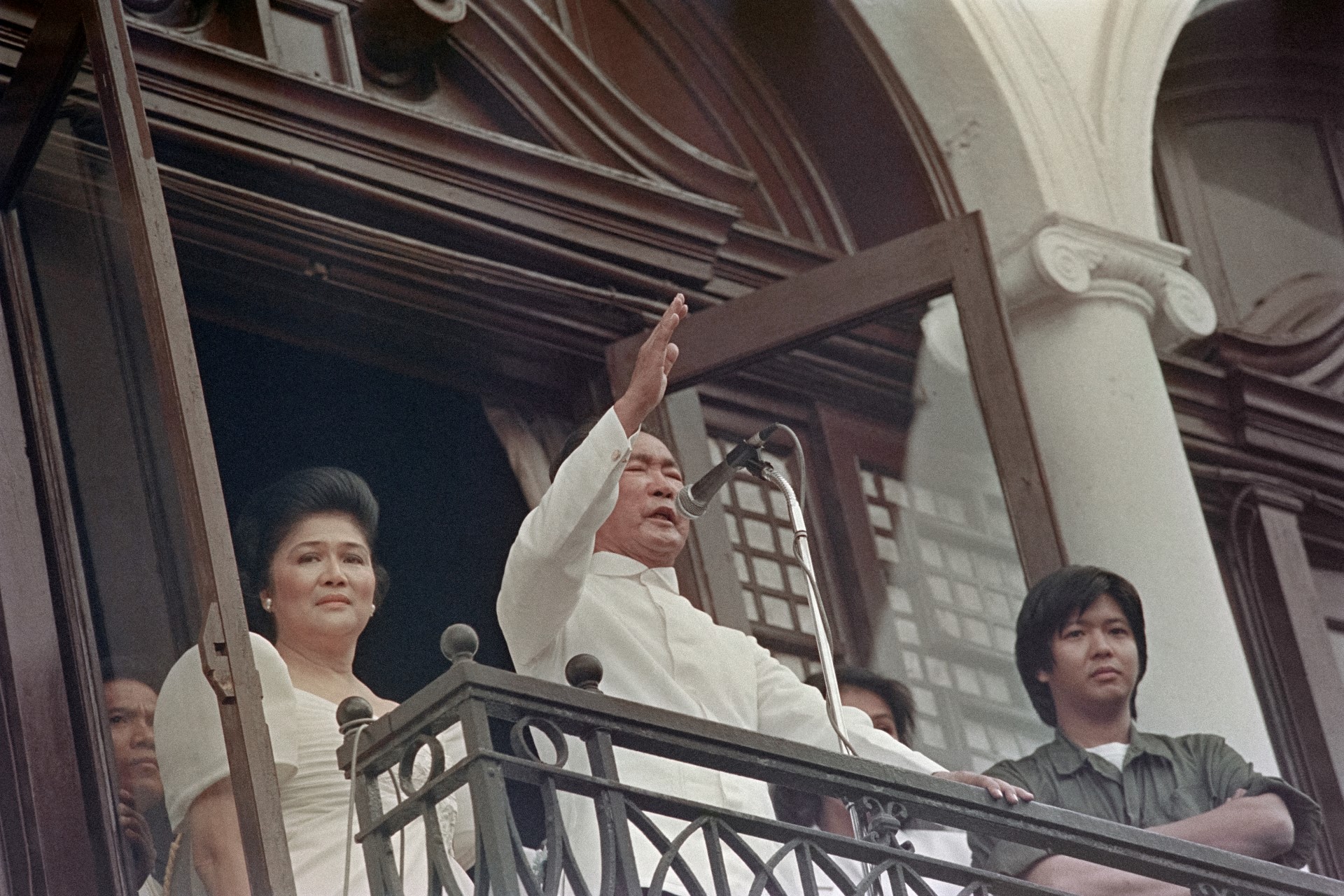

Manila, Philippines – “Bongbong is our principal worry. He is too carefree and lazy,” then-President of the Philippines Ferdinand Marcos Sr wrote in 1972.
Marcos Sr was referring to his only son and namesake by the child’s moniker, Bongbong.
- list 1 of 4Philippines Marcos
- list 2 of 4Is it time to bury Marcos’ past in the Philippines?
- list 3 of 4What’s in store for the Philippines after Marcos’ win?
- list 4 of 4Ferdinand Marcos Jr sworn in as Philippines president
end of list
He was concerned about what the future would hold for the young Marcos.
“The boy must realise his weakness – the carefree wayward ways that may have been bred in him,” his father further warned in his diary.
Half a century later, his son – Ferdinand “Bongbong” Marcos Jr – would be sworn in as the 17th president of the Philippines, following a landslide victory in the 2022 polls.
The rise of Marcos Jr to the presidency marked his family’s dramatic rehabilitation after the mass street protests that forced Marcos Sr from power and the family into exile in 1986.
In his inaugural speech, Marcos Jr invoked memories of his late father’s presidency – though he skipped the years of brutal dictatorship and reported plunder of state resources – to project hope for “a better future” for 110 million Filipinos.
“You will get no excuses from me,” Marcos Jr said as he took his oath of office.
“You will not be disappointed.”
But three years into his term in office, Marcos Jr’s popularity has withered.
His political alliance with Vice President Sara Duterte has shattered, and his administration is ensnared in a multibillion-dollar corruption scandal that has plunged the country into a period of uncertainty.
The president who ran on a platform of unity is now struggling to lead a divided nation that is deeply disappointed over his lacklustre performance.
Advertisement
On the 40th anniversary of the People Power Revolution that ousted his father, Marcos Jr seems unable to escape history as some political factions in the opposition are calling for his removal – an ending that befell his father on the fateful date of February 25, 1986.

‘No plan’
Political analyst and economist Andrew Masigan pulls no punches. Masigan said what is happening in the Philippines is a consequence of an electorate choosing the “entitled son of a dictator” over a more competent candidate.
“[Marcos Jr] campaigned under the slogan and promise of unity. Economists and political pundits all assumed that there was a plan behind it. We’ve been waiting, and it has been three years. No such thing exists,” he said.
“His plan was to be president. It was a self-serving plan. It’s a presidency about Bongbong Marcos for Bongbong Marcos,” he added.
“He just wanted the opportunity to whitewash the tainted Marcos name,” he added.
As president, Marcos Jr has “squandered” the demographic advantage of the Philippines, Masigan continued, pointing to the country’s youth, who make up almost half of the population. Given such a youthful and dynamic society, the country’s economy should have been growing 7 to 8 percent annually by now, Masigan said.
Instead, the economy posted a sluggish 4.4 percent growth in 2025, well below the government target of 5.5-6.5 percent, he added.
Susan Kurdli, an assistant professor at De La Salle University in Manila, said the first three years of Marcos Jr’s six-year term were “indeed a period of missed opportunities”.
Kurdli said the “vague direction” the Philippines is heading was only to be expected, “as Marcos Jr never ran on a clear policy ticket”.
“He won the election largely by relying on the tried and tested tactics of tribalism, name recognition and alliance building,” she said.
Foreign investment has also declined by half from $9.42bn in 2024 to $4.7bn in 2025, its sharpest fall in five years, according to the Philippine Statistics Authority (PSA).
Unemployment rose at the same time from 3.8 percent in 2024 to 4.2 percent in 2025, PSA data showed. In 2025, only 172,000 jobs were added to the overall labour market, making it the fifth-worst year in job creation in 25 years, according to the think tank IBON Foundation.
Advertisement
A lack of economic opportunity and unemployment are the top risks for the Philippines in the next two years, the World Economic Forum (WEF) 2026 Global Risks Report notes.
If the weak economic figures have left Filipinos disgruntled, allegations of corruption have left them seething with anger.
“The scandal allegations surrounding him and his family have particularly hit a nerve with voters,” Kurdli of De La Salle University told Al Jazeera.
“They have definitely impacted the perceived legitimacy of Marcos Jr as a national leader.”
The latest corruption perceptions index conducted by Transparency International (TI) reflects that assessment.
According to the anticorruption body’s latest report, the Philippines has slipped six notches lower, ranking 120th out of 182 territories covered.
In response to the TI report, presidential spokesperson Claire Castro said Marcos Jr “has not lost interest” in fighting corruption, and is working to strengthen government institutions.

‘Ghost projects’
It was in the middle of last year when allegations first emerged that Marcos Jr had abused his authority by approving three consecutive national budgets riddled with questionable infrastructure projects amounting to billions of dollars.
Among those implicated in the alleged scheme was Ferdinand Martin Romualdez, the once-powerful speaker of the House of Representatives and a first cousin of Marcos Jr, who oversaw the drafting of the national budget.
He was accused by opposition congresspeople of manipulating the budget. An investigation by a Philippine news website also linked him to multimillion-dollar homes in the Philippines and the United States that are allegedly not listed in his government disclosure forms. He has since relinquished his post but has not been called to account despite massive protests and political pressure.
Also accused of cornering millions of dollars in public funds for pet projects were the president’s sister, Senator Maria Imelda Marcos, and his son, Ferdinand Alexander Marcos, a congressman.
Combined, the three Marcos relatives secured government projects worth at least $560m in the last three years, according to public works department data and the National Expenditure Program listed in the budget. They have all denied wrongdoing related to the awarding of the lucrative projects.
Private contractors and government bureaucrats were also linked to the scandal.
Some were reported by the news media to have spent their newfound wealth on Bentley and Rolls-Royce vehicles and gambling sprees. One mid-ranking official, whose monthly salary was the equivalent of $1,250, admitted during a congressional inquiry that he owned a GMC Denali SUV worth $200,000, a Lamborghini Urus worth between $500,000 and $700,000 and a Ferrari estimated at $1m.
Advertisement
Further investigations revealed several nonexistent government infrastructure initiatives, described as “ghost projects”, worth millions of dollars. Marcos Jr himself discovered an abandoned flood control project estimated to be about $1m in Baliwag, a city just north of Metro Manila.
In Quezon City in Metro Manila, the local government reported that 35 flood control projects were missing out of the 331 listed, with a total budget of almost $300m.
According to estimates by the Department of Finance, alleged corruption in flood control projects cost taxpayers approximately $2bn between 2023 and 2025.
The scale of the corruption allegations has reminded some Filipinos of the time when Marcos Sr and his wife, Imelda, ruled the country in what historians have described as a “conjugal dictatorship”.
During their two decades in power, the Marcos couple were accused of emptying the Philippine treasury of up to $10bn.
Masigan, the political analyst and economist, said despite all efforts to distance himself from the ongoing scandal, it is difficult for the current president to do so.
“The three budgets were authored, presided over and approved by the president himself. He signed it,” Masigan said.
“Everything leads to him.”
‘Give Marcos some credit’
Jan Credo, political science professor at Silliman University in Dumaguete City, Philippines, said despite the fierce criticism of the president, Marcos Jr should still get some credit for his role in highlighting the massive corruption scandal during his annual State of the Nation Address last year.
“President Marcos, in fact, started the expose when he chastised members of Congress and told them, ‘Shame on you’, for their involvement in the alleged massive bribery,” Credo told Al Jazeera.
“What this has generated is the consciousness among the public about the issue that led to the crystallisation of the social movement against corruption,” he said.
“If you ask me, Marcos Jr does not have anything to do” with the corruption, Credo said, blaming his close allies instead.
Credo also did not believe that the ongoing scandal would cost Marcos Jr the support of one of the country’s most powerful institutions, the military. Over the last four decades, two Philippine presidents, including Marcos Sr, were forced out of office in popular revolts backed by the military. Two other presidents faced coup attempts.
“Marcos Jr may be in survival mode now. But he is also fortunate to have a military that is highly professionalised and no longer politicised,” Credo said.
“The recent calls by retired military officers to withdraw support from Marcos Jr have not gained traction, because we have learned their lesson,” he explained.
Political analyst Masigan agreed, saying a move by the military was “out of the question”, noting that while there were some whispers for Marcos Jr’s removal, “nothing is being seriously considered”.
“As far as the military is concerned, they are loyal to the constitution; there is no movement to oust the president and have a caretaker government,” he added.

Securing a legacy
With just about two more years left in office, Marcos Jr still wields enough power to change the narrative of his administration, restore the Marcos name and implement policies that help Filipinos, political observers who spoke to Al Jazeera said.
But the president must act fast before the narrowing window of opportunity closes on him, and he becomes a “lame duck” leader, they added.
Advertisement
Major legislation that needs to be addressed includes government transparency, education, energy and investment reforms, as well as an overhaul of the transport and manufacturing industries, said Kurdli of De La Salle University.
But the most urgent policy reform that Marcos Jr has to address is the passage of a law banning political dynasties, which is the main culprit of corruption in the country, Masigan and Credo said.
“If he really wants to have an impact, he must get the antipolitical dynasty law passed,” Masigan said of the president.
In the Philippines, political dynasties have dominated about 80 percent of seats in the Senate and the House, according to a 2025 analysis by the Anti-Dynasty Network.
At the Philippine Senate, for instance, there are four sets of siblings occupying a third of the 24-seat chamber. At least eight other senators have close family members in the House.
President Marcos Jr comes from a dynasty himself. He has one sibling in the Senate, a son and two cousins in the House, and several relatives elected as town and provincial executives.
Vice President Duterte, who is the daughter of former President Rodrigo Duterte, is no different. Her brother, nephew and a cousin are serving in Congress. Another brother serves as the mayor of the Duterte stronghold, Davao City, while a nephew serves as the vice mayor.
While political dynasties are prohibited under the 1987 Philippine Constitution, Congress has failed to pass a supplementary law that spells out what a ban should look like.
For Credo, getting the antipolitical dynasty law passed is “a tall order” for Marcos Jr, given that a vast majority of legislators come from dynasties, guaranteeing fierce resistance.
“But if he can get it done, that would be a major achievement on his part. He will be able to secure his place in the history books,” Credo added.
Masigan said, given the Marcos family history, it is really up to the Filipino citizenry to keep the pressure on and demand real reforms from the government.
“I’ve seen how the Marcoses operate since the 1970s. They are fond of creating a semblance of reforms and giving people hope. But it will never come to fruition,” Masigan said.
“I hope this time it’s different. But I am not holding my breath.”
Related News

Ukraine team heads for Geneva talks as Moscow, Kyiv build military pressure
In Munich, Rubio urges transatlantic unity but lashes Europe on migration

Breaking with Trump, US House votes to pass a bill ending Canada tariffs