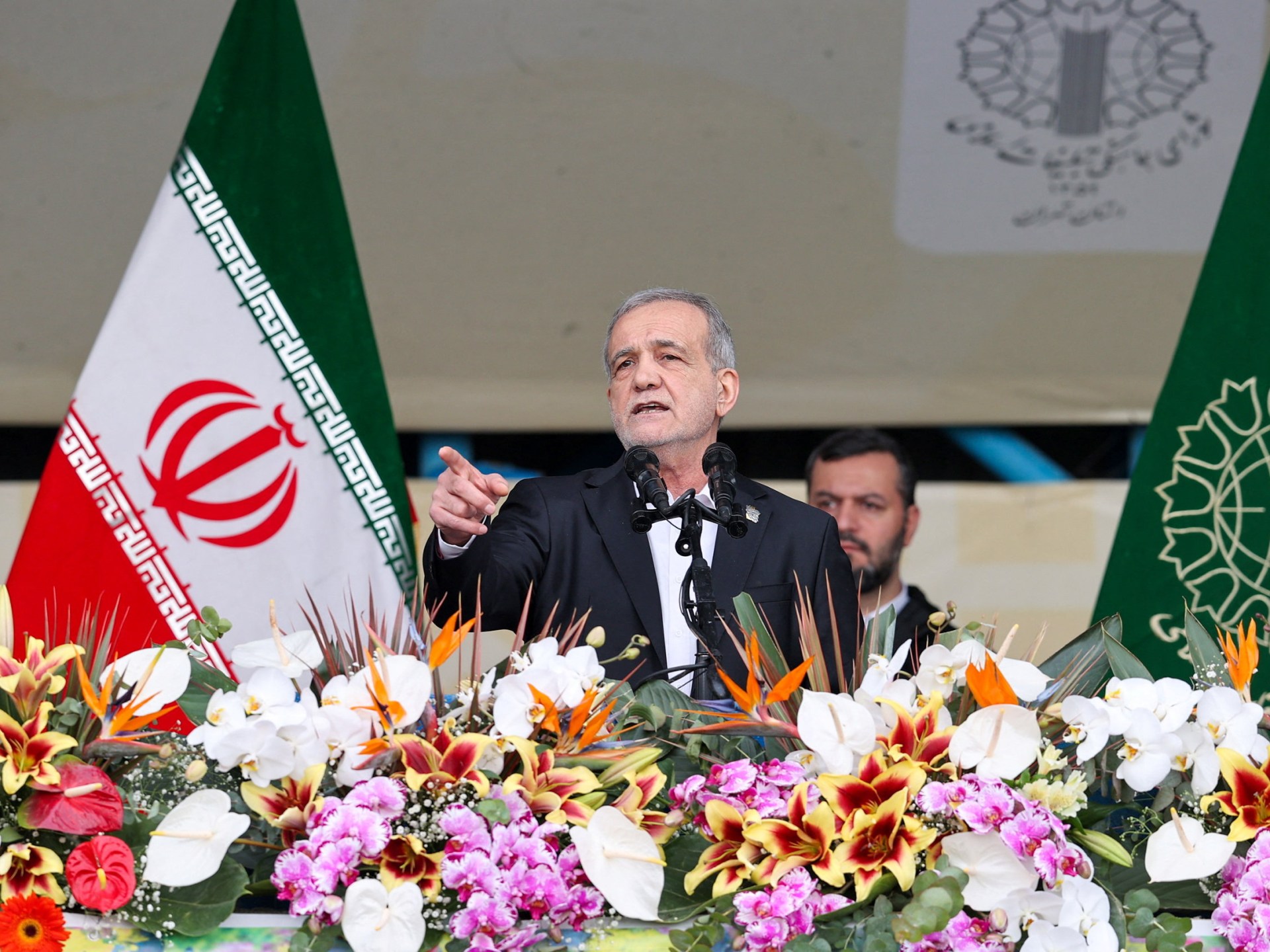

Iran’s President Masoud Pezeshkian has pledged not to fold to pressure from the United States after his American counterpart, Donald Trump, said he was considering limited strikes to force a deal on Tehran’s nuclear programme.
Pezeshkian’s comments on Saturday came amid high tensions in the Gulf, with the US continuing to grow its military presence with the deployment of two aircraft carriers and dozens of jets.
- list 1 of 4Iran demands ‘evidence’ as Trump, UN experts highlight protest killings
- list 2 of 4Tracking the rapid US military build-up near Iran
- list 3 of 4Iran says US military build-up ‘unnecessary and unhelpful’, deal achievable
- list 4 of 4Trump ‘considering’ limited strikes on Iran
end of list
“We will not bow down in the face of any of these difficulties,” Pezeshkian said at a ceremony to honour members of the Iranian Paralympics team.
“World powers are lining up with cowardice to force us to bow our heads. Just as you did not bow down in the face of difficulties, we will not bow down in the face of these problems,” he said.
Iran and the US resumed indirect talks on Tehran’s nuclear programme in Oman earlier this month, and held a second round in Switzerland last week.
Although Washington and Tehran described the talks in overall positive terms, they failed to achieve a breakthrough.
Iranian Foreign Minister Abbas Araghchi said on Friday that a diplomatic solution appeared within “our reach” and that his country was planning to finalise a draft deal in “the next two to three days” to send to Washington.
Crossroads
Al Jazeera’s Tohid Asadi, reporting from Tehran, said the two countries appear to be at a “crossroads once again” and that residents of the Iranian capital were watching closely for signs of diplomatic progress.
“How can anyone not worry about war?” one woman told Al Jazeera. “Even if we don’t worry about ourselves, we worry about our children’s future.”
Advertisement
A businessman said he believed military confrontation was eventually inevitable “because what the Americans want is surrender, and the Iranian state won’t accept that”.
“If that happens, conditions will become even harder – business is already slow,” he added.
Another man was more optimistic.
“The US knows it can’t overpower Iran,” he said. “The US hasn’t truly won a war in any country, say Afghanistan, Iraq or Vietnam. In the end, it will bow to Iran. People shouldn’t worry.”
Iran and the US engaged in nuclear talks last year, too, but the effort collapsed when Israel launched attacks on the country, triggering a 12-day war. The US joined in by bombing three Iranian nuclear sites at Fordow, Natanz and Isfahan.
Trump issued new threats of military action in January following a deadly Iranian crackdown on antigovernment protesters. Tehran responded by threatening to strike US military bases in the region and warning that it could close the Strait of Hormuz, a vital waterway for oil exports for the Gulf Arab states.
Greatest air power since 2003
According to the US media, the airpower Washington is amassing in the region is the greatest since its invasion of Iraq in 2003. In the past few days, Washington has deployed more than 120 aircraft to the Middle East, while the world’s largest aircraft carrier, the USS Gerald R Ford, is on its way to join the USS Abraham Lincoln carrier strike group already positioned in the Arabian Sea.
Iran emphasised in a letter to the United Nations Security Council on Friday that the build-up “must not be treated as mere rhetoric”.
Although Iran is not seeking “tension or war and will not initiate a war”, any US aggression will be responded to “decisively and proportionately”, the letter added.
The letter came after Trump claimed on Thursday during his inaugural Board of Peace meeting that “bad things will happen” without a “meaningful deal”.
Clarifying his remarks on Air Force One later that day, Trump said Iran had “10, 15 days, pretty much, maximum”.
On Friday, in response to a reporter’s question on whether the US could take limited military action as the countries negotiate, Trump said, “I guess I can say I am considering that.” A few hours later, he told reporters that Iran “better negotiate a fair deal”.
Fears of a regional conflict have prompted countries including Sweden, Serbia, Poland and Australia to advise their citizens in Iran to leave the country.
Related News
Ukraine’s ex-energy minister arrested while trying to cross border
Over 80 UN member states condemn Israel’s de-facto annexation of West Bank
IMF warns Venezuela’s economy and humanitarian situation is ‘quite fragile’