Will Trump’s new security doctrine boost the rise of far right in Europe?
 08 December 2025
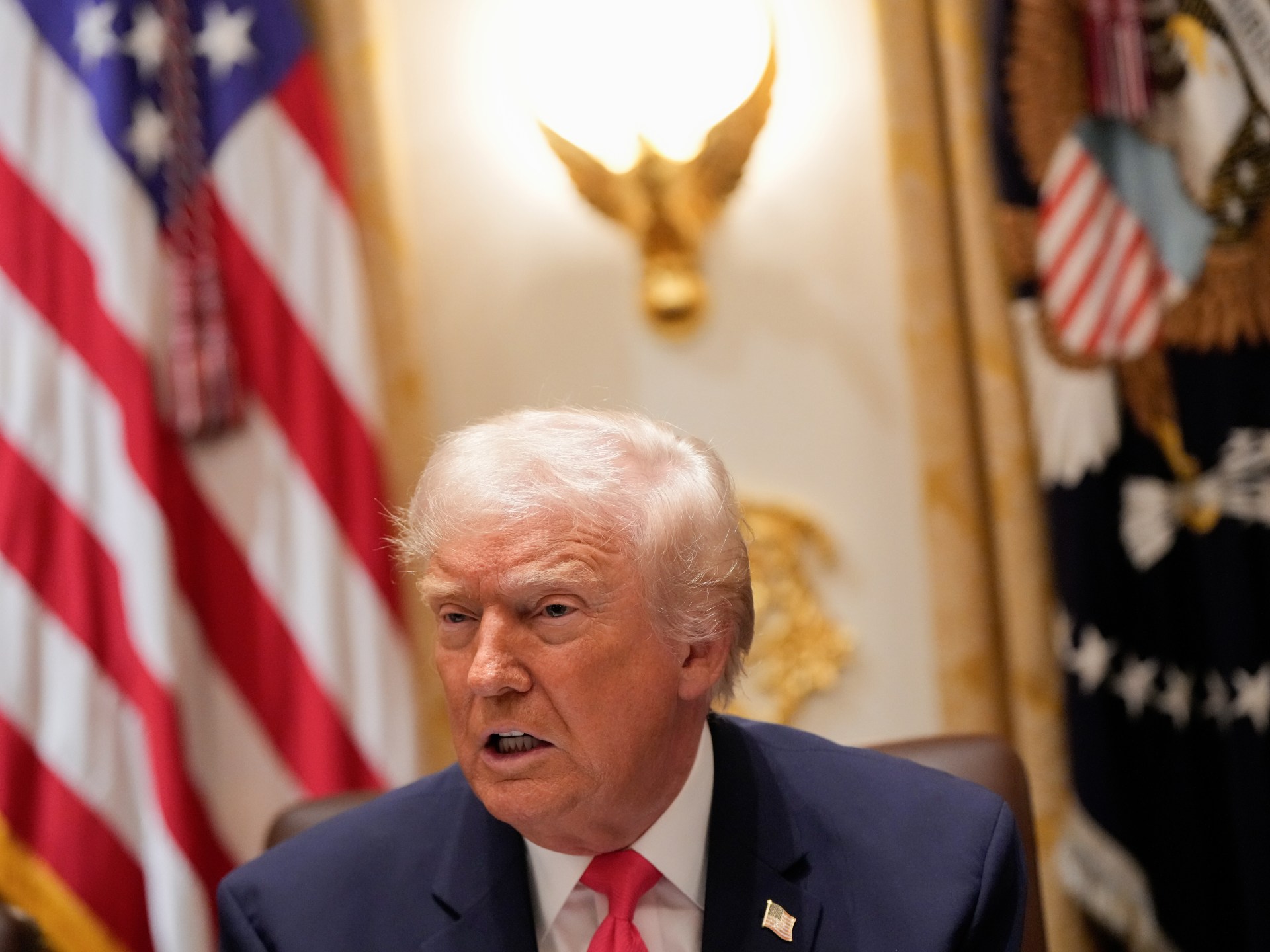

United States President Donald Trump’s administration claims Europe is facing “civilisational erasure” due to mass migration, a narrative often used by far-right parties to drum up support during elections on the continent.
In a 33-page “national security strategy” document released late on Thursday, the Trump administration accused the European Union (EU) of “undermining political liberty and sovereignty” and insisted on the need for US “preeminence” in the Western Hemisphere.
- list 1 of 3Xenophobia runs the world
- list 2 of 3Experts say US boat strikes are illegal killings. Can they be stopped?
- list 3 of 3US Supreme Court to consider Trump’s bid to end birthright citizenship
end of list
Here’s what we know:
Does the Trump administration’s ‘strategy’ align with Europe’s far right?
One section of the NSS document called “Promoting European Greatness” highlights the continent’s decreasing share in the world’s gross domestic product (GDP) but goes on to claim that the continent’s economic decline is “eclipsed by the real and more stark prospect of civilisational erasure”.
The document states that Europe’s migration policies “are transforming the continent and creating strife” which includes the “censorship of free speech and suppression of political opposition, cratering birthrates, and loss of national identities and self-confidence”.
Some European politicians are claiming that this message aligns strongly with European far-right claims. Far-right groups in Europe such as the Alternative for Germany (AfD) party, Vox in Spain, Front Populaire in France and Lega Nord in Italy, among others, have built their electoral campaigns on anti-immigrant and xenophobic narratives.
On Friday last week, Carl Bildt, Sweden’s former prime minister, wrote in a post on X that “in saying that Europe faces ‘civilizational erasure’ the Trump new security strategy places itself to the right of the extreme right in Europe”.
Gerard Araud, former French ambassador to the US, also wrote on X that “the stunning section devoted to Europe reads like a far-right pamphlet. It largely confirms this perception.”
Mark Sedgwick, a professor of Arab and Islamic Studies at Aarhus University in Denmark, told US broadcaster NBC that the language of the Trump administration’s national security strategy also fits with the language used by supporters of the “great replacement” conspiracy theory.
Advertisement
That conspiracy theory was first introduced by French author Renaud Camus in his book Le Grand Remplacement in 2011, and claimed that “elites” in France were trying to replace the White European population by encouraging immigration from Muslim-majority countries.
Since then, it has been used by far-right groups in the West, including the US, to campaign against mass immigration.
Elsewhere, the Trump administration document suggests that “Western Europe is no longer a top priority for the US,” according to Gregoire Roos, director of the Europe and Russia and Eurasia Programmes at Chatham House.
What this means is that the Trump administration now “looks [more] favourably on central and Eastern Europe, where there are closer political proximities”, Roos told Al Jazeera.
“While they don’t agree on everything, countries such as Slovakia and Hungary share views [with the US] on EU bureaucracy, non-European migration as a threat to identity, and greater caution when it comes to siding with Ukraine in its war against Russia,” he added.
Why is Trump aligning with Europe’s far right?
Washington’s relations with European far-right leaders have certainly improved since Trump returned to office in January.
Late on Thursday, through the NSS, the Trump administration called on Washington to take a role in “cultivating resistance” within Europe and encouraged “its political allies in Europe to promote this revival of spirit”.
“We want Europe to remain European, to regain its civilisational self-confidence, and to abandon its failed focus on regulatory suffocation,” the Trump administration added.
According to a December 5 report by The Associated Press news agency, Markus Frohnmaier, a member of Germany’s AfD, said Trump’s NSS is “a foreign policy reality check for Europe and particularly for Germany”.
But Roberto Forin, acting director of the Geneva-based Mixed Migration Centre (MMC), told Al Jazeera that the Trump administration’s NSS doctrine is an “unapologetic defence of whiteness”, and called it a “suprematist’s discourse”.
“The objective of the current administration is to divide Europe, and polarise the continent by weaponising migration,” he said.
“It is another example of how the new US administration is leading the race when it comes to not only migration issues, but rather multiculturalism,” he added.
On December 4, German Foreign Minister Johann Wadephul told reporters in Berlin that Europe is able to deal with its issues without foreign interference. He said that while Washington remains an important security partner in Europe, the alliance is “focused on addressing security policy issues” and not topics such as the continent’s freedom of speech and expression.
Advertisement
“We see ourselves as being able to discuss and debate these matters entirely on our own in the future, and do not need outside advice,” he said.
Amid Russia’s ongoing war in Ukraine, the NSS document targeted European officials’ “unrealistic expectations” for ending the conflict, stating that the US has a “core interest” in doing so.
According to the Reuters news agency, Pentagon officials told diplomats in Washington this week that the US was not yet satisfied with Europe’s defence spending amid Russia’s ongoing war in Ukraine and said the US may stop participating in NATO by 2027 if European countries do not increase their investment.
The NSS stated that Washington would prioritise “enabling Europe to stand on its own feet and operate as a group of aligned sovereign nations, including by taking primary responsibility for its own defence, without being dominated by any adversarial power”.
European countries, including Germany, France and the UK, have announced they will increase their defence spending and investments in military amid Russia’s war in Ukraine. At the NATO Summit in June, members of the alliance pledged to allocate up to 5 percent of their national GDP to defence and related sectors by 2035.
But on December 3, a US official told Politico that US Deputy Secretary of State Christopher Landau told a NATO foreign ministers’ meeting in Brussels that the EU should focus on “turning its defence commitments into capabilities” and highlighted that “protectionist and exclusionary policies that bully American companies out of the market” should be avoided since it “undermines” NATO’s “collective defence”.
Will this bolster Europe’s far right?
Ian Lesser, a fellow and head of The German Marshall Fund of the US (GMF)’s Brussels office, said in a report that EU and NATO observers are likely to view the NSS as “confirmation of established concerns about the direction and style of American policy”.
But he warned that it also “points to European cultural and demographic decline in ways likely to reinforce the views of hard-right elements in Europe”.
“Viewed from Brussels, the strategy underscores the reality of an administration that is not isolationist but rather hyper unilateralist,” he said.
Related News

Trump says Israel must seek ‘strong and true dialogue’ with Syria
Bulgarian government pulls budget amid fierce protests

Russia-Ukraine war: List of key events, day 1,374