Why are Russian warships off Libya, and will Ukraine’s attack change that?
 24 November 2026

Libya’s internationally recognised government in Tripoli has condemned Ukraine’s deadly attack on a Russian warship in Libya, in what Kyiv claimed was an “exemplary” operation.
Libya’s Foreign Ministry said the country would not accept being drawn into the Russia-Ukraine war and that its sovereignty and territorial integrity were non-negotiable, according to a statement posted on Facebook on Monday.
Recommended Stories
list of 4 items
- list 1 of 4What Russian warship did Ukraine just sink?
- list 2 of 4Zelenskyy says Ukraine behind attacks on Russian ships near Libya
- list 3 of 4Russia threatens ‘hostile’ Estonia with ‘open war’
- list 4 of 4Russia warns Ukraine of ‘dangerous trend’ after Libya and Baltic attacks
end of list
“The continuation of the war between Russia and Ukraine gives neither side the right to conduct military operations on Libyan territory or in its territorial waters,” it said.
Sunday’s drone strike on the Merkury, one of Moscow’s newest warships, resulted in the deaths of at least 10 Libyan and Russian crew members, local authorities said.
The attack sent shockwaves through Europe and the Middle East and raised new fears that the months-long war had already spilled over far from the front line.
Kremlin spokesman Dmitry Peskov said Ukraine’s attacks represented a “very dangerous trend”.
Here’s what we know:

What happened?
On Sunday, Ukrainian drones targeted the Merkury in Libya’s coastal city of Benghazi after the Russian corvette docked to refuel and resupply under a cooperation agreement between Russia and Libya’s eastern rival government based in Benghazi. It is led by Khalifa Haftar, commander of the Libyan National Army (LNA), which is based in Tobruk.
Sources told Al Jazeera that the warship was moored in the civilian area of Benghazi seaport, close to a naval base, when it was hit.
Advertisement
In a Monday post on X, President Volodymyr Zelenskyy revealed that the attack had been carried out by Ukraine’s intelligence security service, the SBU, and involved seven Ukrainian drones. The strike also destroyed a Russian Ka-27 combat helicopter. A second Russian ship was also hit. Zelenskyy said the cargo vessel Angara was transporting weapons.
“Despite all the enemy’s efforts to counter the attack, the Russian corvette Merkury was sunk,” he wrote.
Ukraine’s security service justified the attacks in a Monday statement, saying that both vessels were “legitimate military targets for Ukraine because they directly supported Russia’s military capabilities”.
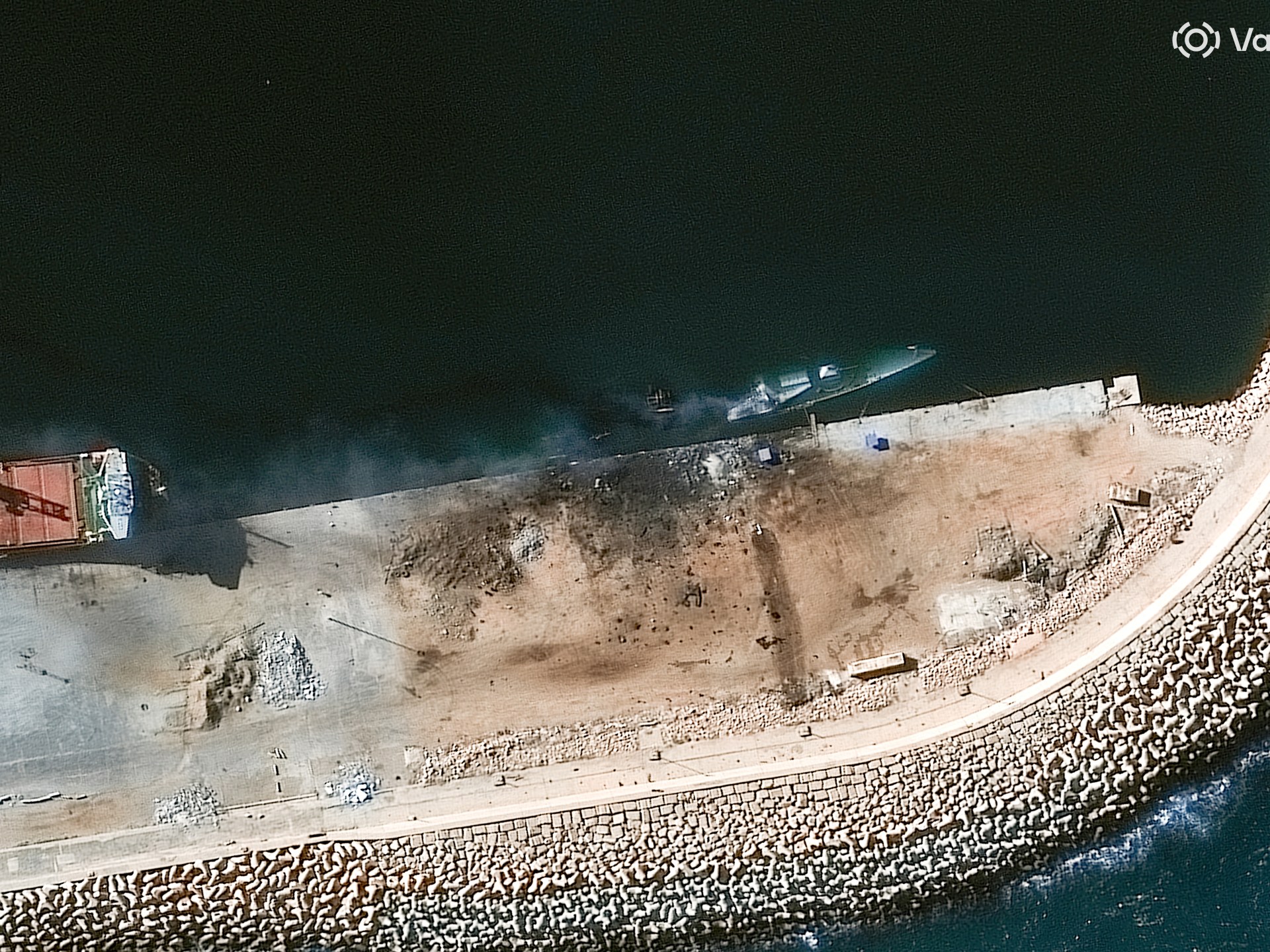
Satellite images on Sunday showed that most of the vessel had capsized, with only its bow still visible above water. Smoke from the initial explosion rose from the ship’s superstructure. Along the pier, debris from the strike lay scattered around.
However, officials in Libya told the Associated Press that the Merkury was only heavily damaged.
Unnamed sources also told AP that Ukraine had launched the drones from a military base run by Ukrainian forces in western Libya.
Tripoli, in its condemnation of the attack on Monday, did not confirm Ukraine’s alleged presence.
Earlier on Sunday, Prime Minister Osama Hammad of the eastern Libyan government said it had submitted an investigation request to the United Nations General Assembly and Security Council.
What’s happening in Libya and why does Russia have a base there?
Oil-rich Libya is a focal point of the long-running rivalry between Russia and the West.
The North African country has been divided since 2011, when a NATO-backed uprising toppled longtime leader Muammar Gaddafi. Moscow’s close ally was killed later that year.
The UN recognises the western Libyan government in Tripoli, while the Benghazi-based administration in the east is a close ally of Moscow. Russia has long maintained deep ties with Haftar in a bid to keep eastern Libya as a logistical hub for its widening military operations across Africa, including in Sudan and the Sahel region.
In 2024, following the fall of the Russia-aligned regime of Bashar al-Assad, Moscow shifted attention to Libya as a potential new site for the vast military infrastructure it had built up in Syria over the previous decade during the civil war there.
Moscow managed to maintain relations with the new government in Damascus, although its footprint is much smaller, according to analysis by the Atlantic Council think tank. Some estimates put the number of Russian troops there at 1,000, significantly fewer than around 10,000 in previous years.
Russia is believed to have planned and funded projects at multiple Haftar-controlled Libyan military bases in its search for a “plan B” following the fall of the Assad regime in Syria: Al-Jufra, Al-Khadim, Al-Qardabiyah, Brak al-Shati, Maaten al-Sarra and Tamanhint.
Advertisement
An estimated 1,800 Russian troops, including those from Africa Corps, which succeeded the paramilitary Wagner Group, are presently based in Libya.
The United States is meanwhile leading efforts to reunite the two Libyan militaries, partly to counter Russia, analysts say, with Washington focusing on relations with the 35-year-old LNA deputy commander and Haftar’s son, Saddam Haftar.
That is likely why Moscow has not yet secured a port in the southern Mediterranean: Libya’s eastern authorities do not want to damage improving ties with the US, Turkiye and European partners by giving Moscow port access, which would be more visible and invite scrutiny, unlike the inland military bases, the Atlantic Council noted.
What does Ukraine’s attack mean for Russia?
It means that Ukraine is achieving results in its push to target Russia thousands of kilometres from the battlefield with what Zelenskyy calls “long-range sanctions”, even as Moscow has focused on overwhelming Kyiv with swarms of killer drones daily.
A particular focus is Russia’s so-called ‘shadow fleet’, the network of tankers Moscow uses to evade Western oil sanctions.
Around the same time the Merkury was hit, a suspected Ukrainian drone struck the Russia-bound dry cargo ship Sparta II in the eastern Baltic Sea, near Finland. Finnish authorities blamed Kyiv, while Moscow called it “terrorism”.
In July, Kyiv said it hit a Russian missile boat and the Iran-linked cargo ship, Anna, in the Caspian Sea, resulting in a diplomatic fallout between Tehran and Kyiv.
Ukraine’s long-range drones have also hit deep inside Russia, targeting oil terminals and other energy infrastructure.
In June 2025, Ukraine’s secret service smuggled components of 117 attack drones into Russia, then arranged and deployed them to hit multiple military bases in five regions. The covert operation, nicknamed Operation Spider’s Web, caused around $7bn in damage to Russian military equipment.
In the Sahel region of western Africa, Ukraine has been accused of working with armed groups fighting against Malian forces and their allied Africa Corps members, although Kyiv denies that.
Related News
Gaza’s infrastructure collapse leaves residents defenceless against floods

UN top court convicts Myanmar of ‘genocidal intent’ against Rohingya

Will Najib Razak be transferred to house arrest?