Why a Bollywood spy film sparked a political storm in India and Pakistan
 16 December 2025
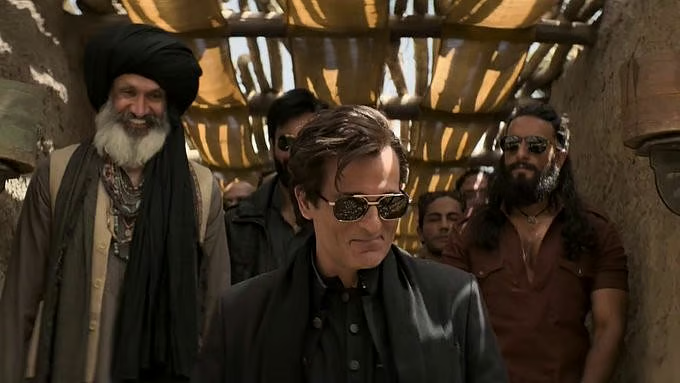

New Delhi, India – A newly released Bollywood spy thriller is winning praise and raising eyebrows in equal measure in India and Pakistan, over its retelling of bitter tensions between the South Asian neighbours.
Sunk in a sepia tone, Dhurandhar, which was released in cinemas last week, is a 3.5-hour-long cross-border political spy drama that takes cinemagoers on a violent and bloody journey through a world of gangsters and intelligence agents set against the backdrop of India-Pakistan tensions. It comes just months after hostilities broke out between the two countries in May, following a rebel attack on a popular tourist spot in Pahalgam, in Indian-administered Kashmir, which India blamed Pakistan for. Islamabad has denied role in the attack.
Since the partition of India to create Pakistan in 1947, the nuclear-armed neighbours have fought four wars, three of them over the disputed region of Kashmir.
The film stars the popular actor Ranveer Singh, who plays an Indian spy who infiltrates networks of “gangsters and terrorists” in Karachi, Pakistan. Critics of the film argue that its storyline is laced with ultra-nationalist political tropes and that it misrepresents history, an emerging trend in Bollywood, they say.

Directed by Aditya Dhar, the film dramatises a covert chapter from the annals of Indian intelligence. The narrative centres on a high-stakes, cross-border mission carried out by India’s Research and Analysis Wing (R&AW), and focuses on one operative who conducts operations on enemy soil to neutralise threats to Indian national security.
Advertisement
The film features a heavyweight ensemble cast led by Singh, who plays the gritty field agent tasked with dismantling a “terror” network from the inside. He is pitted against a formidable antagonist played by Sanjay Dutt, representing the Pakistani establishment, and gangsters such as one portrayed by Akshaye Khanna, while actors including R Madhavan portray key intelligence officers and strategists who orchestrate complex geopolitical manoeuvering from New Delhi.
Structurally, the screenplay follows a classic cat-and-mouse trajectory.
Beneath its high-octane set pieces, the film has sparked an angry debate among critics and audiences over the interpretation of historical events and some key figures.

Why is the film so controversial in Pakistan?
Despite the longstanding geopolitical tensions between the two countries, India’s Bollywood films remain popular in Pakistan.
Depicting Pakistan as the ultimate enemy of India has been a popular theme retold for years, in different ways, especially in Bollywood’s spy thrillers, however. In this case, the portrayal of Pakistan’s major coastal city, Karachi, and particularly one of its oldest and most densely populated neighbourhoods, Lyari, has drawn strong criticism.
“The representation in the film is completely based on fantasy. It doesn’t look like Karachi. It does not represent the city accurately at all,” Nida Kirmani, an associate professor of sociology at Lahore University of Management Sciences, told Al Jazeera.
Kirmani, who has produced a documentary on the impact of gang violence in Lyari of her own, said that like other megacities in the world, “Karachi had periods of violence that have been particularly intense.”
However, “reducing the city to violence is one of the major problems in the film, along with the fact the film gets everything about Karachi – from its infrastructure, culture, and language – wrong”, she added.
Meanwhile, a member of the Pakistan People’s Party (PPP) has taken legal action in a Karachi court alleging the unauthorised use of images of the late former prime minister, Benazir Bhutto, who was assassinated in 2007, and protesting against the film’s portrayal of the party’s leaders as supporters of “terrorists”.
Critics, including Kirmani, say the film also bizarrely casts gangs from Lyari into geopolitical tensions with India, when they have only ever operated locally.
Kirmani said the makers of the movie have cherry-picked historical figures and used them completely out of context, “trying to frame them within this very Indian nationalistic narrative”.
Advertisement
Mayank Shekhar, a film critic based in Mumbai, pointed out that the film “has been performed, written, directed by those who haven’t ever stepped foot in Karachi, and perhaps never will”.
“So, never mind this dust bowl for a city that, by and large, seems wholly bereft of a single modern building, and looks mostly bombed-out, between multiple ghettos,” Shekhar said.
He added that this is also in line with how Hollywood “shows the brown Third World in action with a certain sepia tone, like with Extraction, set in Dhaka, Bangladesh”.

How has the film been received in India?
Dhurandhar has been a huge commercial success in India and among the Indian diaspora. However, it has not escaped criticism entirely.
The family of a decorated Indian Army officer, Major Mohit Sharma, filed a petition in Delhi High Court to stop the release of the film, which, they claim, has exploited his life and work without their consent.
The makers of the film deny this and claim it is entirely a work of fiction.
Nonetheless, the film’s storyline is accompanied by real-time intercepted audio recordings of attacks on Indian soil and news footage, film critics and analysts say.

Is this an emerging pattern in Bollywood films?
Shekhar told Al Jazeera that focusing on a deliberately loud, seemingly over-the-top, hyper-masculine hero’s journey is not a new genre in Bollywood. “There’s a tendency to intellectualise the trend, as we did with the ‘angry young man’ movies of the 1970s,” he said, referring to the formative years of Bollywood.
In recent years, mainstream production houses in India have, however, favoured storylines that portray minorities in negative light and align with the policies of the Hindu nationalist government of Prime Minister Narendra Modi.
Kirmani told Al Jazeera that this frequently means “reducing Muslims across India’s borders and within as ‘terrorists’, which further marginalises Muslims in India culturally”.
“Unfortunately, people gravitate towards these kinds of hypernationalistic narratives, and the director is cashing in on this,” she told Al Jazeera.
Modi himself lavished praise on a recent film called Article 370, for what he said was its “correct information” about the removal of the constitutional provision that granted special autonomous status to the state of Jammu and Kashmir in 2019. Critics, however, called the film “propaganda” and said the film had distorted facts.
In the case of Dhurandhar, some critics have faced online harassment.
One review by The Hollywood Reporter’s India YouTube channel, by critic Anupama Chopra, was taken down after outrage from fans of the film.
Advertisement
India’s Film Critics Guild has condemned “coordinated abuse, personal attacks on individual critics, and organised attempts to discredit their professional integrity”, in a statement.
“More concerningly, there have been attempts to tamper with existing reviews, influence editorial positions, and persuade publications to alter or dilute their stance,” the group noted.
Related News
What has Germany’s position been on Israel’s genocide in Gaza?

Russia-Ukraine war: List of key events, day 1,379

ICC sentences Sudan militia-leading ‘axeman’ Rahman to 20 years