
The US has announced the Gaza ceasefire is moving to phase two, where “demilitarisation, technocratic governance, and reconstruction” will be the focus.
Hamas leaders and representatives of other Palestinian factions in Gaza are in the Egyptian capital, Cairo, for talks, but deep uncertainty remains regarding the next steps.
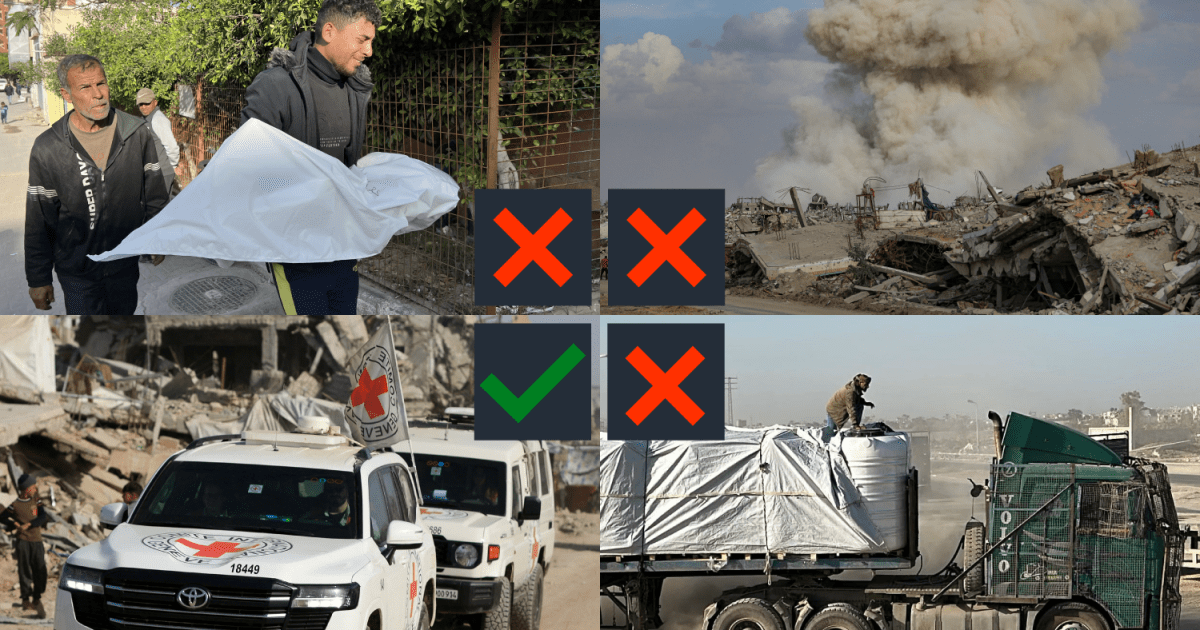
Most of the goals in Trump’s 20-point plan that became the basis for a ceasefire in Gaza three months ago never became a reality on the ground. Here is what has happened in each of the main points of the plan since the ceasefire took effect on October 10, 2025.
What was supposed to happen in phase one?
Phase one of Trump’s 20-point plan was designed to immediately halt the fighting, facilitate the exchange of Israeli and Palestinian captives, set a boundary for Israeli withdrawal from parts of Gaza, allow the full entry of humanitarian aid, and open the Rafah crossing between Gaza and Egypt.

1. Halt on attacks
Status: Did not stop
While the daily number of Israeli attacks has decreased since the start of the ceasefire, Israel has killed at least 451 Palestinians and injured 1,251 – an average of nearly five killed every day – since October 10.

More than 100 children, including at least 60 boys and 40 girls, are among those killed, according to UNICEF.
2. Israeli captives returned in exchange for release of Palestinian prisoners
Status: All captives returned except for one; Israel has not released all the prisoners agreed on
Under the ceasefire deal, Hamas released all 20 living Israeli captives in exchange for nearly 2,000 Palestinian prisoners. Hamas has also returned 27 of the 28 bodies of deceased captives, while the search is still on for the remaining body, believed to be buried under the rubble of buildings bombed by Israel.

However, Suhail al-Hindi, a member of the Hamas political bureau and one of the supervisors of the exchange deal, told Al Jazeera that Israel has failed to release all women and child prisoners as stipulated in the agreement.
Advertisement
It also continues to hold several doctors, including Dr Hussam Abu Safia, Dr Marwan al-Hams, and Dr Tasneem al-Hams, among many others.
Israel has also reneged on a clause in the agreement under which it was to allow the entry of DNA-matching equipment intended to identify the bodies of deceased Palestinian prisoners.
3. Israeli withdrawal
Status: Did not fully withdraw
As part of the ceasefire deal, Israel was supposed to withdraw its troops to an area dubbed the “yellow line”, which takes up more than 50 percent of Gaza and is marked on the ground with a series of yellow concrete blocks.
Al Jazeera’s Sanad fact-checking agency found that Israeli forces have been moving these blocks, thereby expanding their areas of control and forcing Palestinians into increasingly smaller clusters. Israel has also carried out large-scale demolitions of neighbourhoods and surrounding areas near the yellow line.
4. Full humanitarian aid
Status: Israel continues to restrict aid
The ceasefire stipulated that “full aid will be immediately sent into the Gaza Strip”. However, the reality on the ground remains very different. Israel continues to restrict aid.
According to the Gaza Government Media Office, from October 10, 2025 to January 9, 2026, only 23,019 trucks entered Gaza out of 54,000, averaging 255 trucks per day. That is only 43 percent of the trucks that were supposed to have been allowed in.
Israel has blocked essential and nutritious food items, including meat, dairy, and vegetables, crucial for a balanced diet. Instead, non-nutritious foodstuffs are being allowed, such as snacks, chocolate, crisps and soft drinks.
In addition, Israel has banned more than three dozen international organisations, including Doctors Without Borders, known by its French initials MSF; Oxfam; the Norwegian Refugee Council; CARE International; the International Rescue Committee and several other charities from operating in Gaza, further worsening already dire conditions for Palestinians.

5. Opening of Rafah crossing
Status: Did not happen
The Rafah crossing, a key lifeline for aid entry, travel, and medical evacuations, and the main border point between the Gaza Strip and Egypt, remains closed by Israeli forces.
Israeli Prime Minister Benjamin Netanyahu stated that Israel will only reopen the crossing after it receives the body of the last remaining deceased captive, who is buried under the rubble following more than two years of Israeli onslaught.

What is supposed to happen in phase two?
Phase two is supposed to shift the focus to long-term governance and the establishment of a panel of Palestinian technocrats to lead post-war Gaza.
Advertisement
Trump’s special envoy Steve Witkoff said it “establishes a transitional technocratic Palestinian administration in Gaza” and marks the beginning of “the full demilitarisation and reconstruction of Gaza, primarily the disarmament of all unauthorised personnel”.
However, Al Jazeera’s Hind Khoudary, reporting from Gaza City, said the Gaza deal has so far brought no change on the ground. “We’re still hearing the sound of drones [hovering above] and there have been a couple of explosions in the early morning hours, as demolitions take place across Gaza.”

Since the declaration of a ceasefire in the Gaza Strip on October 10, 2025, Israel has violated the agreement with near-daily attacks, killing hundreds of people.
Israel violated the ceasefire agreement at least 1,193 times from October 10, 2025 to January 9, 2026, through the continuation of attacks by air, artillery and direct shootings, the Government Media Office in Gaza reports.
According to an analysis by Al Jazeera, Israel has attacked Gaza on 82 out of the past 97 days of the ceasefire up until January 14, meaning there were only 15 days in this period when no violent attacks, deaths or injuries were reported.
Despite continuing attacks, the US insists that the “ceasefire” is still holding.

Related News
Which countries host the largest Venezuelan populations?
Pakistan court sentences journalists to life over 2023 pro-Khan protests

Top Somaliland official defends Israel ties amid Arab backlash