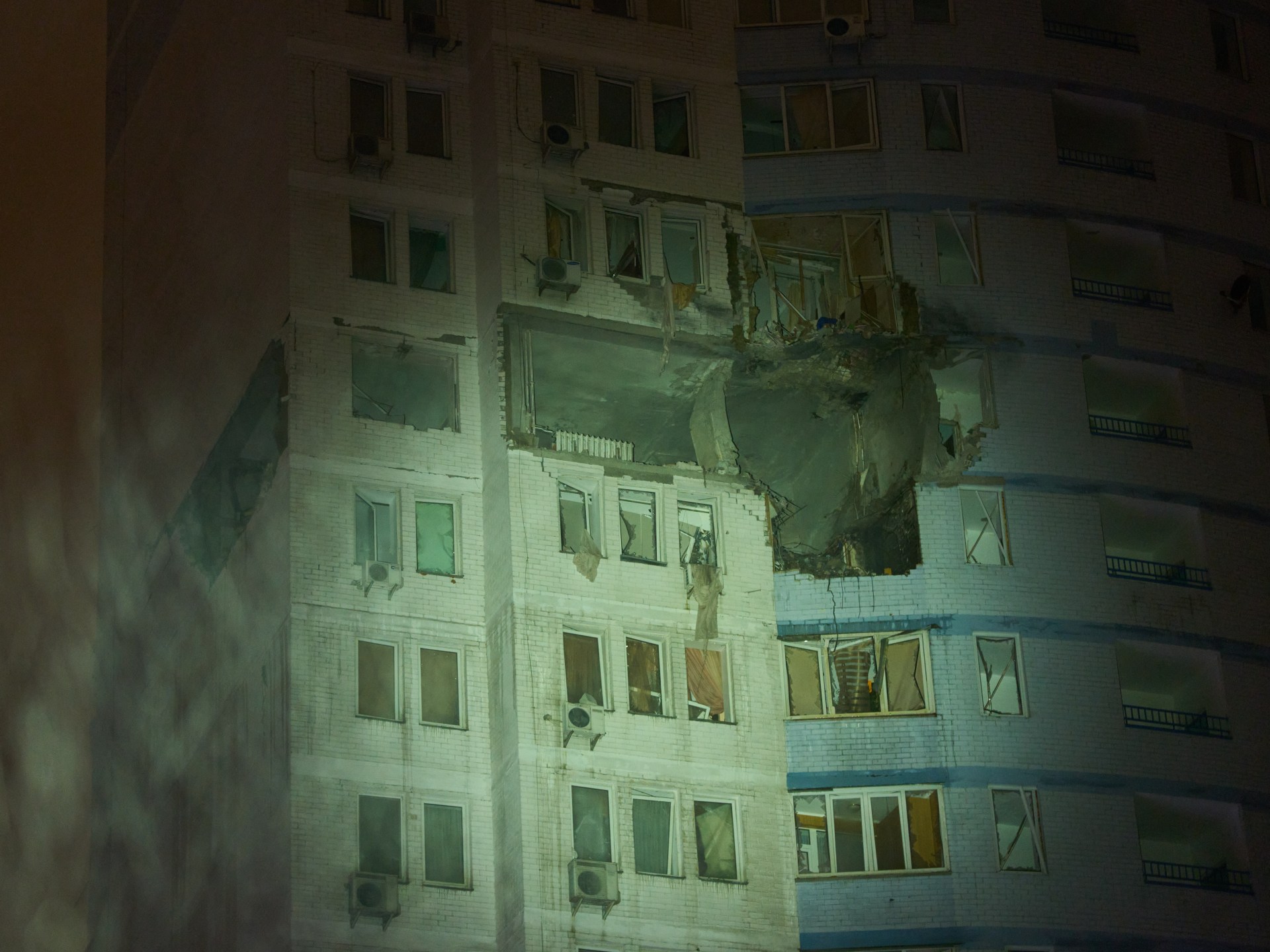

Russia fired its hypersonic Oreshnik missile overnight at Ukraine, Moscow confirmed on Friday, striking a city barely miles away from the Ukrainian border with Poland, at a time when efforts to forge a peace deal are sputtering.
Some experts say that Moscow carried out this attack to intimidate Ukraine’s European and Western allies.
Here is a closer look at what happened, why the use of the Oreshnik is significant, and why all of this matters.
What happened?
The Russian military carried out the attack amid broader strikes on Ukrainian energy infrastructure and drone manufacturing sites in and around Kyiv.
It added that the assault was carried out in response to an alleged Ukrainian drone strike on Russian President Vladimir Putin’s residence in Novgorod in December 2025.
Kyiv has denied that Ukraine attacked Putin’s residence. United States President Donald Trump has also rejected the claim that such an attack took place.
According to Ukraine, the latest strikes killed four people and injured at least 22 in Kyiv.
Russia also hit critical infrastructure in Lviv with an unidentified ballistic missile travelling at about 13,000km/h (more than 8,000mph), according to Mayor Andriy Sadovyi and Ukraine’s Air Force, which said the exact type of missile was still being determined.
Where in Ukraine was the Oreshnik attack?
According to Russia, the strike in Lyiv was from the Oreshnik.
The western Ukrainian city of Lviv is about 550km (340 miles) away from the capital, Kyiv.
Lyiv is near the border with Poland, roughly 70km (45 miles) away.
Advertisement
What is the Oreshnik?
The Oreshnik is an intermediate-range ballistic missile — the word means hazel tree in Russian. The missile’s multiple warheads fall in streaks of light, apparently resembling the tree.
Hypersonic missiles travel at speeds of at least Mach 5 – five times the speed of sound – and can manoeuvre mid-flight, making them harder to track and intercept.
The Oreshnik is also a nuclear‑capable weapon, meaning it is designed to be able to carry a nuclear warhead, even if it is not always deployed with one.
The Oreshnik is believed to be a medium-range missile, with its use so far suggesting a range of about 1,000 to 1,600km (620 to 990 miles).
Russia has only fired the Oreshnik once before, in November 2024. Back then, Moscow said that it had attacked a Ukrainian military factory.
This attack came days after the US government led by former Democratic President Joe Biden authorised Ukraine to use US-supplied Army Tactical Missile Systems (ATACMS) to strike targets in Russia.
In 2024, the Pentagon said that the Oreshnik was based on the “RS-26 Rubezh” intercontinental ballistic missile (ICBM) first developed in 2008.
Putin has said that the intermediate-range Oreshnik missile is impossible to intercept because of speeds reportedly more than 10 times the speed of sound and that its destructive power is comparable with that of a nuclear weapon, even when fitted with a conventional warhead.
On December 30, 2025, Russia deployed the Oreshnik system in Belarus in a move which could strengthen Moscow’s ability to target Europe in a potential future conflict.
During the attack in November 2024, the Oreshnik missiles were equipped with dummy warheads as a test attack, according to Ukrainian sources, Reuters news agency reported.
Hence, the dummy warheads did limited damage to Ukraine back then.
If the missiles were equipped with explosives during the recent attack, it would mark the first time that Russia used the Oreshnik missiles to their full non-nuclear capacity while striking Ukraine.
Another reason why this attack is significant is the location of the target.
Back in November 2024, the missiles hit Dnipro, which is in east-central Ukraine and is not close to Ukraine’s borders with other countries.
However, this time, the missiles hit close to Poland, which is a member of NATO.
Kyiv has labelled the use of the weapon close to the European Union and NATO border a “grave threat” to European security.
“Such a strike close to [the] EU and NATO border is a grave threat to the security on the European continent and a test for the transatlantic community. We demand strong responses to Russia’s reckless actions,” Ukrainian Foreign Minister Andrii Sybiha wrote on social media.
Advertisement
“Vladimir Putin is using this to communicate with the West, because he could undoubtedly achieve the same operational effects without this missile,” Cyrille Bret, a Russia expert at the Paris-based Montaigne Institute, told the AFP news agency.
A UK government spokeswoman said that, in a call on Friday, the leaders of United Kingdom, France and Germany condemned Russia’s use of the missile as “escalatory and unacceptable”.
Why does this matter?
The latest Russian attack comes as peace talks aimed at ending the war in Ukraine continue to stall. In February, the war will enter its fifth year.
The latest attack risks undermining those ceasefire negotiations, at a time when the two sides remain far apart on core issues such as territory.
Observers and analysts have previously told Al Jazeera that the issue of territorial concessions remains a major sticking point.
Trump’s 28-point peace plan for Ukraine, which he unveiled in November 2025, involved Ukraine ceding not only large amounts of land that Russia has occupied during nearly four years of war, but also some territory that Kyiv’s forces currently control. Zelenskyy has stated on numerous occasions that this is unacceptable to Ukraine.
Most analysts are sceptical that any progress has been made on this point and said the latest intensification in fighting will not, by itself, add to the already significant complications in talks.
“I don’t think there is anything to derail at this point,” Marina Miron, an analyst at King’s College London, told Al Jazeera in December 2025.
The peace process “is not going well due to disagreements on key issues between Ukraine and Russia”, she said.
Mikhail Alexseev, a professor of political science at San Diego State University, told Al Jazeera that Moscow’s goal is not to “end or derail” peace talks, but instead it is to “keep them going as a cover and an enabler of continuing Russian brutal invasion in an attempt to wipe Ukraine off the world’s map regardless of human cost”.
“Russia started the war and Putin can end it in five minutes if he wanted to do so. All he needs to do is to agree to [US] President [Donald] Trump’s unconditional ceasefire proposals made early this year.”
Related News

Press association condemns Israel’s continued ban on media access to Gaza

Venezuela’s Maduro to appear in US court as Trump threatens more bombing
Ceasefire in Aleppo after at least 22 people killed since Tuesday