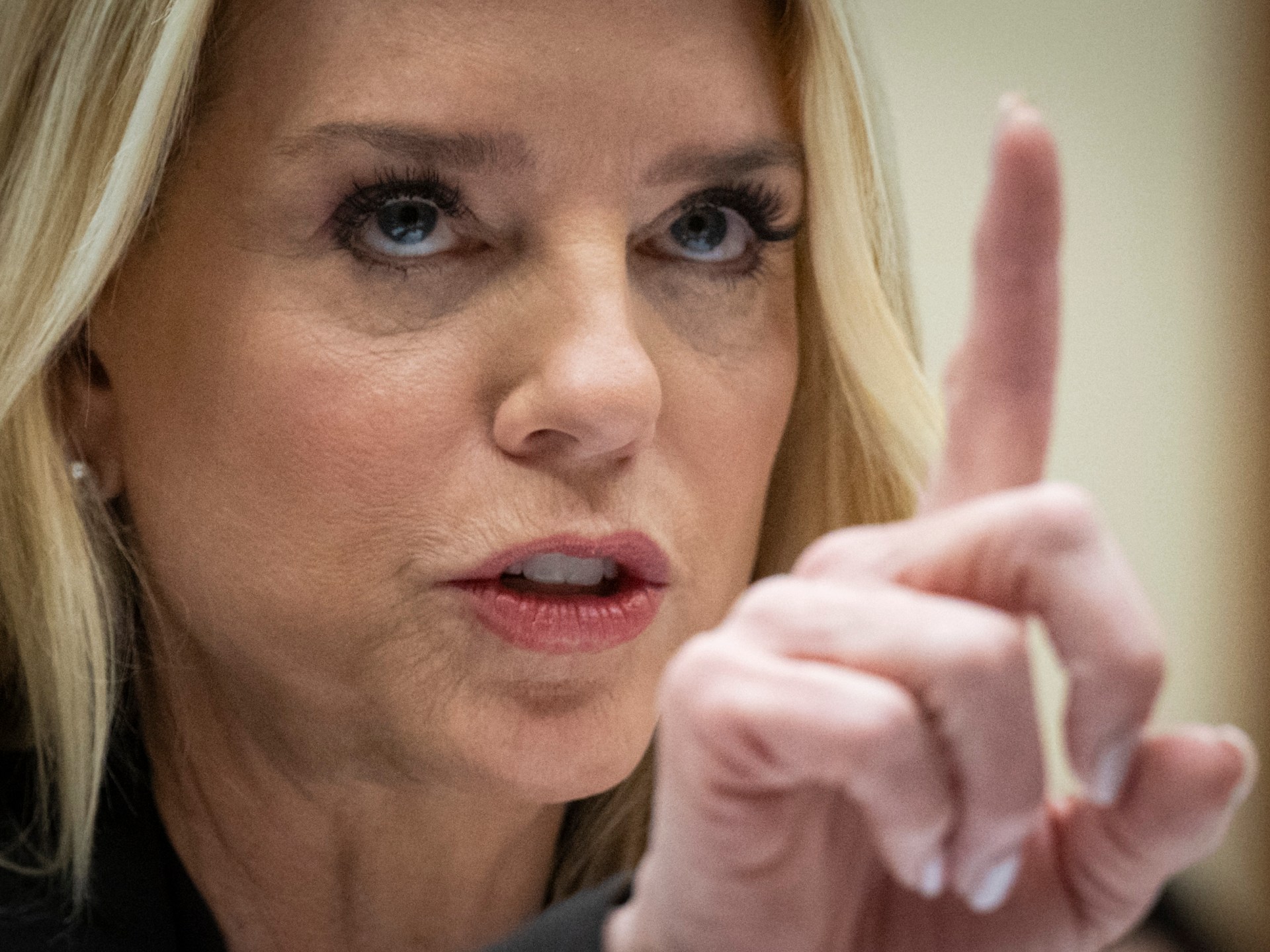

Over the span of five hours on Wednesday, United States lawmakers questioned Attorney General Pam Bondi over the US Justice Department’s (DOJ) handling of documents related to convicted late sex offender Jeffrey Epstein.
Bondi, testifying before the House Judiciary Committee, defended the DOJ’s handling of the release of the Epstein records and said there are “pending investigations” in the case.
- list 1 of 4‘Tell the truth’: Epstein survivors demand justice in Super Bowl ad
- list 2 of 4Six men named in US Congress: Why is so much redacted in the Epstein files?
- list 3 of 4Congresswoman presses Pam Bondi to apologise to Epstein victims
- list 4 of 4US lawmakers slam Pam Bondi over handling of Epstein files
end of list
Here are key takeaways from Bondi’s congressional hearing.
Why is Pam Bondi being questioned?
Bondi testified before the House of Representatives Judiciary Committee on Capitol Hill in Washington, DC, in a hearing entitled “Oversight of the US Department of Justice”, but the Epstein files quickly became a primary focus.
Since the start of his second term, US President Donald Trump and his administration have consistently faced questions about the decision to withhold or redact documents related to Epstein.
That new law, called the Epstein Files Transparency Act, passed into law in November with bipartisan support. It requires the Justice Department to publish all of its documents related to Epstein in an easily searchable format.
Though the law allows for some limited redaction to protect the identities of victims, critics argue that scores of documents have been published with heavy redactions. Some of those blacked-out sections appear to shield the identity of powerful figures involved with Epstein.
During her opening statement on Wednesday, Bondi, a prosecutor from Florida, defended her record of addressing sexual abuse.
Advertisement
“I have spent my entire career fighting for victims, and I will continue to do so,” she said.
Epstein victims were present
With several victims of Epstein seated behind her in the hearing room, Bondi forcefully defended the department’s handling of the files related to the well-connected financier, an issue that has dogged her tenure.
During her opening remarks, Bondi deemed Epstein a “monster” and issued an apology to the victims.
“I am deeply sorry for what any victim, any victim, has been through, especially as a result of that monster,” Bondi said.
At one point during the hearing, Representative Pramila Jayapal, a Democrat from Washington, asked the Epstein victims to raise their hands if they had not had a chance to meet with a member of the Justice Department. All the victims raised their hands.
The victims included Danielle Bensky, who met Epstein in 2004 when she was 17 years old. She has accused Epstein of sexually assaulting her.
“There was such a lack of empathy today. There was such a lack of, honestly, humanity today,” Bensky told an NBC programme after the hearing.
Bondi clashes with Democrats
Congressional Democrats accused the US attorney general on Wednesday of engaging in a “cover-up” of the Jeffrey Epstein files and turning the Department of Justice into an “instrument of revenge” for Trump.
Maryland Democrat Jamie Raskin criticised the slow release of the Epstein files and the redactions made to the documents.
“You’re running a massive Epstein cover-up right out of the Department of Justice,” Raskin said. “You’ve been ordered by subpoena and by Congress to turn over six million documents, photographs and videos in the Epstein files, but you’ve turned over only three million.”
When pressed by Representative Jayapal, Bondi refused to turn and face the Epstein victims in the audience and apologise for what Trump’s Justice Department has “put them through”. She accused the Democrat of “theatrics”.
Texas Democrat Jasmine Crockett stormed out of the hearing after a spat with Bondi. “This is a big cover-up. And this administration is still engaged in it. In fact, this administration is complicit,” Crockett said.
During a heated exchange, Crockett said Bondi would be remembered as one of the worst attorneys general, prioritising loyalty to Trump over the law, before yielding the rest of her time.
Bondi shot back that Crockett had not even tried to question her and accused her of ignoring the fact that Democratic leader Hakeem Jeffries had taken money from Epstein after his conviction, a claim Jeffries has denied.
Advertisement
The attorney general also clashed with Ted Lieu, a Democrat from California. Lieu asked whether Trump had attended a party with underage girls, a question Bondi deemed “ridiculous”.
Bondi insisted there was no evidence Trump had committed a crime.
Lieu suggested that her answer amounted to lying under oath, noting that Trump’s name appears repeatedly in the Epstein files. Bondi shot back: “Don’t you ever accuse me of committing a crime.”
Trump’s name appears multiple times in the released Epstein files, but not in connection with the sexual abuse of women. Rather, the records primarily show that he and Epstein were acquainted and had a social relationship.
For instance, Trump was listed as a passenger on Epstein’s private jet at least eight times between 1993 and the mid-1990s.
On February 1, Trump told reporters on board Air Force One about his name being mentioned in the latest tranche of Epstein files: “I was told by some very important people that not only does it absolve me, it’s the opposite of what people were hoping, you know, the radical left.”
Republicans join Democrats in questioning Bondi
Bondi accused Democrats of using the Epstein files to distract from Trump’s successes, even though it was Republicans who initiated the furore over the records and Bondi herself fanned the flames by distributing binders to conservative influencers at the White House last year.
Representative Thomas Massie, a Republican from Kentucky, who helped lead the effort to require the files’ release, accused the Justice Department of a “massive failure” to comply with the law as he questioned why billionaire Leslie Wexner’s name was redacted in an FBI document listing potential co-conspirators in the sex trafficking investigation into Epstein.
Bondi said Wexner’s name appeared numerous times in other files the department released and that the DOJ unredacted his name on the document “within 40 minutes” of Massie spotting it.
“Forty minutes of me catching you red-handed,” Massie replied.
On Tuesday, Democratic Representative Ro Khanna revealed the names of six men, including Wexner. The other names made public are Sultan Ahmed bin Sulayem, the head of Dubai-based logistics company DP World, Salvatore Nuara, Zurab Mikeladze, Leonic Leonov and Nicola Caputo. Al Jazeera could not independently verify their identities or affiliations.
Khanna said he was revealing the men’s names after he reviewed the files with Massie.
‘Trump orders prosecutions like pizza’: Bondi came to the president’s defence
Raskin and other Democratic lawmakers condemned the prosecutions brought by the DOJ against Trump’s political foes, such as former FBI director James Comey and New York Attorney General Letitia James.
“You’ve turned the people’s Department of Justice into Trump’s instrument of revenge,” he said. “Trump orders up prosecutions like pizza and you deliver every time he tells you to.”
Ghislaine Maxwell, Epstein’s former girlfriend, is the only person behind bars in connection with Epstein. She was convicted in 2021 of sex trafficking underage girls and is serving a 20-year prison sentence.
Advertisement
Trump has not been accused of any wrongdoing regarding Epstein but he fought for months to prevent the release of the files about his one-time friend.
A rebellion among Republicans eventually forced the president to sign off on the law mandating the release of all the records.
The move reflected intense political pressure to address what many Americans, including Trump’s own supporters, have long suspected to be a cover-up to protect rich and powerful men in Epstein’s orbit.
Trump’s repeated denials of any knowledge of Epstein’s crimes have come under scrutiny due to a 2019 FBI interview – contained in the Epstein files – with Palm Beach’s then-police chief Michael Reiter.
Reiter told the FBI that Trump had called him in 2006 – when the sex charges against Epstein became public – to say: “Thank goodness you’re stopping him, everyone has known he’s been doing this.”
Related News
Epstein files reveal web of relationships among rich and powerful
Advocates call to end anti-Muslim hate 9 years after Quebec mosque attack

Police probe explosive device thrown at Indigenous protest in Australia