Lives on hold for two years: Some hope stuck behind Gaza’s Rafah crossing
 27 January 2026
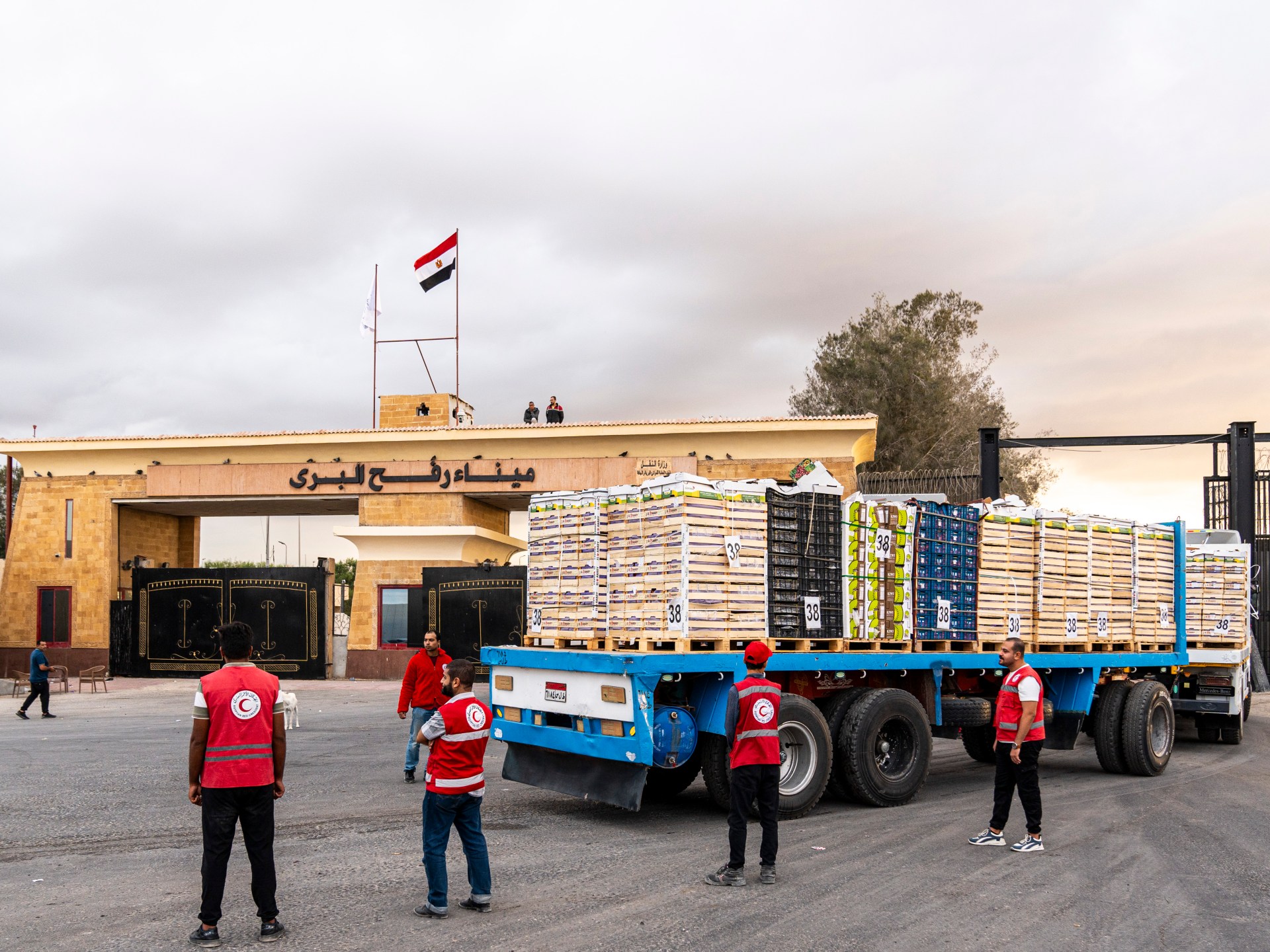

Deir el-Balah and Khan Younis, Gaza – For the past two years, Khitam Hameed has clung to the hope of a single sliver of news that could fundamentally change the fate of her entire family.
The reopening of the Rafah crossing, shut and controlled by Israel as part of its genocidal war on Gaza in spite of a ceasefire agreement, would allow her family to travel and reunite with her husband outside Gaza.
- list 1 of 4Israel’s genocide wiped out over 2,700 families in Gaza
- list 2 of 4Investigation reveals Israeli campaign to flatten Gaza town of Beit Hanoon
- list 3 of 4‘Yellow line’, the de facto Israeli buffer zone shaping life in Gaza
- list 4 of 4Gaza’s Rafah crossing to reopen when final Israeli body is returned
end of list
But for this family, the reopening is not just about freedom of movement. It represents both a chance for reunion after a long separation, and an opportunity to secure treatment for their son, whose life, schooling, and normal childhood have all been destroyed by the two-year Israel-Palestine war.
With the United States pushing a deeply intransigent Israel to progress to phase two of the ceasefire that began on October 10, the reopening of the Rafah crossing was directly tied by the far-right government to the recovery of the remains of the final Israeli captive, and only partially for pedestrian use under strict military supervision.
On Monday, the retrieval of the last Israeli captive’s body appeared to open that locked door, with thousands in urgent need of treatment or family reunification in a state of anxious anticipation.
From her family’s displacement site in the Nuseirat refugee camp near Deir el-Balah in central Gaza, Khitam, 50, a mother of six, sits trying to organise her thoughts as news circulates about Rafah.
Next to her is her 14-year-old son, Yousef, unable to walk, suffering from a rare genetic disorder called Ehlers-Danlos Syndrome (EDS), a painful condition primarily affecting his bone development, with potential cardiac complications.
Advertisement
“Yousef has been undergoing treatment for this syndrome since he was very young … he has had around 16 surgeries,” Khitam tells Al Jazeera.
“We got used to hospitals, but before the war, there was some monitoring and a little hope.”
Since long before October 2023, the Rafah crossing between Gaza and Egypt has been a lifeline for Palestinians, not only as a natural exit and entry point, but also as a symbol of connection with the outside world.
Before the war, the crossing was heavily used by patients seeking medical treatment, families visiting relatives abroad, and the movement of goods and supplies that helped ease Gaza’s economic pressure under Israeli blockade.
Its closure, beginning in May 2024 after Israeli forces took control, marked a dramatic turning point in the humanitarian crisis.
The shutdown affected not just the movement of people, but also significantly reduced the flow of medical aid and essential supplies, impacting thousands of patients waiting for treatment outside Gaza, including children and the wounded, amid a severe shortage of health services and medical equipment.
‘Opening the crossing shouldn’t be a miracle’
Before the war, Khitam and her family monitored Yousef’s condition regularly, and he could walk and move.
But the war halted everything. Hospitals were routinely bombed by Israel, and most ceased functioning. Medics were killed by the hundreds, medications ran out, and medical checkups became nearly impossible.
“Since the war, Yousef’s condition has deteriorated. His legs are weaker, walking is harder, he uses crutches,” Khitam pauses before continuing: “He falls often… and my heart is in my throat every time.”
The mother no longer knows the full extent of her son’s health. “I don’t know if he has heart complications, or if his spine has worsened … we are living with him with no answers.”
The war also separated the family. Weeks before the conflict erupted, Khitam’s 52-year-old husband, Hatim, had left Gaza for Egypt, as an initial step to secure a chance for the family to migrate and access advanced medical care for Yousef.
“Since then, I’ve been alone. Six children, one with a special medical condition, war, displacement, hunger,” Khitam says, her voice exhausted.
“Being displaced alone is so difficult. You don’t know where to go, how to protect your children, how to provide food or safety. The constant anxiety and fear have affected everyone, but Yousef suffers the most.”
“No school, no play, no outings, no treatment … even psychologically, he is exhausted. A child his age should be living his life, not caught between war and illness.”
Advertisement
But, she adds, “just the idea of travelling eases us a bit psychologically. It feels like a door might open” for treatment outside of the besieged enclave.
She still fears how the crossing will operate, even as hope keeps her going.
“Even if the crossing opens, not everyone can leave, and not every case will be approved,” she adds. “Opening the crossing shouldn’t be a miracle… it’s a right.”
Yousef’s story intersects with those of hundreds of families of sick children in Gaza, for whom Rafah is not just a crossing, but a lifeline.
Local estimates indicate that more than 22,000 patients and injured people, including about 5,200 children, are unable to travel for treatment due to the Israeli closure, with thousands more waiting for approved medical transfers that cannot be executed.
Among them is Hur Qeshta, a newborn girl only 15 days old, born with a large, unusual tumour in her neck, affecting breathing and swallowing.
She requires urgent surgery outside Gaza, according to doctors at Nasser Hospital in Khan Younis, in southern Gaza.
Her mother, Doaa Qeshta, 32 and a mother of five, tells Al Jazeera, “From the first moment she was born, the family started a new battle against time to ensure she could urgently travel for treatment.”
Hur was delivered via Caesarean section and now lies in the Nasser Hospital neonatal ICU, on oxygen and fed via a tube from her abdomen.
“She can’t breastfeed, everything is through a tube, and the mass is growing rapidly … all within 15 days,” says her mother.
Doctors confirmed that surgery inside Gaza is currently impossible due to a lack of facilities.
Doaa links her daughter’s condition to the circumstances during her pregnancy, including displacement in a tent in al-Mawasi, exposure to nearby shelling, smoke, gunpowder, hunger, and lack of nutrition.
“I was pregnant during famine … no food, no vitamins, no safety,” she recalls. “Shelling was nearby, 300 metres (980 feet) away… the tent shook; we thought we were dead.”
“Opening the crossing means saving my daughter’s life,” she says. “I’ve registered the whole family as companions … the most important thing is Hur goes, gets treatment, and survives.”
Of the reopening of the Rafah crossing, Doaa says, “We hear news and live on hope, but we are really in a limbo… we don’t know what’s happening or when. We just pray this is true.”
‘Our lives and futures hang on a hope’
The effects of Rafah’s closure go beyond medical access, affecting an entire generation of youth whose education has been halted at a closed gate.
Among those affected is Rana Bana, a 20-year-old from the Daraj neighbourhood in Gaza City.
She graduated from high school in 2023 with a 98 percent average in the science track, with a focus on pharmacy. Within a single year, she received multiple opportunities abroad, but none materialised due to Rafah’s closure.
“In 2024, I was accepted for a scholarship in Egypt, ready to leave, but the crossing closed. A year later, I got a scholarship to Turkiye, did the online interviews, was accepted, and since then I’ve been stuck,” Rana tells Al Jazeera.
Advertisement
Her Turkish scholarship includes 220 students from Gaza, all from different disciplines, most with high academic grades.
Over the past two years, Rana tried not to stagnate, taking Turkish language courses and exploring alternatives like local universities. But she would hold back each time she heard news of Rafah possibly reopening.
“Every time there’s news the crossing might open, I tell myself, ‘Let me wait a bit’… but it turns out to be just talk, and my hopes are dashed,” she adds. “A lot of our time and life has been wasted waiting … our lives and futures hang on a hope.”
Rana is displaced with her family of eight. They returned briefly to northern Gaza during the first ceasefire, found their home intact, but fled again after fighting resumed, and are now settled in Deir el-Balah.
“My biggest fear is leaving and not being able to come back,” she says. “Before, they [her family] were 100 percent supportive. Now there’s fear because the travel process is unclear, and they don’t know how many will be allowed or registered to travel.”
Many Palestinians fear leaving Rafah would be a one-way ticket as part of an openly touted Israeli plan to permanently expel the population from Gaza.
“We students and youth are the most affected group during the war,” Rana says. “Our years have gone by silently, our studies destroyed by war, and no one talks about us. All we want is education — not travel for tourism or anything else.”
Related News
Syrian army sends troops to rural Aleppo to stop any SDF attempt to regroup
Gaza war docudrama The Voice of Hind Rajab nominated for Academy Award
Public opinion shifts on ICE as advocates warn of US ‘inflection point’