
A raw material – not gold – is having an outsized influence on the fighting in Sudan as it is smuggled to help fund the war effort of the paramilitary Rapid Support Forces (RSF).
It is gum arabic, an essential, unsung hero in many products around the world.
So what is gum arabic? Why is it important? And how is it helping fund the RSF’s war? Here’s what we know:
What is gum arabic?
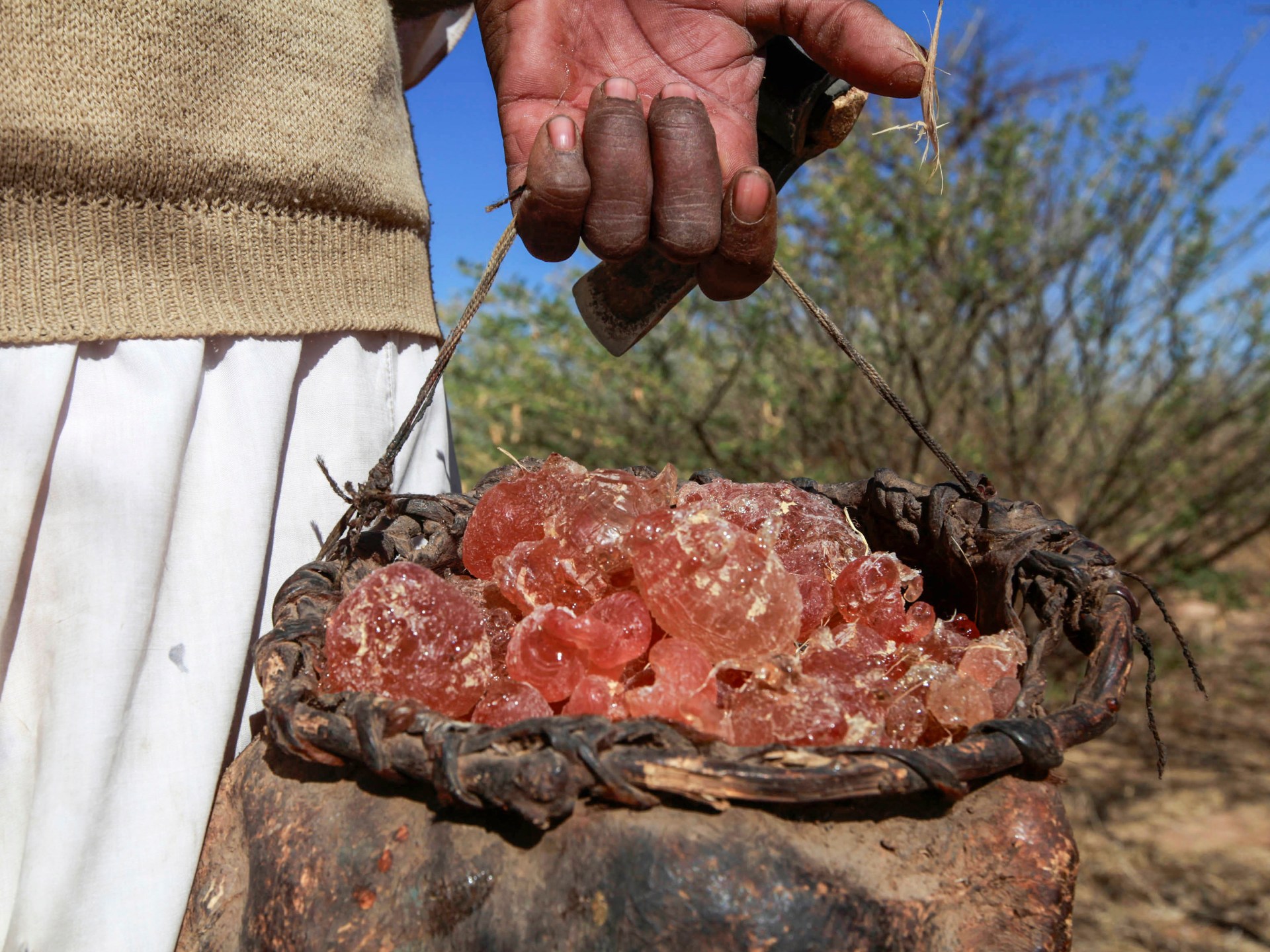
It is a resin produced by tapping the acacia senegal tree, which grows in a belt across Central Africa.
The resin is powdered and used as an emulsifier and binder in nearly everything: soft drinks, ice cream, confectionery, chewing gum, adhesives, paint and some cosmetic products.
It can be found on ingredient labels as “gum arabic”, “acacia gum”, “E414”, or “I414”.

International corporate giants rely heavily on gum arabic for their products, importing nearly 200,000 tonnes of it in 2024 for various uses, a market worth nearly $300m.
Here is how important gum arabic is. When the United States imposed sanctions on Sudan in the 1990s, designating it a “state sponsor of terrorism”, gum arabic was excluded from sanctioned exports.
How important is Sudan in the gum arabic trade?
There are two varieties of gum arabic: the more robust and commonly used hashab, and the flakier, less-in-demand talha.
Sudan’s climatic conditions are ideal to grow hashab, the variety that is most in demand worldwide.

Before war broke out in April 2023, Sudan was the world’s biggest gum arabic exporter, specifically hashab, with an estimated market share of 70 to 80 percent.
Advertisement
The exact export or production figures have always been difficult to determine, but we do know that most of the world’s gum arabic comes from Sudan.
“The trade has … traditionally [been] quite opaque, and there are no clear figures,” Joris van de Sandt, a researcher with Dutch peace organisation PAX, told Al Jazeera.
What has happened since Sudan’s war began?
Post-April 2023, official export numbers from Sudan have dropped drastically, but that does not mean the international appetite for gum arabic has gone unsatisfied.
Instead, export numbers from neighbouring countries have gone up, a fact that is being pointed to as indicating how this cash crop is being exploited to finance the war in Sudan.
A report by van de Sandt and coauthor Esther Bijl has found that most Sudanese gum arabic is now being smuggled out of the country, making it difficult to trace its origins.
Some of this smuggling is being done by regular Sudanese traders, who take their product over the borders into Chad, South Sudan, or any other neighbouring country they can reach.

They do that to avoid having to certify that their product is conflict-free, but also to evade levies imposed by the Sudanese government and the RSF, which is fighting the government-aligned Sudanese army.
Once the gum is smuggled to another country, it is mixed with locally produced gum and relabelled as originating from this second country.
But a more insidious smuggling is being done by the RSF, which realised it could benefit by looting the extracted gum to sell in neighbouring countries as well as by imposing levies on regular traders under its power.
“In the beginning, the RSF didn’t know anything about gum arabic; they just taxed people who were moving it, like any other good,” Sudanese exporter Haisam Abdelmoneim told Al Jazeera.
Now, Bijl said, “Armed groups are controlling the routes, and they’re controlling stockpiles, and they are controlling border crossings, and they keep extracting revenue on all of these.”
Who is buying this conflict gum?
The biggest buyers of raw gum arabic are European companies, with French and German firms leading the pack.
While these companies say they are undertaking all due diligence to ensure that their imports of gum arabic are ethically sourced, the PAX researchers found otherwise.
“The European companies that import these ingredients, they import something that has profited the RSF, and that is sustaining the war effort,” Bijl said.
Advertisement
Al Jazeera reached out to two French companies that are among the world’s biggest exporters of gum arabic.
A spokesperson for Nexira said over email: “Since the beginning of the conflict, we have continuously adapted our operations. When local conditions no longer allowed for a minimum level of visibility and control, we suspended purchases.”
Alland & Robert’s spokesperson told Al Jazeera that the company “applies rigorous traceability standards, ensuring that every batch is traceable to its origin”.
The researchers are not saying international companies are buying directly from armed groups, but van de Sandt remains sceptical about the traceability, saying: “It’s very difficult to believe that companies in Europe can assure that it is conflict-free.”

How is all this affecting people in Sudan?
As the fighting rages and the RSF tries to raise more money for its war chest, the risk to farmers, tappers, and everyone working along the supply chain is worsening.
“It’s a very important livelihood for millions of Sudanese people. But at the same time, it’s become a very insecure trade,” Bijl said.
Despite the price for a tonne of hashab having more than doubled during the war, people who made a modest living off gum arabic – because, like all natural resources, the producers make the least money anyway – are making even less.
Related News
Explosions heard over Venezuelan capital Caracas amid US tensions
‘No true sense of celebration’ as Israeli bombs drown out Christmas in Gaza
Here’s how the US imposed regime change overnight in Venezuela