How Florida Governor Ron DeSantis will shape his state’s 2026 midterm race
 03 November 2026
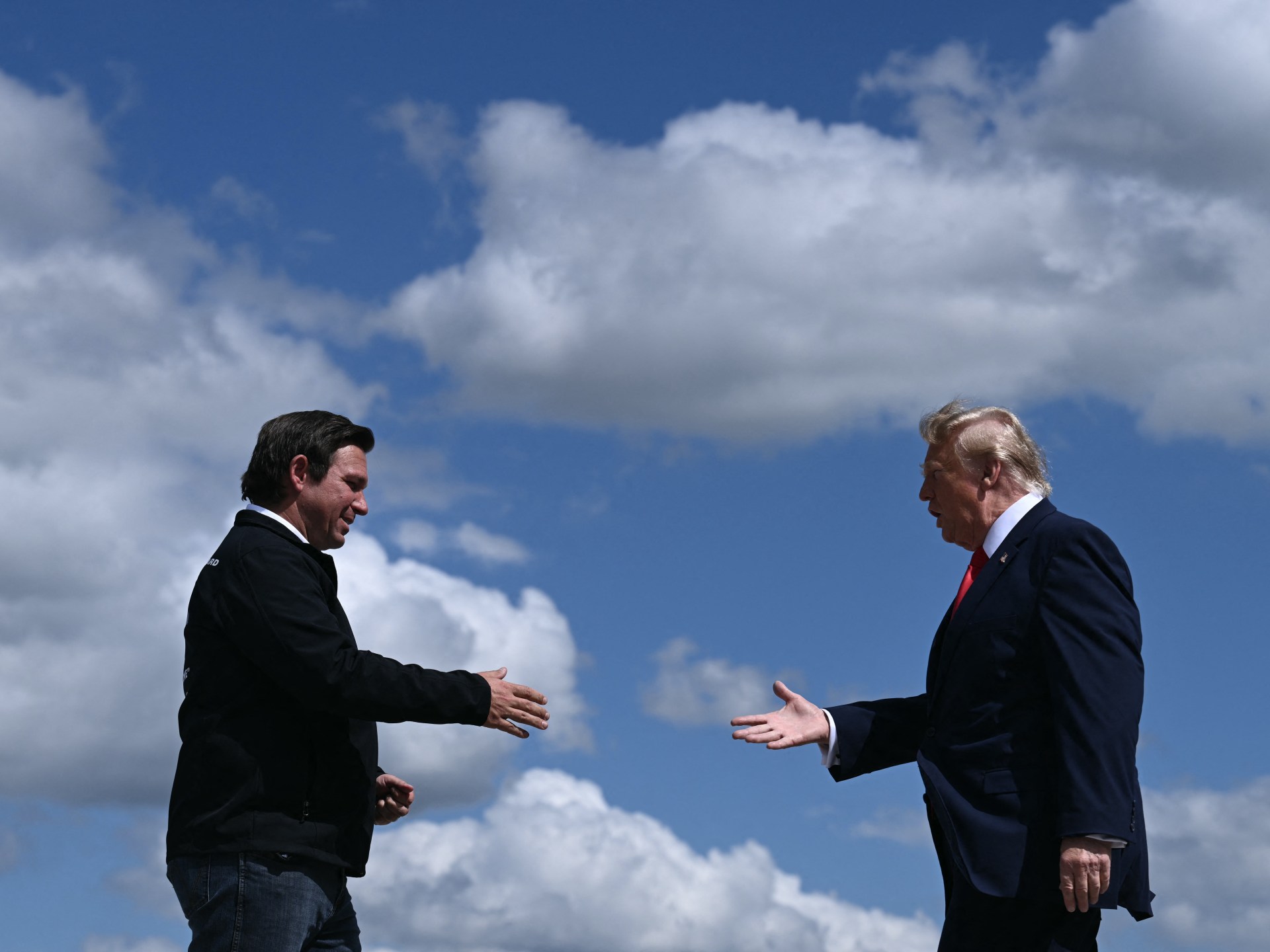

Few modern governors have left as deep a mark on Florida’s character as Republican Ron DeSantis.
Across his two terms, the 48-year-old politician has overhauled the state’s political landscape, turning what was once a swing state into a Republican stronghold.
- list 1 of 4Democrat Emily Gregory wins Florida seat in Trump’s Mar-a-Lago district
- list 2 of 4New Florida map boosts Republican seats amid national redistricting fight
- list 3 of 4Five key takeaways from Trump-Netanyahu meeting in Florida
- list 4 of 4US-Israel ties: What Netanyahu and Trump will discuss in Florida
end of list
The Florida governor has also established himself as a key national figure in United States politics. During the 2024 presidential race, he was considered one of the chief Republican challengers to President Donald Trump.
DeSantis leaves office in January: Due to term limits, he cannot run in a third election for governor.
But experts say his legacy as a hardline Republican will define the race to succeed him in Tuesday’s midterm elections.
US Representative Byron Donalds is campaigning to defend the Republicans’ hold on the governor’s mansion in Florida, but he faces stiffer-than-expected competition from former Congress member David Jolly, a centrist Democrat.
“Was [DeSantis’s position] going to alienate some voters? It definitely has. We’ll find out tomorrow if it’s enough to make a change,” Aubrey Jewett, a political science professor at the University of Central Florida, told Al Jazeera.
Dark horse turned dominant force
A decade ago, DeSantis was hardly the household name he is today in the US.
A former naval officer who served three terms in the US House of Representatives, the Republican was by no means a shoo-in for the governor’s chair when he first ran for office in 2018.
The race was tight. Even with Trump’s endorsement, DeSantis only scraped past his Democratic rival, Andrew Gillum, by less than half a percentage point.
Advertisement
At the time, Florida was a quintessential “purple” state, capable of leaning towards either Republican or Democrat.
Under DeSantis’s leadership, however, the state took a rightward turn. The last Democrat to win statewide office in Florida was Nikki Fried, the former agricultural commissioner – and her victory came eight years ago.
Ever since, Democrats in Florida have endured a dry spell, while the Republican margin of victory has grown.
In 2022, for instance, DeSantis overwhelmingly won re-election by 19 points, the largest gap since 1982. He also became the first Republican gubernatorial candidate in 20 years to win the Democratic stronghold of Miami-Dade County.
By Trump’s re-election in 2024, Florida’s reputation as a reliably red bastion was undeniable.
Trump notched a decisive victory with 13.1 percentage points over former Vice President Kamala Harris in Florida’s presidential vote that year, a far cry from his wafer-thin 1.2-point advantage during the 2016 election.
According to Florida’s Division of Elections, Republicans currently hold an advantage of 1.5 million registered voters over the state’s Democrats.
That is a dramatic reversal from 2020, when Democrats held a registration advantage of at least 100,000 voters.
Many experts credit DeSantis with spearheading this registration surge. Republicans have been attracted to the state by DeSantis’s platform of low taxes and light regulations, as well as his rejection of pandemic-era restrictions.
Trump himself made the Mar-a-Lago resort in Palm Beach, Florida, his permanent residence in 2019, in a move widely speculated to take advantage of Florida’s favourable tax regime.
A model for the right
Though Trump and DeSantis were briefly rivals during the 2024 Republican primaries, Jewett said the Florida governor has helped shape the meaning of “Trumpism”, the president’s political movement.
DeSantis himself has held up Florida as a “blueprint for America’s revival”.
Under his leadership, Florida has participated in Trump’s immigration crackdown and sought to purge public universities of diversity, equity and inclusion (DEI) initiatives.
In April 2022, for instance, he signed into law the Stop Woke Act, which limited how race and gender were taught in public schools by barring instruction that portrayed any group as “inherently racist”.
Part of the law was later struck down after advocates argued that it constituted censorship in violation of the First Amendment of the Constitution.
Other DeSantis-era laws, like 2022’s Parental Rights in Education Act, curbed classroom instruction on sexual orientation and gender identity.
Advertisement
“Those things have been cemented in Florida’s K-12 system,” Jewett explained. “There’s not a lot that the school boards could do, given that the governor has removed several people for policy disagreements.”
Those laws, however, had wide-reaching impact across the US.
States like Arkansas, Indiana, Kentucky and Iowa subsequently pursued laws curtailing how public schools addressed sexuality, gender identity and race in the classroom.
Florida’s future after DeSantis
As Floridians head to the polls to choose DeSantis’s successor, Jewett said DeSantis will cast a long shadow over state and national politics for years to come.
“Whether anyone agrees or disagrees with [DeSantis], from a neutral political science perspective, the man has had a huge impact in Florida and across the nation,” he said.
Donalds, the Republican, has pledged to continue DeSantis-style politics, calling the outgoing leader “best governor in the country”. While in the US Congress, Donalds even sponsored legislation to limit how gender and race are taught, echoing DeSantis’s own legislative platform.
His challenger Jolly, a Republican-turned-Democrat, is pitching himself as an alternative to “partisan politics”, with affordability and healthcare at the heart of his campaign.
Jewett expects Donalds to preserve much of DeSantis’s right-wing agenda, though not necessarily replicate his approach to all subjects, including Black history.
The DeSantis administration has previously been accused of attempting to sanitise the teaching of slavery by rejecting an Advanced Placement course on African American history.
“Maybe on the racial issue […], you might see a little bit of softening there,” Jewett said of Donalds.
He cautioned, however, that Donalds was likely “not going to turn into a progressive on those issues either”.
DeSantis, meanwhile, is unlikely to disappear from national politics.
“I don’t think we’ve seen the last of him,” Jewett said. He predicts DeSantis will “certainly try to run for president again” in 2028.
Related News

Activist Greta Thunberg joins French student protests

Almost all shallow-water coral reefs now face extinction risk, study warns

Iran war live: Trump claims US Navy blockade stops Iranian ships in Hormuz