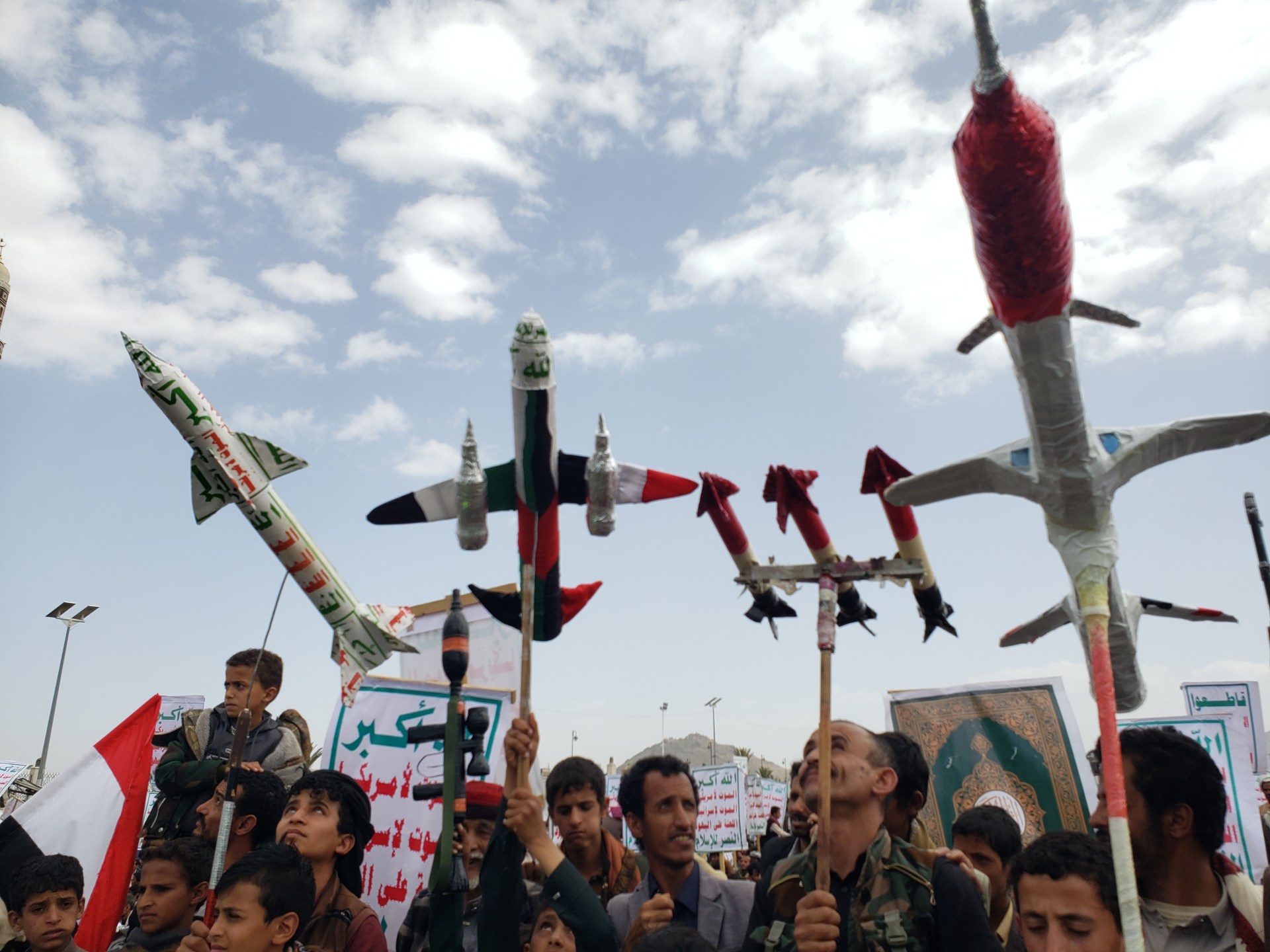

Yemen’s Houthis have entered the Iran war by launching strikes on Israel, and some analysts have warned their arrival could open another front in the conflict – the potential blockade of Bab al-Mandeb, a strait that presents another chokepoint in the global commodities trade.
Brigadier-General Yahya Saree, a military spokesperson for the Houthis, announced on Saturday the Iranian-backed group’s first attack on Israel. On Sunday, he said the Houthis had carried out a “second military operation” against Israel using cruise missiles and drones and said the Houthis would continue carrying out military operations in the coming days until Israel “ceases its attacks and aggression”.
- list 1 of 3Living in the dark: Gaza’s struggle for electricity
- list 2 of 3Analyst says that Iran’s interest is in an extended war
- list 3 of 3US-Israel war on Iran: What’s happening on day 30 of attacks?
end of list
Does the Houthis’ warning raise the prospect of a broader regional war, particularly given the group’s ability to block Bab al-Mandeb and strike targets far beyond Yemen?
Here’s what we know:

Why have the Houthis joined the war?
So far, unlike Lebanon’s Hezbollah and Iraqi armed groups, the Houthis have not made any formal announcement of joining the war.
While Iran champions the Houthis as part of its “axis of resistance”, Houthi religious doctrine does not adhere to Iran’s supreme leader in the same way Hezbollah’s and the Iraqi groups’ do. Iran has built the “axis of resistance” of like-minded factions to oppose Israel and the United States across the region.
Al Jazeera’s Tohid Asadi, reporting from Tehran, said the Houthis joining the war will be welcomed by Iran.
“Speaking of the broader context, we have to keep in mind that over the past months and years, officials in Tehran have said the Houthis in Yemen are close allies. But their decision-making and actions are largely independent,” he said.
Advertisement
“Still, geopolitically, Iran is likely to see this as a significant development,” he added.
Negar Mortazavi, a senior nonresident fellow at the Center for International Policy, told Al Jazeera that the entrance of the Houthis into the fighting is “no surprise”, noting that Iranian actions have been in accordance with their statements.
“Every step has really been what they have telegraphed, what they have threatened even before the war when they went to their Gulf Cooperation Council neighbours and they warned that this [the war] is not going to be inside their borders and they are going to immediately turn it into a regional war,” she told Al Jazeera.
But Nabeel Khoury, a former US diplomat, told Al Jazeera that the missile attacks launched by the Houthis against Israel amounted to “token participation, not full participation”.
“They have fired a couple of missiles as a warning because of all the talk of potential escalation. There are US troops on their way to the region. There’s been talk that if there is no agreement, there might be a full-scale attack on Iran as has not been seen so far,” the former deputy chief of mission in Yemen told Al Jazeera.
“So for all that, the Houthis are saying, ‘We are still here, and if you’re really going to go all-out against Iran, we will then jump in.’ But at this point, they haven’t yet jumped in.”
If they do, Khoury said, their most significant move would be blocking Bab al-Mandeb with boats, mines or missiles.
“All they have to do is fire at a couple of ships coming through, and that would lead to the arrest of all commercial shipping through the Red Sea,” he said. “That would be a red line, and then you would see attacks against Yemen very quickly.”
The passage of oil and gas through the Strait of Hormuz has almost entirely ground to a halt after Iran targeted vessels passing through the waterway. The closure has caused a global energy crisis, adding inflationary pressure to economies across the globe. Several countries have been forced to impose fuel rationing and reduce working hours to conserve energy.
Where is Bab al-Mandeb?
The strait sits between Yemen to its northeast and Djibouti and Eritrea in the Horn of Africa to its southwest. It connects the Red Sea to the Gulf of Aden, which then extends into the Indian Ocean. It is 29km (18 miles) wide at its narrowest point, limiting traffic to two channels for inbound and outbound shipments and is de facto controlled by the Houthis.
It is one of the world’s most important routes for global seaborne commodity shipments, particularly crude oil and other fuel from the Gulf bound for the Mediterranean via the Suez Canal or the Sumed (Suez-Mediterranean) Pipeline on Egypt’s Red Sea coast as well as commodities bound for Asia, including Russian oil.
Advertisement
Reporting from Sanaa, Yemen, Al Jazeera’s Yousef Mawry said the main card in the war for the Houthis is Bab al-Mandeb.
“With the Strait of Hormuz closed off to US and Israeli shipping, if the Houthis also decide to block Bab al-Mandeb, it’s only going to make the situation economically a lot worse for Israel,” Mawry said.
“As of right now, shipping is still available for all vessels, including US- and Israeli-linked vessels. The Yemeni group has not imposed a blockade for the time being. That’s expected in the next phase if Israel decides to target the port of Hodeidah or Yemeni civilian and public infrastructure.”
Can this strait be blocked by the Houthis?
Neither the Houthis nor Iran has commented on whether there is a plan to block one of the world’s busiest maritime routes.
But on Wednesday, an unnamed Iranian military official said Iran could open a new front at Bab al-Mandeb if attacks are carried out on Iranian territory or its islands, the country’s semiofficial Tasnim news agency said.
Then on Saturday, Mohammed Mansour, the Houthis’ deputy information minister, told local media that the group is “conducting this battle in stages, and closing the Bab al-Mandeb strait is among our options”.
Al Jazeera’s Asadi said that so far in the war, Iran has sought leverage through the Strait of Hormuz but now attention is turning to another key chokepoint, likely Bab al-Mandeb.
“If that were to be disrupted, it would provide additional leverage for Iran and its allies amid ongoing air attacks by Israel and the US,” he said.
Elisabeth Kendall, a Middle East specialist and the president of Girton College at Cambridge University, told Al Jazeera that if this strait is blocked, it would create a “nightmare scenario”.
“Because if you have restrictions on the Strait of Hormuz at the same time as restrictions are escalating in the Bab al-Mandeb, then you really will disrupt, if not cripple, trade toward Europe. So this is a knife edge, really, depending on what happens next,” she told Al Jazeera.
“Going to actually strike the Red Sea at the moment when it’s one of the more dependable routes out,and oil is going out via Yanbu from Saudi Arabia on the Red Sea, that would be a bit of a game-changer,” she added, referring to Saudi Arabia’s alternative route to export oil.
Kendall, however, said that while this was a “sweet spot” for the Houthis, she noted that the Yemeni group might not want to “provoke a Saudi or indeed a broader response.”
The Houthis previously carried out attacks in the Red Sea in 2024 when they targeted commercial ships. The Houthis then said they were targeting Israel-linked or Israel-bound vessels in protest against Israel’s genocidal war on Gaza.
Ahmed Nagi, a Yemen senior analyst at the International Crisis Group, told Al Jazeera that the Houthis’ current posture reflects a deliberate calculation rather than restraint born of weakness.
“The Houthis today didn’t attack the Red Sea or speak even about escalation in the Red Sea. They just attacked Israel directly,” Nagi noted.
Advertisement
“That choice matters. The Bab al-Mandeb, linking the Red Sea to the Gulf of Aden, remains one of the most sensitive arteries in the global economy. About 10 percent of global trade and a significant share of oil and gas shipments pass through it,” he said.
For now, Nagi suggested the Houthis are aligning their moves with Tehran’s broader strategy.
“The aim is to support the Iranians in their negotiations, … and they are betting that maybe there will be a way out, so there will not be a need to use Bab al-Mandeb.”
Related News
Iran war live: Tehran vows to ‘completely close’ Hormuz if power plants hit

US says they’re talking, Iran says they’re not. Who’s telling the truth?
Two teenagers killed in Shiraz, two dead in Abu Dhabi as Iran war expands