Hebron’s Israeli rooftop settlers threaten the city’s Palestinian identity
 04 November 2026

Hebron, occupied West Bank – Yusef al-Khatib, 65, never expected that the building that housed the tailoring shop he inherited from his father, and where he has spent most of his life, would be swallowed up by an illegal Israeli settlement in Hebron’s Old City.
He continues to practice the trade that has been part of his family’s history for decades. But the settlers in newly erected prefabricated structures on the rooftops over his shop have created uncertainty about the future of his tailoring business.
- list 1 of 3US midterms present a test for Republican redistricting in Texas and beyond
- list 2 of 3Palestine weekly: Election deadlock meets West Bank sieges, Gaza killings
- list 3 of 3Palestinians return to ruined Hebron homes after Israel’s 10-day siege
end of list
Yusuf said his father began working at the business about 80 years ago, and when he was just five years old, he began helping in the shop. Nearly 60 years later, he is still working there.
“This shop is my livelihood and the livelihood of my family. It enabled me to raise my children and provide them with an education,” he told Al Jazeera.
Hebron’s Old City has had a settler presence since 1978, but these illegal outposts have extended since then to cover a wider area. About 500 settlers live in the Old City, despite it being illegal under international law, with Palestinians living there fearing that they will eventually engulf the whole of Hebron.
Settlement expansion
Over the years, Yusuf has witnessed major changes in the Old City, from the closure of markets and streets to Palestinians to the establishment of Israeli settlement outposts right in the heart of Hebron.
The Palestinian businesses located on Shalala Street, the main entrance to Hebron’s Old City, are adjacent to Shuhada Street, which has been closed to Palestinians since 1994, after an Israeli settler killed 29 Palestinians as they prayed at the city’s Ibrahimi Mosque.
Advertisement
Settlers, present in hundreds, are continuing to find ways to expand into the Old City area and force Palestinian residents to leave.
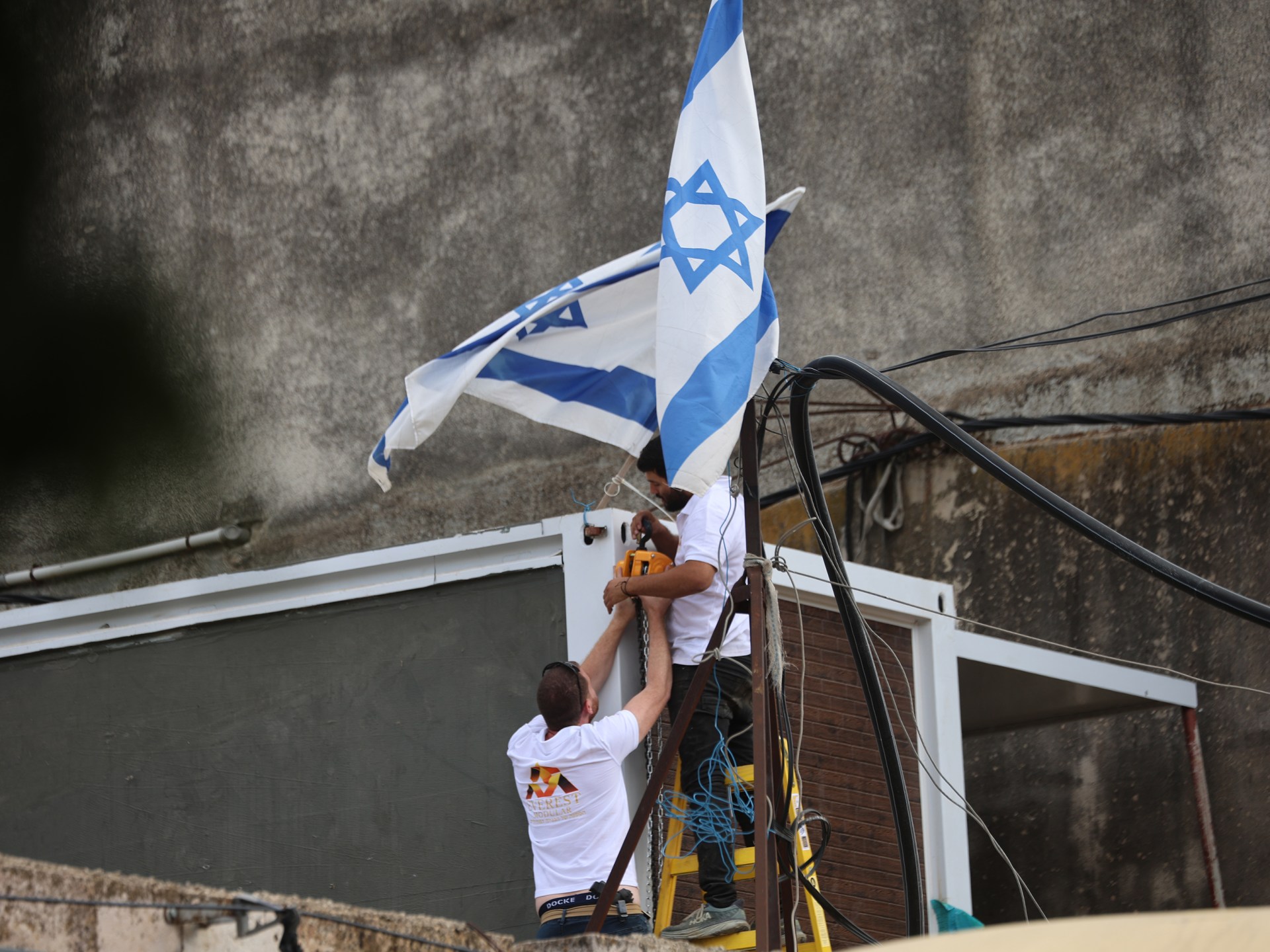
On October 29, settlers placed mobile structures on the rooftops of commercial buildings in the area, which are expected to accommodate 20 new settler units, which activists say will change the Palestinian character of the area.

This includes building housing on top of Yusuf’s tailoring shop. In the face of this pressure, his response is to keep his shop open, to maintain the legacy left behind by his father.
“It is an inheritance I received from my father, and I will continue to protect it and hold on to it, despite my fear of the settlers on the rooftop above the shop and the threats we may face.”
Bader al-Daour al-Tamimi, who has four children at university, has seen settlers take over the rooftop above his shop and turn it into a new outpost. He fears that one day, he will lose access to his shop and the only source of income he has to support his children in their education.
“Shop owners have come to expect that they may not be able to open their shops the following day, because of the constant threats from settlers and soldiers,” he said.
“Our presence here is not just about business; this is the home of our fathers and grandfathers, and part of our history.”
Inheritance
For Adel Mustafa al-Shuyukhi, 67, the shop represents another story of a longstanding connection to the Old City. He inherited it from his father and has spent about 50 years working there, becoming intimate with every inch of the neighbourhood.
“I know every corner of it, and I know the shop owners here one by one,” he told Al Jazeera.

He, too, has witnessed the changes to the Old City throughout his working life, watching the closure of markets and the raising of military gates at the entrances of neighbourhoods.
He remembers when Israeli authorities began issuing restrictions that have stopped Palestinian customers and business owners from reaching stores.
But al-Shuyukhi believes that keeping his shop open is not just a financial necessity but also essential to maintain the Palestinian identity of the Old City. He wants his children to continue running the shop when he dies, just as his father left it to him.
Advertisement
“Despite all the restrictions, we are standing firm and do not want to leave our shops,” he said. “I have told my children that if anything happens to me, they should come and open the shop so that it remains open and we do not abandon it.”
From the division of Hebron to expansion
Issa Amro, 46, an anti-settlement activist and founder of the Youth Against Settlements group, places the current expansion in a broader historical context dating back to the 1994 Ibrahimi Mosque massacre and the agreements that reshaped control over Hebron.
Before then, the Old City housed a bustling market, filled with vegetables, poultry, camels and carpentry. That changed after the massacre and the subsequent restrictions imposed on Palestinians by Israeli forces.

Amro says Hebron is distinct from other West Bank cities because it has a special agreement, the 1997 Hebron Protocol, which divided the city into two areas, H1 and H2.
Under the agreement, roughly 80 percent of the city came under H1, where the Palestinian Authority has civil and security responsibilities. The remaining 20 percent, known as H2, remained under Israeli security control, including the Old City and areas where settlers live.
Unlike other West Bank cities, settlers live among Palestinian neighbourhoods, while Palestinian residents also face tighter restrictions on movement and access to their homes and businesses.
The takeover of the Old Municipality building, a symbol of Palestinian sovereignty in Hebron, and the establishment of a military position on its roof coincided with the replacement of Arabic street and neighbourhood names with Hebrew ones. Israeli flags raised above settler buildings are seen as another attack on the Palestinian identity of the Old City.
“Settlers used to be confined to certain areas, but today, we are seeing expansion beyond the areas that have been closed since 1994, reaching the Old Municipality building and the rooftops of commercial properties,” Amro said.
“These restrictions aim to empty the area of its Palestinian residents and expand the settlement presence.”
Related News

India-China border face-offs test Modi six years after deadly clash
No regrets: Trump says Iran war justified despite polls drubbing

Why are three of the UK’s four nuclear deterrent submarines at sea?