Guyana Police Arrest Country’s Opposition Leader For Fourth Time In Weeks
 28 October 2026


News Americas Now, GEORGETOWN, Guyana, Wed. October 28, 2026: Guyana Opposition Leader Azruddin Mohamed was arrested Wednesday for at least the fourth time since early September, as police opened another investigation involving the businessman-turned-politician.
This time the arrest came over allegations that a police constable was paid by Mohamed for government surveillance footage connected to a controversial shooting incident earlier this month. Mohamed, leader of the opposition We Invest in Nationhood, (WIN), party, was arrested at his Eccles, East Bank Demerara residence, according to police.
Head of the Guyana Police Force’s Criminal Investigations Department, Deputy Commissioner Wendell Blanhum, confirmed the arrest. “I can confirm that Mr. Azruddin Mohamed was arrested,” Blanhum said. The latest arrest concerns an investigation into how Mohamed obtained video recordings from Guyana’s government-operated Safe Country surveillance system. Police allege a 20-year-old constable attached to the Force’s Command Centre downloaded footage and provided it to Mohamed in exchange for GY$800,000.
Police said the constable told investigators that he downloaded the recording on October 23 and saved it to a flash drive after being instructed to do so by Mohamed. According to the police account, an employee of Mohamed transported the constable to Mohamed’s Houston, East Bank Demerara residence the following day, where the officer was allegedly paid GY$800,000 in cash in exchange for the recording.
Police further allege the constable spent some of the money during a shopping trip and gave the remainder to his mother. The allegations have not yet been tested in court, and police had not announced new charges against Mohamed in connection with the alleged payment as of Wednesday afternoon.
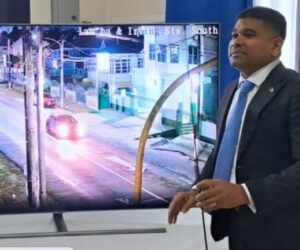
The footage at the center of the investigation was publicly screened by Mohamed during a press conference Monday. Mohamed said the approximately 23-minute recording supported his assertion that an October 12 encounter involving Senior Superintendent Prem Narine, head of the Guyana Police Force’s Special Branch, amounted to a failed attempt on his life.
Police have presented a sharply different account. According to investigators, Narine was at his Barr Street, Kitty residence on the night of October 12 when he observed a vehicle carrying Mohamed and two other men travelling slowly in the area. Police said Narine heard what appeared to be a gunshot and responded by firing several rounds toward the vehicle.
Mohamed has disputed that version of events and has said the surveillance recording demonstrates that an attempt was made on his life. He has also indicated that he intends to pursue private criminal charges against Narine. Mohamed and two associates were arrested following the incident and subsequently charged in connection with alleged firearm and ammunition possession and attempting to pervert the course of justice. They were granted bail. Those proceedings remain separate from the new investigation into how Mohamed obtained the government surveillance recording.
Wednesday’s detention adds to a striking series of encounters between Guyana’s main opposition leader and law enforcement authorities. In early September, Mohamed was arrested during an investigation involving alleged unauthorized drone activity near President Irfaan Ali’s private residence at Leonora.
He was released on self-bail, but was arrested a second time later that same night after returning to the area with supporters and livestreaming from the vicinity. Police said at the time that he had allegedly breached security protocols. He was subsequently released again. Then, on October 13, Mohamed was arrested with two associates following the shooting incident near Narine’s residence.
Wednesday’s arrest therefore marks at least the fourth time Mohamed has been taken into police custody since early September. The repeated arrests come as Mohamed and his father, businessman Nazar Mohamed, are also fighting extradition proceedings brought at the request of the United States. Those proceedings are separate from the latest police investigations and are scheduled to return to court in November.
The police constable accused of providing the surveillance footage and his mother also remained in custody on Wednesday. The constable’s father has moved to the High Court seeking their release, arguing through an attorney that the police must establish a lawful basis for continuing to detain them. The court application challenges the legality of their detention and asks that they either be brought before the court or released, with or without conditions.
Meanwhile, Guyana Attorney General Anil Nandlall has said the alleged payment for the footage could potentially raise questions involving bribery, evidence tampering and attempting to pervert the course of justice. No court has yet determined that Mohamed committed any of those offences in connection with the leaked footage.
The continuing investigation now adds another layer to an increasingly contentious confrontation involving Guyana’s opposition leader, senior members of the police force and the government’s own surveillance system. At the center of that confrontation remains the October 12 shooting – an incident Mohamed describes as an attempt on his life, while police maintain that their actions arose from an alleged firearm discharge near the home of the country’s Special Branch chief.
With the surveillance video now itself the subject of a criminal investigation, the dispute has expanded beyond what happened that night to include how potentially critical evidence was obtained, who had access to it, and whether the recording ultimately supports either side’s account.
Related News
At Least 238 Killed In U.S. Boat Strikes In The Caribbean

U.S.-Caribbean Partnership: Who Sets The Agenda, Who Holds The Power And Who Benefits?
Three Months After The Guyana MV Barima Tragedy – Wreck Still Unrecovered As COI Exposes...