
European foreign ministers have told United States Secretary of State Marco Rubio that Europe must have a say in any deal to end Russia’s war on Ukraine, as US-mediated peace talks get under way in Abu Dhabi.
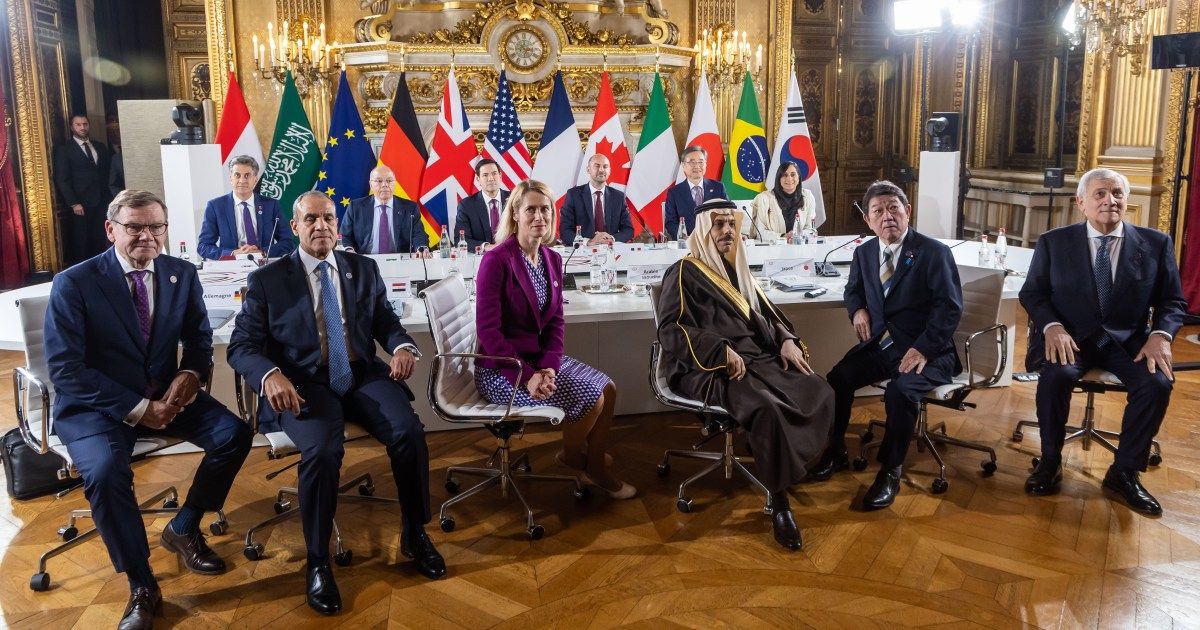
They made the appeal on Monday in Paris, at a meeting of foreign ministers from the Group of Seven, which includes Canada, France, Germany, Italy, Japan, the United Kingdom and the United States.
- list 1 of 3Macron lines up more Gulf diesel as France battles soaring fuel prices
- list 2 of 3Europe needs a war economy
- list 3 of 3Why India has soured on Trump ahead of US midterms
end of list
It was Rubio’s first meeting with allies since last week’s midterm elections, in which President Donald Trump’s Republican Party suffered stunning losses. The meeting gave Washington’s allies a chance to air their concerns with Rubio directly amid concern about Trump’s growing rhetoric of a new security architecture for Europe.
“It is certainly neither necessary, nor right, nor appropriate to make a fundamental change” to Europe’s security architecture, said German Minister for Foreign Affairs Johann Wadephul after talks with Rubio.
“Europe belongs at this table. There can be no solution without Europe – only with Europe,” he added.
The two-day Paris meeting, which ends on Tuesday, overlaps with the talks between Russia and Ukraine, scheduled for Tuesday and Wednesday.
Wadephul said the Abu Dhabi talks must show whether Russia is “genuinely prepared to negotiate”, urging Moscow to “give up maximalist demands” and warning against any “negotiation show” in the capital of the United Arab Emirates.
With Russian attacks on Ukraine’s civilian infrastructure continuing, he said, “we see no substantial contribution whatsoever toward negotiations gaining any serious momentum” from Moscow.
Advertisement
Andrii Sybiha, Ukraine’s foreign minister, is set to join a session on Ukraine in Paris on Tuesday.
“No one has the right to decide our fate behind our backs,” Sybiha said before departing for the meeting.
The Paris meeting comes as G7 members have grown increasingly uneasy with the direction of US policy, including Washington’s scaling back of support for Ukraine and of sanctions on Russia, as well as its increasingly unilateral course.
Ministers from Saudi Arabia, Egypt, South Korea and Brazil are also attending.
Iran is expected to feature prominently in the discussions on Tuesday.
Washington’s G7 allies have repeatedly voiced scepticism about the US and Israeli war on Iran and fear that further US military action could deepen the crisis rather than resolve it.
Al Jazeera’s Rebecca Collard, reporting from Paris, said the first day of talks had wrapped up with little clarity on US policy after the midterm elections.
“The second day of talks will include a session on instability in the Middle East,” she said.
“But there is something bigger up for discussion, too: The future of the multilateralism that has dominated relations among these countries for decades.”
Related News
Officials from Mecca pact states to hold talks in Iran amid regional tensions
President Milei welcomes Pope Leo during historic visit to Argentina
Governing party leads in New Zealand’s knife-edge vote, early results