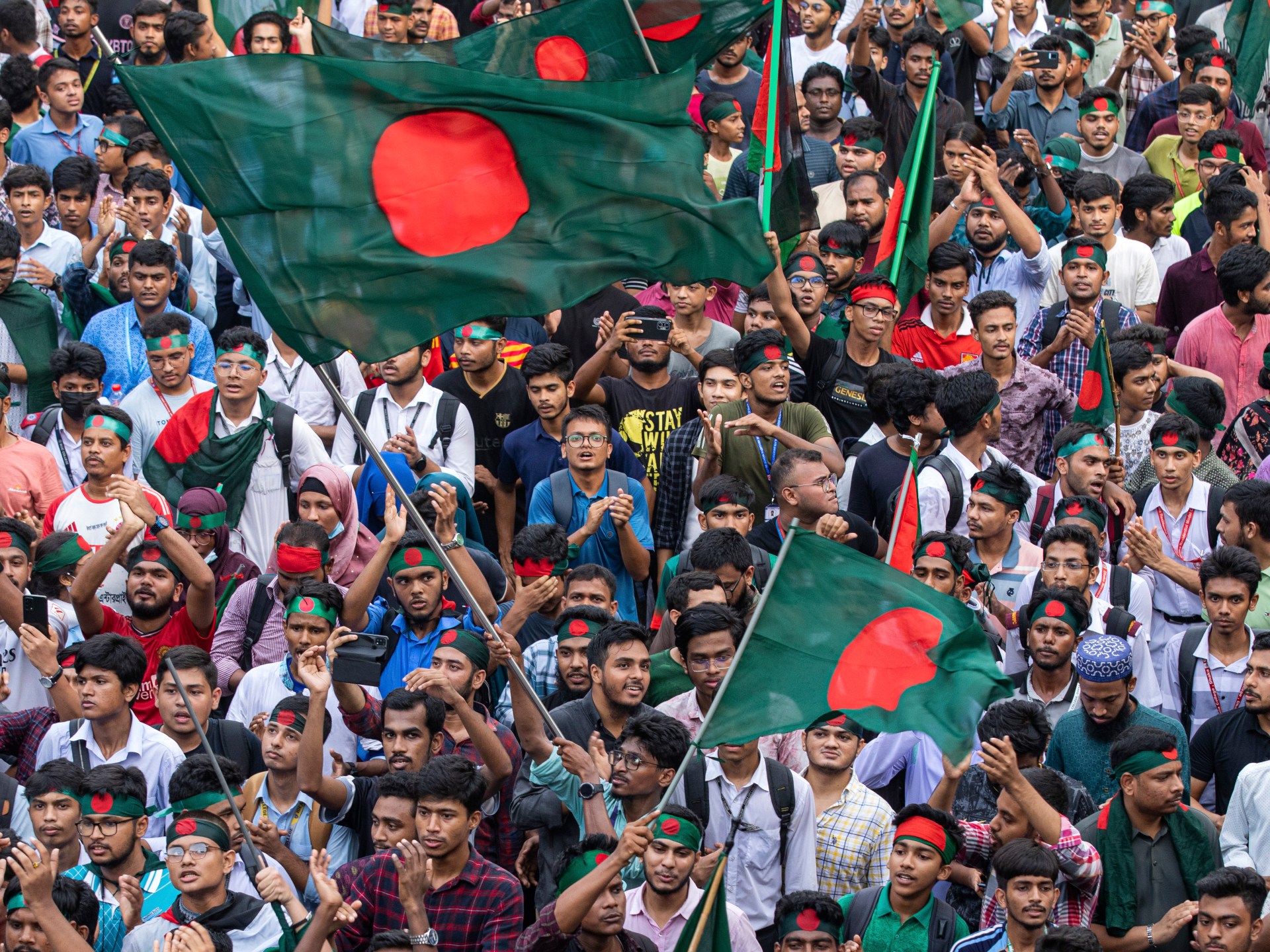

As Bangladesh prepares to hold its first elections since the overthrow of then-Prime Minister Sheikh Hasina and her Awami League party in 2024, neighbours India, Pakistan and China are watching closely.
Bangladesh is currently being governed by an interim administration led by Nobel laureate Muhammad Yunus. The two main parties competing for power in this month’s polls are the Bangladesh Nationalist Party (BNP) and the Jamaat-e-Islami (JIB), both of which began campaigning in late January.
- list 1 of 3‘Frightening situation’: Bangladesh elections haunted by political violence
- list 2 of 3Pakistan to boycott T20 World Cup match against India on February 15
- list 3 of 3‘Deeply insecure’: Why Bangladeshi minorities are scared ahead of elections
end of list
The Awami League, which has historically had close ties with India, has been barred from these elections because of its role in the brutal crackdown on student-led protests in 2024. Hasina, 78, currently in exile in India, was found guilty of allowing lethal force to be used against protesters, 1,400 of whom died during the unrest.
She was tried in absentia by the International Crimes Tribunal (ICT) in Bangladesh in November last year – and sentenced to death – but so far India has refused to extradite her.
Hasina has denounced the upcoming elections, telling The Associated Press news agency last month that “a government born of exclusion cannot unite a divided nation”.
Since her ousting, political analysts say, Bangladesh’s geopolitical positions have undergone a “paradigm shift”.
“Bilateral relations with India have witnessed a historic low in contrast to a warm rapprochement with Pakistan. Furthermore, strategic ties with China have deepened significantly,” Khandakar Tahmid Rejwan, lecturer of global studies and governance at the Independent University, Bangladesh, told Al Jazeera
Advertisement
“[Hasina’s] 15-year tenure was marked by several key features that defined the foreign and security policy of Dhaka in terms of external engagement. Significant among these features were developing a close and holistic bilateral tie with India; strategic negligence and diplomatic isolation in terms of bilateral relations with Pakistan; and maintaining a strong but calculated defence, trade, and infrastructure development partnership with China,” he said.
“This predictive and patterned alignment of Dhaka has now been reversed with respect to India and Pakistan or revised with respect to China,” he said.
So, how do India, Pakistan and China see the upcoming elections? Does the election outcome matter to these three nations?
Here’s what we know:
How are India-Bangladesh relations?
Until the toppling of Hasina, India largely viewed Bangladesh as an important strategic partner and ally with respect to maintaining security in South Asia.
India is also Bangladesh’s largest trading partner in Asia. Between April 2023 and March 2024, before Hasina’s ousting, India sold goods, including textiles, tea, coffee, auto parts, electricity, agriculture, iron and steel and plastics, worth $11.1bn and imported readymade garments, leather and leather products, among other items, worth $1.8bn.
Since Hasina fled to India, both countries have imposed restrictions on each other’s exports, from land and sea, due to ongoing tensions.
Over the decades since Bangladesh’s independence from Pakistan, which India supported in 1971, their relationship has had ups and downs depending on which political party is in power in Dhaka.
Hasina, who served as prime minister from 1996 to 2001 and again from 2009 to 2024, maintained close ties with India.
“In the last five to six years, India and Bangladesh have scripted a golden chapter of bilateral ties and given a new dimension and direction to our partnership,” India’s Prime Minister Narendra Modi stated in March 2020.
But opposition parties in Bangladesh often criticised Hasina for being “very weak” when it came to dealing with India.
According to the Indian daily Economic Times, in 2016, a key BNP adviser called on Hasina to scrap certain joint venture power-sharing projects with India since they could be detrimental to Bangladesh’s environment.
For decades, the BNP has also had an alliance with JIB, Bangladesh’s largest Islamist group that advocates for stronger ties with Pakistan, India’s archenemy, and that opposed Bangladesh’s independence from Pakistan in 1971.
Advertisement
Anti-India sentiment gained momentum in Bangladesh after Hasina’s ousting in 2024 and India’s refusal to return her to the country.
The relationship between the two countries has further soured over the past year, especially after the murder of Osman Hadi, a 2024 protest leader who was vocally anti-Indian, which also led to protests against India in Bangladesh late last year.
India has also alleged the ill-treatment of the Hindu minority under the interim government in Bangladesh.
Last December, a Hindu Bangladeshi man was lynched in the country’s Bhaluka region after being accused of making derogatory remarks against the religion of Islam. The incident took place amid widespread protests after Hadi’s death.
Also last month, the Bangladesh Cricket Board (BCB) requested that all of its team’s ICC Men’s Twenty20 World Cup matches scheduled in India be shifted to Sri Lanka.
But the International Cricket Council (ICC) responded to this demand last weekend by expelling Bangladesh from the tournament instead. In a show of solidarity, the Pakistan Cricket Board (PCB) swiftly threw its weight behind Bangladesh and, on Sunday, Pakistan said it would refuse to take part in its match against India, scheduled for February 15.
“India suffered a significant strategic loss when Hasina was ousted, and it has been very uncomfortable with the interim government. New Delhi felt that it [Bangladesh] was heavily influenced by Jamaat and other religious actors that, in India’s view, threaten its interests,” Michael Kugelman, senior fellow for South Asia at the Atlantic Council, told Al Jazeera.
However, amid ongoing tensions, India’s Prime Minister Narendra Modi and Yunus held their first meeting on the sidelines of a BIMSTEC summit in Bangkok, Thailand, in April last year. Vikram Misri, India’s foreign secretary, told reporters that Modi had “reiterated India’s support for a democratic, stable, peaceful, progressive and inclusive Bangladesh”.
Misri added that Yunus and Modi also discussed Hasina’s extradition. But to date, Hasina remains in India.
How does India view the upcoming election?
Analysts say the stakes are high for India.
“India is hoping that this upcoming election will produce a government that is willing to engage with India and will not be influenced by the types of actors that India feels threaten its interests,” Kugelman said.
It is unlikely that any new government will ignore worsening tensions with India, however, said Rejwan of Independent University, even if it includes JIB or other Islamist parties.
“Any government coming to power in Dhaka will find it difficult to neglect its largest neighbour and a regional power like India for the sake of mutual interest regarding nontraditional security threats, trade and food security, cultural and human ties,” he said.
“It is easy to give inflammatory and popular rhetoric against India when you are competing for votes, but when you are in government, the populist posture ultimately changes while dealing with a powerful and influential neighbour.”
Advertisement
Driven by New Delhi’s “Neighbourhood First” policy, which focuses on maintaining friendly relations with neighbours to safeguard its security, Indian policymakers have often stressed that the subcontinent needs to maintain a friendly relationship with Bangladesh.
Speaking at an event in the south Indian city of Chennai last month, India’s Foreign Minister S Jaishankar wished Bangladesh “well” for the upcoming elections. “We hope that once things settle down, the sense of neighbourliness in this region will grow,” he said.
Jaishankar also visited Dhaka in early January for the funeral of former Bangladeshi Prime Minister and BNP leader Khaleda Zia. He later wrote on X that he had conveyed his condolences on behalf of India to Khaleda’s son, Tarique Rahman, and “expressed confidence that Begum Khaleda Zia’s vision and values will guide the development of our [India and Bangladesh’s] partnership”.
Atlantic Council’s Kugelman said India is likely to be concerned from political and security standpoints if JIB wins the election, but would be “comfortable” with a BNP-led government.
“Today’s BNP no longer has an alliance with Jamaat, and the party has expressed its interests about wanting to engage with India,” he noted.
“I think that India will be ready to pick up the pieces of what has been a shattered relationship with Bangladesh … It obviously would have preferred the Awami League to be leading the next government. But India also recognises that the Awami League is not going to be a political factor for quite some time and is not going to try to push for ways to bring the Awami League back into the mix. It would accept a government led by the BNP and would be willing to work with it,” Kugelman added.
But with polls suggesting that the Jamaat and BNP are in a neck-to-neck race, India has been reaching out to both. In an interview this month, Jamaat chief Shafiqur Rahman revealed that an Indian diplomat had met him in December. And Indian high commissioner in Dhaka, Pranay Verma, met BNP leader Tarique Rahman on January 10.
How are Pakistan-Bangladesh relations?
Since Hasina’s ousting, Pakistan’s relationship with Bangladesh has grown warmer.
In 2024, Pakistani Prime Minister Shehbaz Sharif met Yunus twice, seeking to strengthen military and diplomatic ties. In September last year, Pakistani Foreign Minister Ishaq Dar visited Dhaka, seeking to “reinvigorate” a relationship that had been fractured since Bangladesh’s 1971 war of independence with Pakistan.
After India and Pakistan gained independence from British rule in 1947, Pakistan was created as a Muslim-majority state with two geographically separated regions, with Bangladesh being known as East Pakistan. In 1971, India supported Bangladesh’s liberation struggle in which the Pakistani military carried out atrocities, killing hundreds of thousands of people and allegedly raping an estimated 200,000 women. Bangladesh continues to seek an apology from Pakistan.
But according to analysts, Yunus’s interim government has been seeking to boost economic ties with Pakistan. Last February, the two nations resumed direct trade for the first time since the 1971 war under a new agreement negotiated by Yunus. Last week, they resumed direct flights after 14 years. Flight services had been stopped in 2012, with Dhaka citing security concerns. The two nations have also held military and defence dialogues over the past year.
“Pakistan primarily wants to develop closer bilateral ties by extending its defence and cultural diplomacy with Bangladesh,” Independent University’s Rejwan said. “This is because, in reality, given its own economic challenges, it has very little to offer to Bangladesh in terms of trade and investment. By doing so, it wants to heighten India’s security concerns to its east by developing close strategic ties with Dhaka.”
Advertisement
He added that while Pakistan has generally refrained from commenting on the ousting of Hasina directly, it does aim to take advantage of the ongoing political change in Bangladesh.
“[Pakistan] has tried to sideline the dark genocidal legacies of 1971 during the liberation war of Bangladesh by utilising the rising anti-India and Islamist sentiment in Bangladesh,” he said. “Moreover, it has also been the most active proponent of creating a Bangladesh-China-Pakistan trilateral regional arrangement, something about which Dhaka has expressed its reservations until now.”
How does Pakistan view the upcoming elections?
“Pakistan would clearly be the only regional player that would most prefer a Jamaat government,” he said.
“If we see a BNP-led government, I think, Pakistan would be OK with that,” he said.
But he warned that Islamabad would be eager to ensure that BNP does not try to patch Bangladesh’s ties with India.
“That would diminish Islamabad’s recent efforts to work towards a better relationship with Bangladesh.”
Still, Kugelman pointed out, “if Jamaat comes to power, there is a high chance that despite having close ties with Islamabad, they might also develop an understanding with New Delhi for their own interest rather than being overtly confrontational,” he said.
“BNP, in contrast, will keep all the channels of cooperation open with Pakistan but will not … tilt heavily on Islamabad. BNP’s policy is loud and clear; it’s Bangladesh first, which means national interest comes first, which means avoiding bandwagoning a foreign power and, rather, strategically hedging with a diverse range of external partners,” he added.
How are China-Bangladesh relations?
China’s influence in South Asia has been growing in recent years, and the country has been making efforts to boost military and economic ties with Bangladesh.
While China backed Pakistan during Bangladesh’s 1971 liberation war, since 1975, the two nations have been diplomatic partners, and Beijing has maintained cordial relations with Dhaka irrespective of the governing party.
Under Hasina, the two signed several economic agreements. That trend has continued under Yunus, whose administration has secured approximately $2.1bn in Chinese investments, loans and grants and encouraged more investment from the world’s second-largest economy in Bangladeshi infrastructure.
China has also pledged assistance for Bangladesh in managing the influx of refugees to Cox’s Bazar, where hundreds of Rohingya have fled persecution in Myanmar, placing pressure on Bangladesh’s infrastructure.
Last year, Yunus said he had discussed the possible purchase of fighter jets during his visit to China, though a deal has yet to be signed.
“China has been pragmatic and realistic about Hasina’s ouster,” Rejwan said. “Beijing warmly welcomed the formation of the interim government and was one of the first external partners to extend all kinds of support under the new political realities in Bangladesh.”
“Due to this Chinese charm offensive, the interim government in Dhaka further bolstered the existing bilateral cooperation with Beijing,” he added. “Indeed, it can be said that the Sino-Bangladesh relations were strong during Hasina’s regime and even stronger under the current interim administration, and are perceived to remain as so irrespective of whoever comes to power in Dhaka after the election,” he added.
How does China view the upcoming election?
China appears to be taking an active interest. Over the past year, Chinese leaders have been meeting leaders from Bangladesh’s political parties ahead of the elections.
In April last year, a senior Chinese Communist Party delegation met a delegation from the Jamaat. In June, Chinese Vice Minister of Foreign Affairs Sun Weidong met BNP secretary-general Mirza Fakhrul Islam Alamgir. In both these meetings, the upcoming elections were discussed.
Kugelman said China will watch the elections closely as it views Bangladesh as a key trade and investment partner.
“For Beijing, political stability in Dhaka is key due to its investments in the region. Beijing wants to ensure that the law-and-order challenges and other security concerns in Bangladesh would not impact Chinese interests on the ground,” he said.
Rejwan said, for China, the upcoming elections are also important since Bangladesh, for its strategic influence over South Asia, a region which has long been considered India’s sphere of influence.
“Unlike India, China has refrained from interfering in the domestic politics of Bangladesh and has historically maintained close ties with political parties like BNP and JIB even during the peak of Hasina’s rule,” he said.
But when it comes to the election outcome, Rejwan said, China has no explicit favourites.
“Whoever wins the majority, it will give its full support to that regime and, side by side, will maintain interaction with other major political parties. Beijing prefers inclusive rather than exclusive interactions with all the political players in Bangladesh,” he said.
“China’s primary challenge will be to prevent any US influence over the party that secures the majority in the polls and forms the government,” Rejwan added.
Related News
Trump’s ‘board of peace’: Who has joined, who hasn’t

Palestinians deny reports Israel halted refugee football pitch demolition
Power lines and power struggles: Unpacking Syria’s push towards unification