
Hamas is expected to hand over the body of the last Israeli captive held in Gaza in the coming days and has commented that it would be open to discussing “freezing” its weapons to facilitate entering the second phase of the ceasefire.
Meanwhile, Israeli Prime Minister Benjamin Netanyahu said on Sunday that the second phase would be challenging to achieve but that it could begin as soon as this month.
- list 1 of 4UN chief says Israel’s conduct of war in Gaza ‘fundamentally wrong’
- list 2 of 4Video: Five killed in Israeli strike on Gaza encampment
- list 3 of 4Dispute over Israeli plan for one-way opening of Gaza’s Rafah Crossing
- list 4 of 4Netanyahu will win again, because in Israel, ‘there is none like him’
end of list
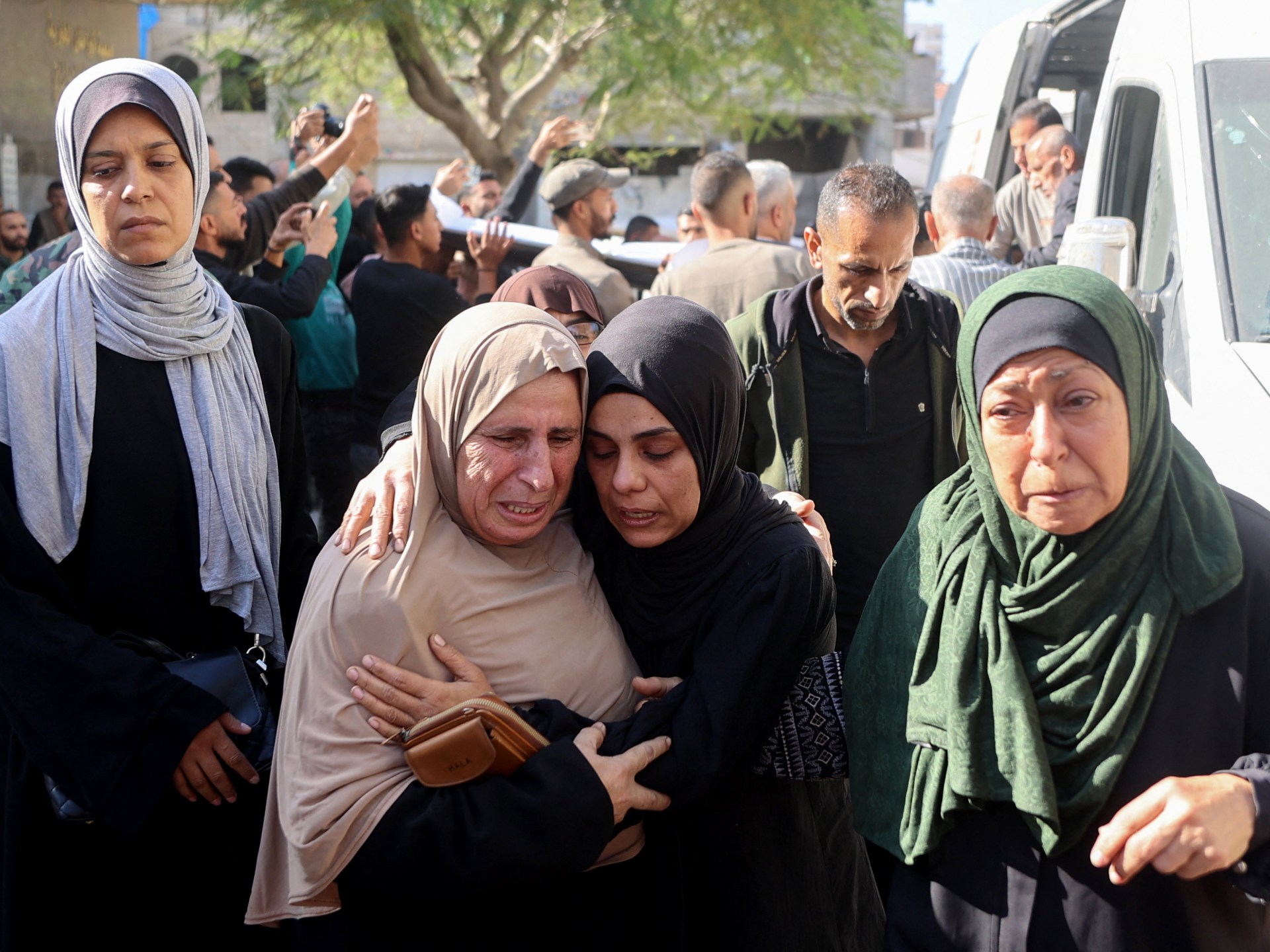
However, Israel has been attacking Gaza throughout the first phase, killing at least 360 Palestinians, and still restricts the entry of aid, with quantities allowed in far below what was agreed.
So, how has phase one of the ceasefire gone? And what are the chances of it continuing into phase two?
Here’s what we know.
Has Israel observed the ceasefire?
No.
Since the ceasefire began on October 10, Israel has broken it more than 590 times, killing at least 360 Palestinians, and sending the total death toll in Gaza from two years of attacks above 70,000.
Under the first phase – based on US President Donald Trump’s 20-point peace plan – Israel was required to halt its genocidal war on Gaza, pull back its troops, allow aid in, and exchange hundreds of Palestinian detainees for the remaining captives still held in Gaza.
Speaking a month after agreeing to the ceasefire, Israeli Prime Minister Benjamin Netanyahu said Israel’s war on Gaza “has not ended” and that Hamas “will be disarmed”.
Throughout Israel’s genocidal war on Gaza, Israeli officials have been pledging to “destroy” Hamas and claiming that Israeli bombardment, which has killed mostly civilians according to Israel’s own tally, was to achieve that.
Advertisement
Palestinians in Gaza remain in limbo and suffering daily attacks.
Has Israel withdrawn its troops?
Under the terms of the agreement, Israel initially pulled its troops back behind what it called the “yellow line”.
Running around the land edges of the Strip, the poorly demarcated yellow line separates the areas of Gaza controlled by the Israeli army and those controlled by Hamas.
Hamas accuses Israel of pushing the yellow line further into Gaza “daily”, displacing those who find themselves on the wrong side and killing Palestinians, including children, approaching the unclear boundary.
Has Israel allowed aid in?
A full Israeli blockade on Gaza this year led to an engineered famine that was recognised by the UN-backed Integrated Food Security Phase Classification (IPC) in Gaza City in August.
Since the ceasefire, Israel has allowed slightly more aid in, although far less than Gaza’s needs and what the agreement stipulated.
Aid agencies are reporting that the situation remains desperate, despite cases of malnutrition starting to slow.
UNICEF and partners in October identified nearly 9,300 children less than five with acute malnutrition, five times the level reported during a previous ceasefire in February.
“A big portion of the goods coming in is commercial [not humanitarian] – meaning that big aid agencies, including UNRWA, aren’t getting there,” said Tamara Alrifai, the director of external relations for Gaza’s principal aid agency, UNRWA.
Is Israel really committed to this ceasefire?
Considering Israel’s past actions – including unilaterally breaking a ceasefire earlier this year and Netanyahu saying the war isn’t over – it is uncertain.
According to many Netanyahu critics, much of the genocide Israel unleashed on Gaza has been shaped by his own political circumstances.
But that makes him more reliant on the Trump administration, which supports the ceasefire, to protect him.
“Israel has never had a leader in a weaker position, so the US will never have a better chance of pushing their deal through,” Yossi Mekelberg, a senior consulting fellow at Chatham House, said, listing the threats to the PM that Trump’s support might save him from.
Netanyahu has petitioned Israel’s President Isaac Herzog to grant him a pardon in his ongoing corruption trial. Trump has also asked Herzog to pardon Netanyahu.
Netanyahu can also use Trump as an excuse if his far-right government members are angered by an end to the war on Gaza.
“Netanyahu can always shrug and say, ‘it’s not me, it’s Trump,'” Mekelberg said.
What’s planned for phase two?
Phase two of the deal concerns Gaza’s post-war governance. The most detailed framework so far has been the US-backed plan, now endorsed in part by the UNSC.
Advertisement
The plan sets out a transitional phase in which Palestinian technocrats – not political factions – would run day-to-day governance.
Their work would be overseen by a multinational “Board of Peace”, and supported by an International Stabilisation Force tasked with security and demilitarisation. This is meant to allow for the reconstruction of Gaza and stop a return to armed conflict.
But Hamas and other Palestinian groups have rejected the idea of foreign guardianship over Gaza.
They were also opposed to the UNSC resolution, saying it “paves the way for field arrangements imposed outside the Palestinian national will”.
So, could a final deal be likely?
Other than the still escalating death toll in Gaza, nothing is certain.
Netanyahu, according to his critics, is an opportunist to his core, who is still balancing several competing threats at home.
Meanwhile, Trump and his inexperienced political negotiators drawn from outside of the US’s diplomatic core find themselves negotiating a settlement to both the genocide in Gaza and the war in Ukraine.
And, whatever deal is agreed upon, Israel is almost certain to continue to attack Gaza whenever it likes, much as it does in the occupied West Bank, Lebanon, Syria, and elsewhere in the region.
A Palestinian state also does not look any closer to fruition.
Mekelberg points out that with so many potentially shifting factors, including Israel’s domestic politics, it is hard to know if a final deal is achievable.
“It’s Netanyahu,” Mekelberg said.
“His corruption cuts through everything, from his legitimisation of the far-right at home to the way he’s approached the conscription of the ultra-Orthodox [Jews in the Israeli military]. It’s too messy. There are no lines through.
“Add to this a US president that is also unpredictable, and it’s close to impossible to predict how this will play out.”
Related News
Infantino’s ‘Peace Prize’ to Trump raises questions about FIFA’s neutrality

Are tech companies training their AI with private data?
Israeli attack kills two children in southern Gaza despite ceasefire