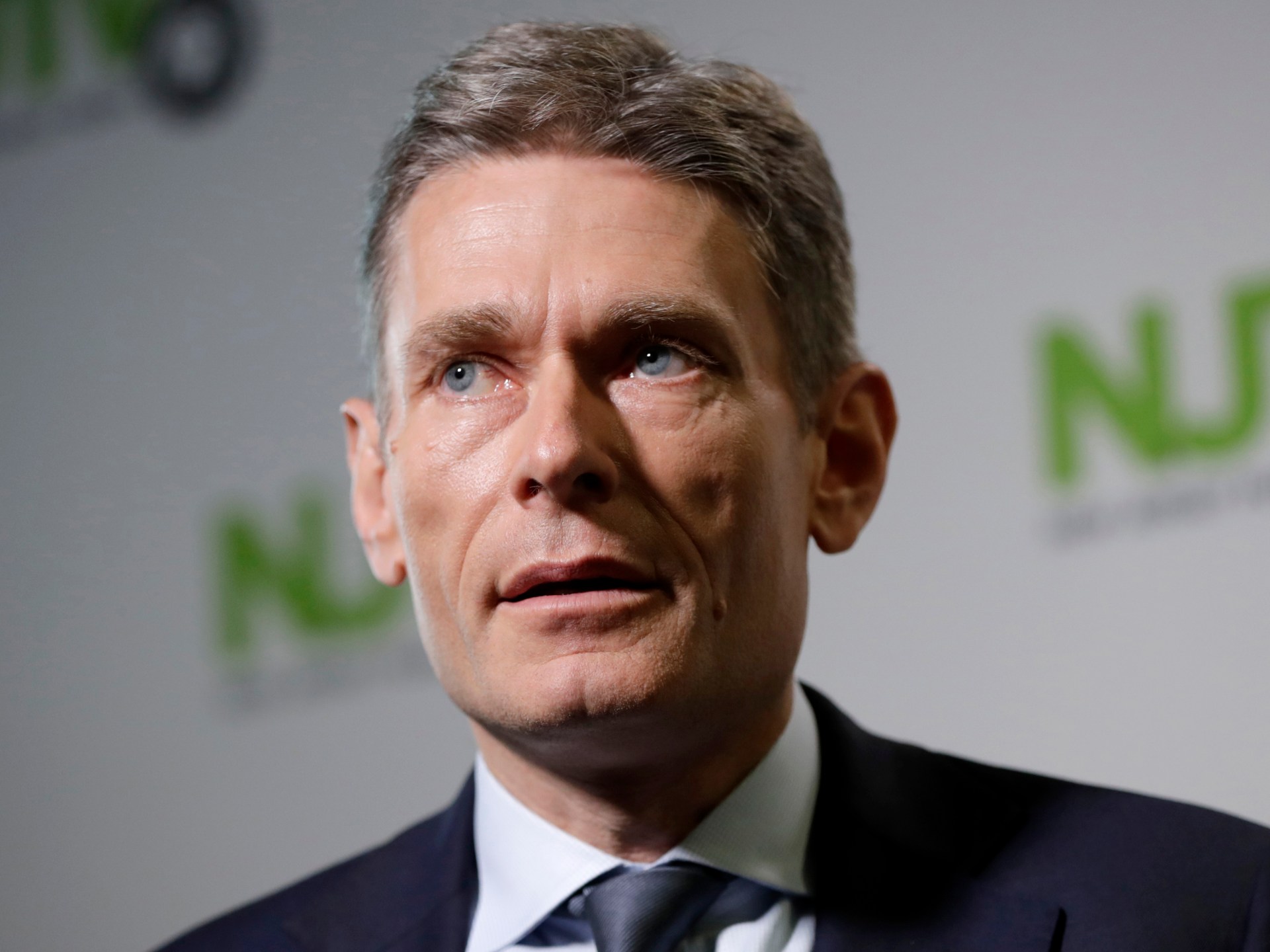

Washington, DC – A super PAC linked to the American Israel Public Affairs Committee (AIPAC) has made its first major venture into the United States midterm elections.
But this time around, the pro-Israel lobby group is not targeting a progressive candidate pushing to reset US-Israel policy, but a so-called “moderate” Democrat who tepidly questioned Washington’s unconditional military support amid the genocidal war on Gaza.
- list 1 of 3After backing Israel, Iran’s self-styled crown prince loses support
- list 2 of 3AIPAC slams Trump ally Marjorie Taylor Greene over Gaza genocide remark
- list 3 of 3Advocates hail ‘historic’ progress after US Senate vote on arms to Israel
end of list
The $2.2m spending by the United Democracy Project (UDP) targeting former US Representative Tom Malinowski in advance of the Democratic primary in New Jersey on Thursday comes as polls have consistently shown surging dismay among Democratic voters over unwavering US support for Israel.
Amid shifting views, critics see the spending strategy as a wider message to candidates as they prepare for party primaries in the months in the run-up to the 2026 midterm elections, which will determine the makeup of the US Senate and House of Representatives.
“It shows that they are very concerned, obviously, about the shifting perspective of especially Democrats on funding for Israel, and they’re very, very keen to keep Democrats elected who are out of touch with the Democratic electorate more broadly,” Sadaf Jaffer, a former member of the New Jersey General Assembly, who has herself been a critic of Malinowski’s past refusal to take a harder line on Israel, told Al Jazeera.
Candidates in the 11-way primary are running to represent a largely suburban district in central New Jersey considered increasingly Democratic-leaning. The special election is scheduled for April 16.
Advertisement
However, UDP’s strategy appears focused on Malinowski, neither AIPAC nor its super PAC have explicitly endorsed Tehesha Way, the former lieutenant governor of New Jersey, although she has won the endorsement of another pro-Israel lobby group, the Democratic Majority for Israel (DMFI).
“It may be [AIPAC’s] sense is that this is a way to scare those in the middle of the road, who have started to express some concerns about what’s going on and the funding that’s being sent to Israel,” Jaffer said.
“It seems very excessive … but it may be an investment in trying to intimidate others who are watching,” she said.
A familiar strategy
Parts of the strategy have become familiar. In the US elections in 2024, the UDP poured about $35m into party primaries, with the biggest buys aimed at scuttling Democratic candidates who called for cutting off aid to Israel.
That included a combined $24m against progressive congressmembers Jamaal Bowman and Cori Bush, who both lost their races to opponents running to their right.
Like the messaging targeting those candidates, the advertisement campaign against Malinowski has not specifically referenced Israel; instead, it focuses on more domestic issues, including Malinowski’s past stock trades and his 2019 vote in support of an annual Department of Homeland Security (DHS) funding bill.
The line of criticism comes as support for US immigration, and the DHS sub-agency ICE, has tanked among Democratic voters amid the administration of US President Donald Trump’s mass deportation drive.
Usamah Andrabi, the communications director of Justice Democrats, an organisation that supports progressive candidates regularly targeted by AIPAC, called the approach particularly disingenuous, noting that AIPAC had previously endorsed Malinowski despite the DHS funding vote.
During his previous three runs for Congress, Malinowski received more than $378,000 from pro-Israel groups, including those affiliated with AIPAC.
“It’s interesting, as always, to see that again, you’re not going to see a single television ad actually talking about their, quote ‘single issue’: Israel,” he told Al Jazeera.
“Tom Malinowski is no champion for progressive values or for the Palestinian people, but he is not going to ask ‘how high?’ when they say, ‘jump’,” Andrabi told Al Jazeera. “And that’s not enough for AIPAC. They truly demand unconditional support for their policies.”
Malinowski had previously served as Washington director of Human Rights Watch, which, during his tenure, lobbied for US aid not to be used in Israeli abuses of Palestinian rights.
Advertisement
But as a congressman from 2019 to 2023, Malinowski took a distinctly divergent path in Congress, including petitioning against conditioning US aid to Israel.
Malinowski, who also served as assistant secretary of state for democracy, human rights, and labour under former President Barack Obama, has further enraged pro-Palestine advocates by suggesting that using the terms “genocide” and “apartheid” to describe Israel’s approach towards Palestinians in Gaza and the occupied West Bank fuels anti-Jewish sentiment in the US.
Nevertheless, the candidate has become a vocal critic of AIPAC’s approach in advance of Thursday’s vote, condemning the “dark-money” influence on the race.
“I committed one sin in their minds,” Malinowski told a small group of supporters in mid-January, as reported by the New Jersey Globe news site.
“I was not willing to tell them that I would unconditionally, unquestionably, blindly support any request for assistance that Prime Minister Netanyahu of Israel might make. That position puts me in the mainstream, not just of all Americans, but of the Jewish and pro-Israel community in this country,” he said.
‘A sour taste’
The UDP’s spending has also been condemned by other pro-Israel lobbying groups, including J Street, which supports Israel, but has staunchly criticised providing a “blank cheque” to the government of Israeli Prime Minister Benjamin Netanyahu.
“It weakens bipartisan support, alienates the next generation – Jewish and non-Jewish alike – and ties Israel’s fate to the most corrosive elements of American politics,” Jeremy Ben-Ami, the president of the group, which has endorsed Malinowski, said in a January post on Substack.
AIPAC and UDP did not respond to Al Jazeera’s requests for comment on the spending initiative’s objectives.
But Beth Miller, the political director of Jewish Voice for Peace Action, which advocates for Palestinian justice through US policy, saw the attack on Malinowski as in line with AIPAC’s increasing embrace of the Republican Party, which remains staunchly pro-Israel. She pointed to UDP’s history of relying on donations from wealthy conservatives to influence Democratic primaries.
Former assembly member Jaffer noted that the super PAC had not targeted Analilia Mejia, a progressive in the race who has won endorsements from US Senator Bernie Sanders and Representative Alexandria Ocasio-Cortez.
Some analysts have suggested AIPAC may see a win-win approach in targeting Malinowski, either leading to the success of a candidate like Way, who led the New Jersey-Israel Commission and has been embraced by many right-wing Israeli news outlets, or a candidate like Mejia, who could be seen as more vulnerable against a Republican in the general election.
Miller said the spending “should show every other candidate that there is no middle or centrist lane that will protect them from AIPAC spending attacks”.
“Democratic candidates watching the NJ special election should learn that the politically and morally correct move is to fully embrace Palestinian rights and demand an end to US complicity in Israel’s apartheid and genocide,” she told Al Jazeera.
Advertisement
Both Andrabi and former assemblywoman Jaffer, meanwhile, saw potential for the approach to backfire, particularly as AIPAC has become an increasingly toxic brand in some segments of the Democratic party.
“It’s definitely the most I’ve heard people who are not particularly interested in Israel-Palestine talking about AIPAC,” Jaffer told Al Jazeera, adding that outside spending in the race has left a “sour taste” for some New Jersey residents.
Andrabi added that it was “interesting to see the moderates of the world and the corporate Dems becoming willing to comment on [AIPAC] now that one of their own is getting eaten alive by this spending”.
That comes as AIPAC and UDP have amassed a $100m war chest heading into 2026.
“What [AIPAC] is really doing is expanding the base of people who don’t like AIPAC and who will vote against candidates for being supported by AIPAC,” he said.
Related News
Epstein email reveals plan to access Libya’s frozen state assets

Explosion in Iran’s Bandar Abbas caused by gas leak, official says
Trump orders federal agents to stay away from protests in Democrat cities