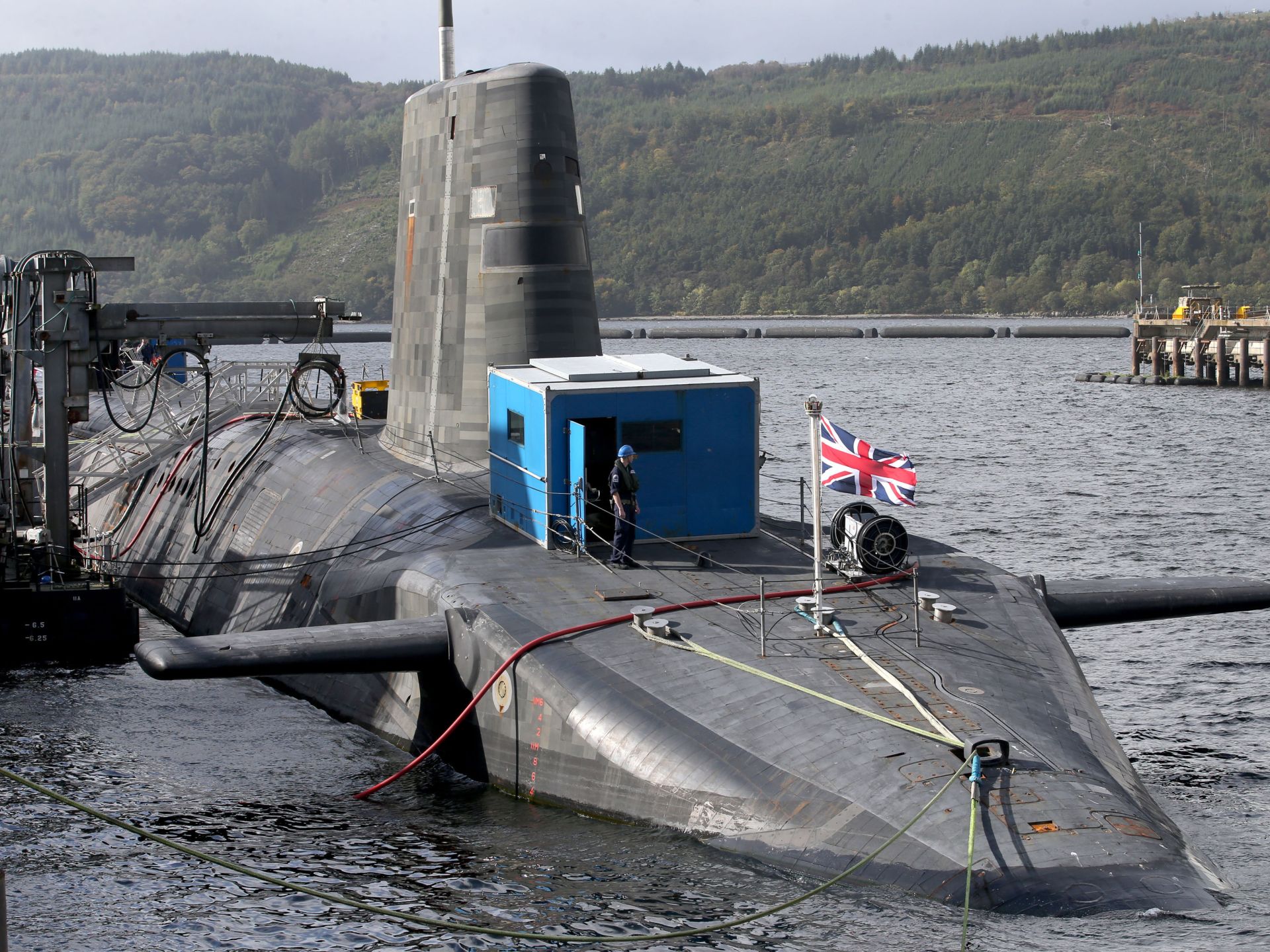

The United Kingdom has simultaneously deployed three of its four nuclear deterrent submarines at sea for the first time in five years, The Times reported on Wednesday.
At least one of the vessels – known as Vanguard-class submarines – was said to be armed with ballistic missiles which carry nuclear warheads.
- list 1 of 3France to increase nuclear warheads, lend nuclear aircraft to Europe allies
- list 2 of 3Could Russia hit northern Europe if it gained control of Arctic’s Bear Gap?
- list 3 of 3Russian nuclear-powered submarine fires missiles during Pacific drills
end of list
The report named the three submarines at sea as HMS Vanguard, HMS Vigilant and HMS Vengeance, with the fourth, HMS Victorious, currently undergoing maintenance.
A navy source quoted by The Times described the deployment as “unusual”, without elaborating.
The UK continuously deploys at least one of the four submarines as a security guarantee.
The deployment has raised questions over whether the UK has changed its defence posture after Defence Secretary Wes Streeting warned last week that Britain should be prepared for war.
Here’s what we know:
Has this happened before?
The last time three submarines were at sea was more than five years ago, according to The Times.
Navy Lookout, the UK’s leading independent publication on the Royal Navy, says one submarine carrying ballistic missiles has been at sea without interruption since 1969.
It said the second vessel was believed to be preparing to relieve a patrol boat, while the third was likely conducting sea trials or work-up activity.
Last year HMS Vanguard patrolled the seas for 200 days, just a week shy of the longest known submarine deployment of 207 days, carried out by HMS Victorious in 2021.

What has the UK government said?
According to Sky News, a spokesperson for the defence ministry said the country’s nuclear deterrent is the “cornerstone of our national security, protecting the UK and our NATO allies every moment of every day”.
Advertisement
“We remain the only European ally to commit its nuclear deterrent to the defence of NATO. This means that all NATO allies already benefit from the protection of our nuclear deterrent,” the spokesperson added.
Last week, British and French fighter jets flew together in their first joint exercise involving France’s airborne nuclear capability.
The French armed forces ministry said British RAF Typhoon fighters escorted the French jets, simulating a nuclear strike.
France’s Armed Forces Minister Catherine Vautrin said that having “independent nuclear forces does not preclude coordination”.
“Our nuclear cooperation with the United Kingdom continues to deepen,” she added.
The UK’s Streeting said that in an “increasingly dangerous world, our adversaries should be in no doubt”.
“The United Kingdom and France stand together in their commitment to European security and to maintaining the deterrence that has helped preserve peace for generations,” he added.
What are the UK’s ‘war readiness’ plans?
On Saturday, Streeting wrote in the Telegraph newspaper that Britain must be ready for war within 1,000 days.
“Our adversaries’ willingness to harm us is not new. What has changed is their capacity. By 2030, their force strength and war economy could put them in a position to attack,” Streeting wrote.
“That gives us a little over 1,000 days to complete our mission: to be ready with our allies to fight and win. This Government will make sure it is mission accomplished,” he said.
His message followed last week’s launch of the government’s “Be Ready” campaign, which called on households to store three days’ supply of tinned food and water bottles, cash and a wind-up radio in case of a cyberattack or a weather event which disrupts infrastructure.
The warning also followed reports that Russia has been using fishing trawlers to track and spy on the UK’s undersea cables.
Related News

Colombia peace tribunal charges ex-FARC members with anti-Indigenous crimes
Why do Iran’s oil ‘intermediaries’ owe the government billions?

Iraq parliament approves al-Zaidi’s cabinet amid growing economic concerns