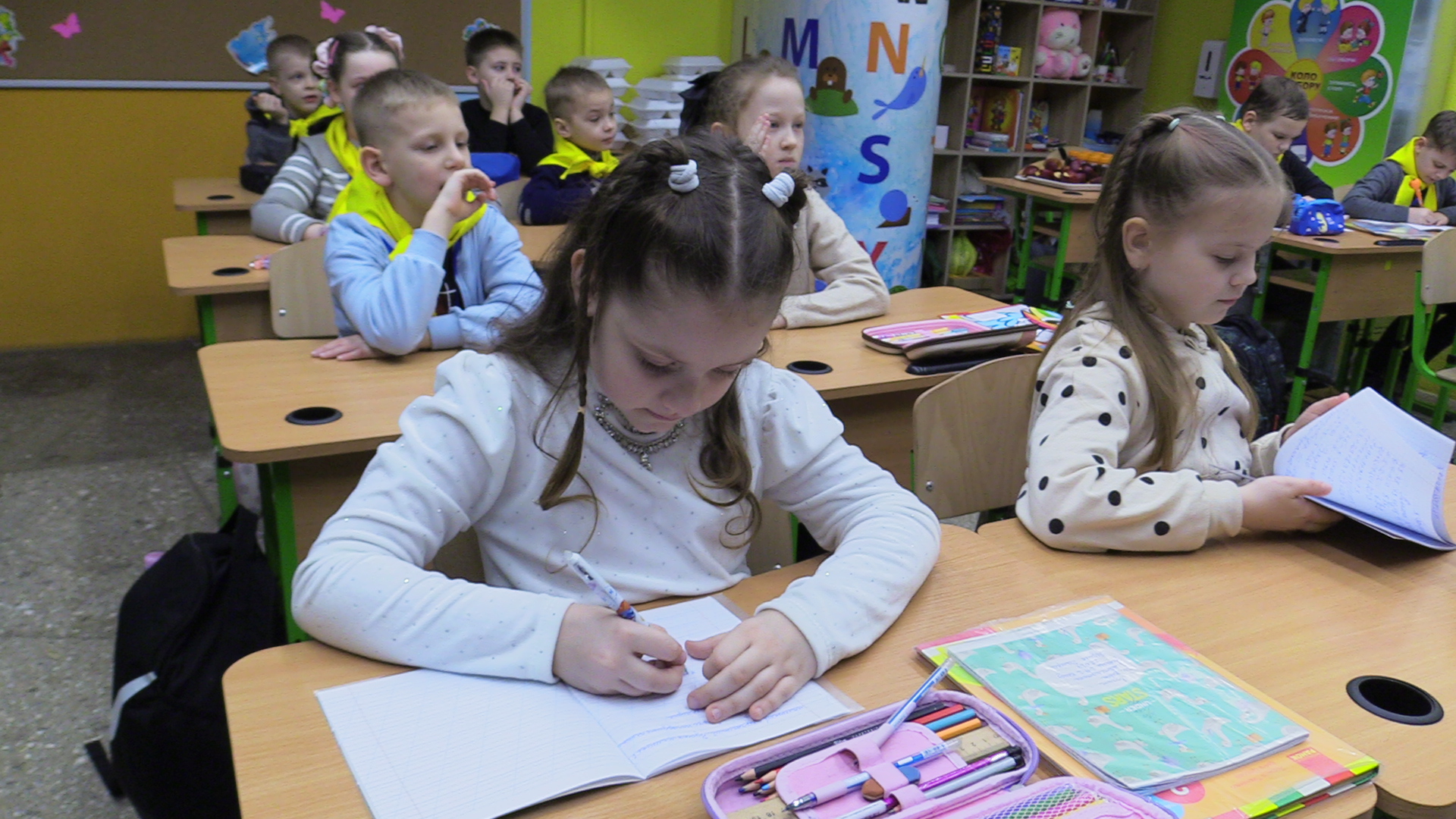

Kharkiv, Ukraine – Maksym Trystapshon takes the subway to work. But the school head teacher and English teacher from Kharkiv, Ukraine’s second-largest city that sits only 40km (25 miles) from the Russian border, does not need to leave the subway station to see his students.
His school is right inside the Oleksandr Maselsky station on Kharkiv’s southeastern outskirts, a stone’s throw away from roaring trains and hurrying commuters.
- list 1 of 4Ukraine eyes money and tech in return for Middle East drone support
- list 2 of 4Ukraine to help down Iran’s drones: How Russia’s war rewrote the playbook
- list 3 of 4Ukraine records first territorial gains since 2023 amid Russian army woes
- list 4 of 4Six killed in attacks on Ukraine as EU extends sanctions against Russians
end of list
It used to be a draughty hallway on the way out of the station that closed down three decades ago. Now, it is a small “metroschool” with flimsy white plastic doors that let in and out almost 2,000 schoolchildren and preschoolers who study in four cramped classrooms in shifts seven days a week.
“You don’t have to think about the war, it’s a safe place, and you only think about teaching children, not the problems that surround us,” Trystapshon, bespectacled and burly, told Al Jazeera minutes before three dozen third-graders stormed into his classroom.
“Safety” is the mantra even the youngest students repeat here.
“I like studying here, like meeting friends, because it’s safe,” Alisa, nine, told Al Jazeera.

Since 2022, more than 100 children – and about 3,000 civilian adults – have been killed by Russian artillery, multiple-launch rocket systems, drones and missiles in the Kharkiv region.
In recent days, a Russian missile struck yet another apartment building, killing a nine-year-old boy and a 13-year-old girl – along with nine adults.
Advertisement
Air raid sirens howl in Kharkiv several times a day, and recently, a new danger emerged – Russian drones with kilometres-long optic fibre that makes them immune to electronic jamming.
Kharkiv’s subway system of 30 stations that served the city with a pre-war population of 1.4 million turned out to be the safest and most accessible place for schools.
Eight operate already, along with 10 schools in basements and bunkers in the Kharkiv region serving some 20,000 students, while all regular schools have been closed.
Under the pale light of luminescent bulbs, children study, communicate and play with peers instead of “attending” classes online in their apartments or houses that could be hit by drones or missiles at any moment.
White plastic boxes with their lunches are delivered daily – along with cauldrons of uzvar, a vitamin-rich beverage of simmered dried fruit and berries.
“This is safer than sitting in front of a screen at home alone,” Oksana Barabash, a 39-year-old homemaker, told Al Jazeera after dropping off her son Nazar, a first-grader who had never attended kindergarten because of the COVID-19 pandemic and the war. “I never had a single doubt about enrolling him here.”
Not all parents were that brave initially.
“It was hard to convince parents,” city education department spokeswoman Daria Kariuk-Vinohradova told Al Jazeera.
The school’s safety proved irresistible – these days, “there’s a waiting list of parents wanting to enrol their kids here”, she said.
A bus collects the children who live in the district above the school.
Named Industrialny (Industrial), the area in Kharkiv’s southeast is relatively safe in comparison with northern districts that are closer to the Russian border.
But it cannot escape attacks.
In August 2025, a drone flew into an apartment building in the district, killing an 18-month-old girl and a 16-year-old boy along with five adults.
That is why “kids don’t wait at bus stops” that can be hit by drones or missiles, Kariuk-Vinohradova said.
From day one of its full-scale invasion, Russia struck civilian buildings, including hospitals, maternity wards, kindergartens and schools.
“They wanted to leave us without our past, history, culture, knowledge,” Ukrainian President Volodymyr Zelenskyy wrote on Facebook on September 1, 2022, the first day of term in Ukraine, next to photos of ruined schools.

In June 2022, fewer than four months after Russia’s full-scale invasion began, a 16-year-old school graduate named Valeriya came to the ruins of her Kharkiv school wearing a red, fluffy ball gown intended for her prom night, and her classmates danced a waltz on the school’s basketball court.
Advertisement
In occupied areas, schools became concentration camps.
In early 2022, the entire population of the northern village of Yahidne – 368 people, including six dozen children – was herded to the school’s basement for 27 days with next to no food or water.
Seventeen villagers died there; their bodies remained next to the living for days until the invaders let them be removed and buried.
By early 2026, more than 4,000 schools, kindergartens and universities have been damaged or destroyed throughout Ukraine, officials said.
Among them are more than two-thirds of Kharkiv’s schools – 134 out of 184, the city’s top education official, Olha Demenko, said in January.
“Some will have to be rebuilt from scratch,” she said.
Their curriculum includes a new discipline titled “Defence of Ukraine” that includes lessons in first aid and survival skills.
The children’s socialisation has another aspect.
Despite being the cradle of Ukrainian nationalism and literature and Soviet Ukraine’s first capital between 1919 and 1934, by the 1970s, Kharkiv had almost exclusively switched to Russian.
The language is still ubiquitous here and is often heard in shops, banks and hospitals despite the 2019 law that restricts its use in the “public sphere”.
Schools often prove to be the only place where children can study and practise Ukrainian.
“I’m an old-timer, I keep speaking Russian, but my grandchildren need to speak Ukrainian,” Anna Mikhalchuk, a 67-year-old retired factory worker, told Al Jazeera, as she waited for her granddaughter sitting on a bench inside the subway station.
Related News

Trump says Iran war to end ‘soon’ as Israel claims no time limit
Republic of Congo votes in election that could extend Sassou’s 42-year rule
Hezbollah promises to confront US, Israel over Khamenei killing