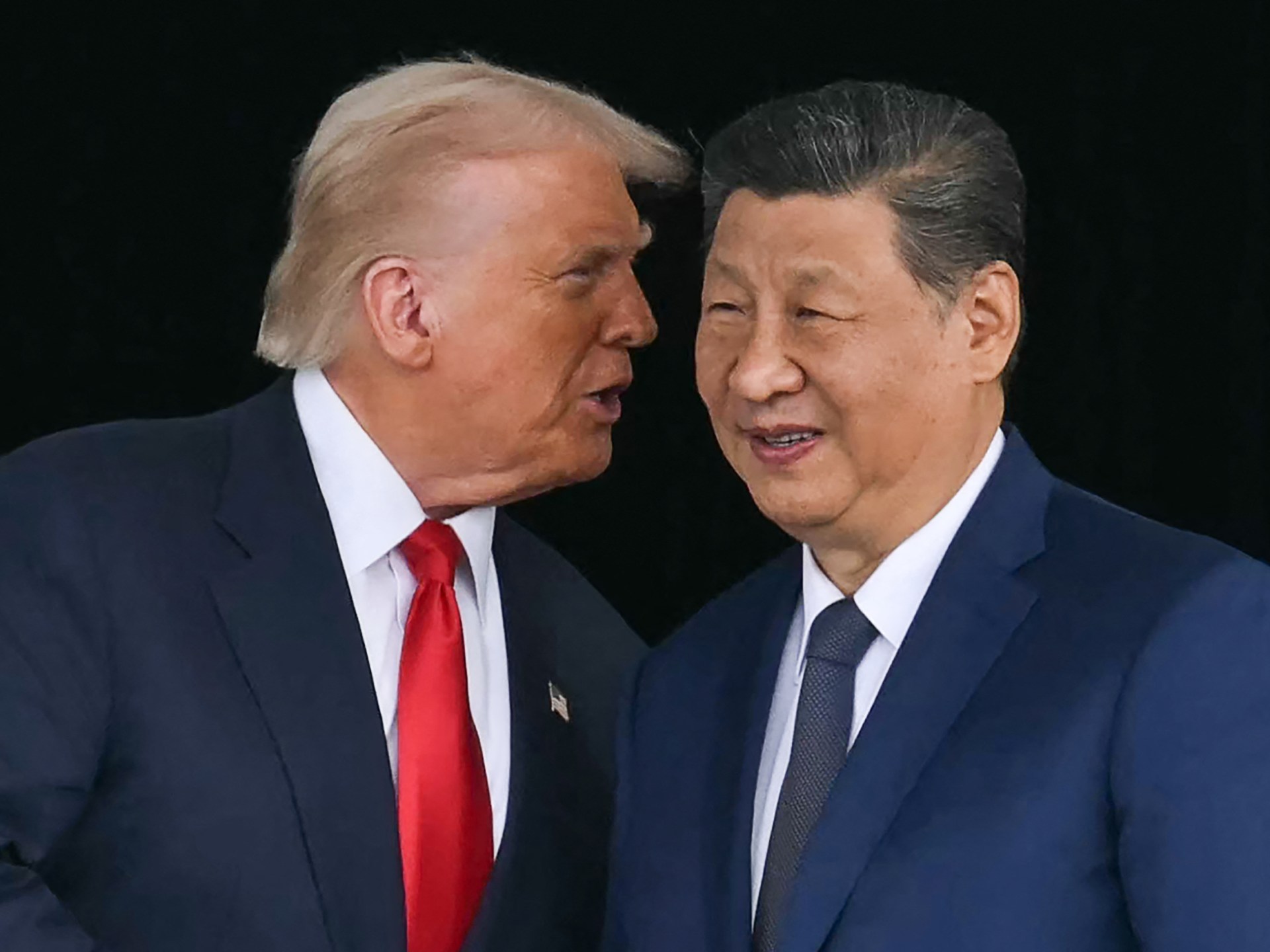

Top officials from the United States and China have launched a new round of talks before a summit between their presidents, Donald Trump and Xi Jinping, expected in Beijing later this month.
US Treasury Secretary Scott Bessent met Chinese Vice Premier He Lifeng on Sunday at the Paris headquarters of the Organisation for Economic Cooperation and Development to hash out trade issues between the world’s two largest economies.
- list 1 of 4Trump says ‘many countries’ will send warships to Hormuz amid Iran blockade
- list 2 of 4The Take: Why China’s citizens are rooting for Iran in the US-Israel war
- list 3 of 4Oil stays above $100 a barrel amid Iran’s stranglehold on Strait of Hormuz
- list 4 of 4Could Iran be using China’s highly accurate BeiDou navigation system?
end of list
The discussions are expected to focus on shifting US tariffs, the flow of Chinese-produced rare earth minerals and magnets to US buyers, the US’s high-tech export controls and Chinese purchases of US agricultural products.
China and the US fought a bruising trade war for much of 2025, with reciprocal tariffs reaching triple digits at one point and export restrictions threatening to wreck global supply chains for critical minerals.
Tensions cooled after Trump met Xi in Busan, South Korea, in October, but new US probes into Chinese industrial overcapacity and forced labour announced on Wednesday threaten more instability.
China’s commerce ministry said in a statement on Friday that officials in Paris would “conduct consultations on economic and trade issues of mutual concern”, without giving further details about the content of the talks.
Bessent, who was to be accompanied by US Trade Representative Jamieson Greer, said in a statement on Thursday that “economic dialogue” between the countries “is moving forward”.
The Paris gathering, which is due to last two days, is seen as setting the stage for Trump’s meeting with China’s Xi. Washington has said Trump will visit China from March 31 to April 2, although Beijing has yet to confirm those dates in line with its usual practice.
Advertisement
Trump and Xi could potentially meet three times this year, including at a China-hosted APEC summit in November and a US-hosted G20 summit in December that could yield more tangible progress.
The diplomatic engagements between the US and China come at a tumultuous time for the global economy, as energy markets are sent spinning from the impact of the US-Israeli war with Iran.
Beijing is a close partner of Tehran and has condemned the killing of Iran’s former supreme leader Ayatollah Ali Khamenei, but it has also criticised Iranian strikes against the Gulf states.
The US-Israeli war on Iran will likely come up at the Paris talks, especially in reference to the spike in oil prices and the closure of the Strait of Hormuz, through which China gets 45 percent of its oil.
Bessent on Thursday night announced a 30-day waiver of sanctions to allow the sale of Russian oil stranded at sea in tankers, a move to raise supplies.
On Saturday, Trump urged other nations to help protect shipping in the Strait of Hormuz, after Washington bombed military targets on Iran’s Kharg Island oil loading hub and Iran threatened to retaliate.
“Meaningful” progress in Sino-US economic cooperation could restore confidence to an increasingly fragile global economy, China’s state-run Xinhua news agency said in a commentary on Sunday.
US-China trade analysts say that with little time to prepare and Washington’s attention focused on the US-Israel war on Iran, prospects for a significant trade breakthrough in the Paris talks are limited.
“Both sides, I think, have a minimum goal of having a meeting, which sort of keeps things together and avoids a rupture and re-escalation of tensions,” Scott Kennedy, a China economics expert at the Center for Strategic and International Studies in Washington, DC, told the Reuters news agency.
Related News
Elementary school in Tehran hit, Iran’s foreign ministry says
War against Iran: How far will it go?
Which countries have seen the highest petrol prices since the Iran war?