A vote for continuity? What to know for Costa Rica’s presidential election
 01 February 2026
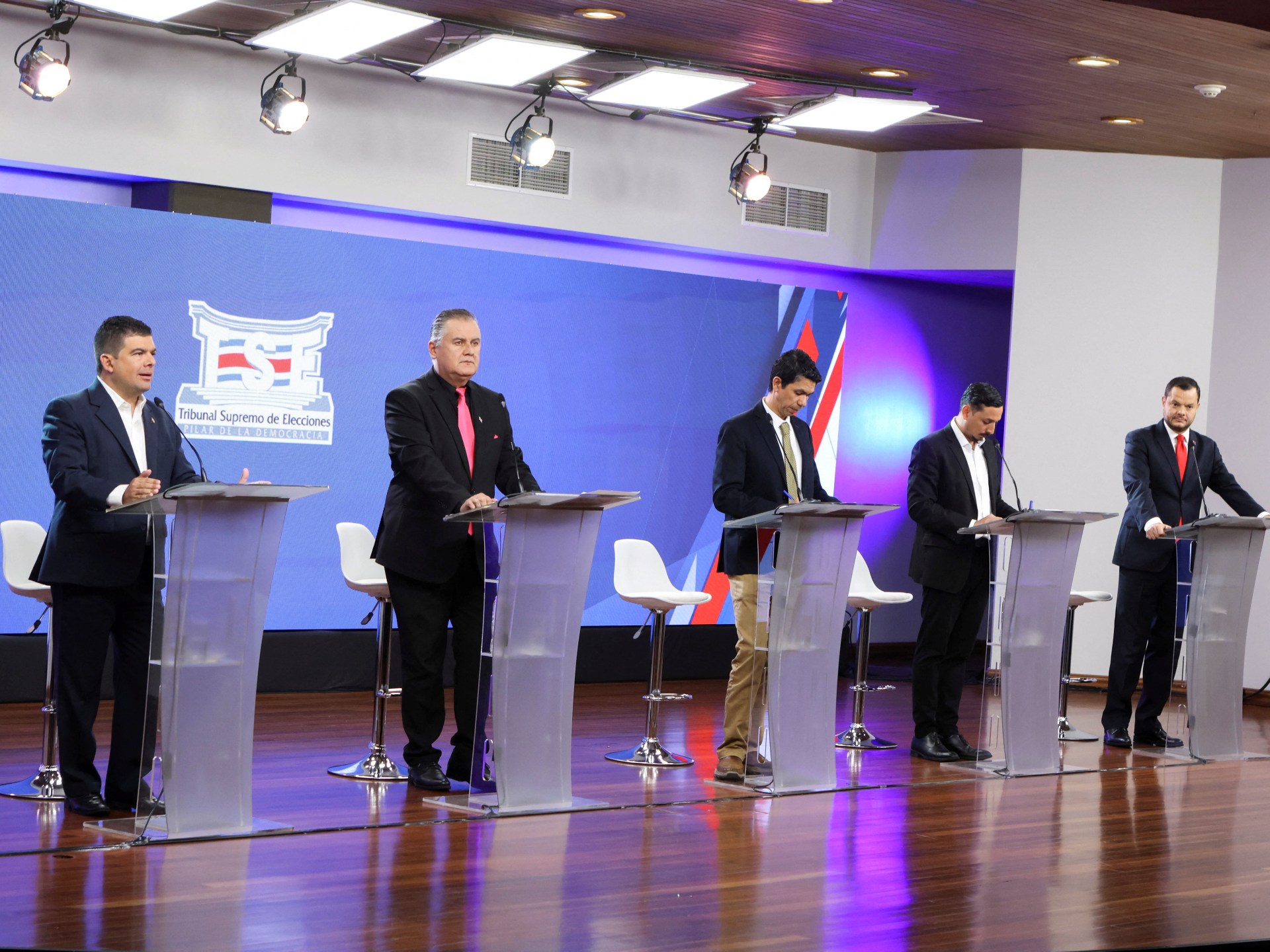

The ruling party of Costa Rica is hoping to extend its control of the presidency for another four years in the country’s upcoming election, as voters express apathy about their options and opposition parties struggle to mobilise support.
On Sunday, millions of Costa Ricans will head to the polls to vote. But while the forecast looks promising for the centre-right populist movement championed by outgoing President Rodrigo Chaves, the election conceals a wild card: a large number of undecided voters.
- list 1 of 3All the big elections to look out for in 2026
- list 2 of 3Prominent Nicaraguan dissident shot dead in exile in Costa Rica
- list 3 of 3Chaves Robles becomes first Costa Rican president to face loss of immunity
end of list
As many as a third of Costa Ricans have yet to settle on a presidential candidate.
Still, Chaves’s movement appears on track to secure enough votes to avoid a run-off. Its prospects have been bolstered by a splintered opposition and waning support for centre-left groups like the National Liberation Party and Citizens’ Action, both of which held the presidency before Chaves.
Just as voter support has shifted, so too have voter priorities: Polls show more Costa Ricans are concerned with security than the economy in the upcoming election.
“Costa Rica is moving towards a political realignment,” said Ronald Alfaro, the coordinator of the Public Opinion and Political Culture Unit at the University of Costa Rica.
Who are the candidates? Which issues are top of mind for voters? We answer these questions and more in this brief explainer.
When is the election?
Voting is scheduled to take place over a 12-hour period on February 1, with the presidency, the two vice presidential positions and all 57 seats of the country’s legislature up for grabs.
Advertisement
If no presidential hopeful crosses the 40 percent threshold necessary to avoid a run-off, the two top candidates will face off in another round of voting on April 5.
Is voting mandatory in Costa Rica?
While Costa Rica’s constitution states that voting is a “compulsory civic function”, there are no penalties for those who don’t participate.
More than 3.7 million Costa Ricans are eligible to vote. But many have expressed indifference to this year’s election cycle.
A January 21 poll from the University of Costa Rica’s Centre for Political Research and Studies (CIEP) found that nearly 79 percent of respondents said they felt little or no enthusiasm about the campaigns.
But the respondents had a range of responses when asked about their willingness to actually cast a ballot. More than 57 percent answered they felt motivated to vote. Only 19.5 percent said they had no desire to participate in the election.

Former government minister Laura Fernandez is running with the Sovereign People Party (PPSO) to succeed President Chaves, promising continuity with his leadership.
Chaves remains popular in Costa Rica and has built a reputation for railing against what he defines as a corrupt status quo.
But presidents are restricted from running for back-to-back terms, and Fernandez has campaigned on her work within Chaves’s government, including as his chief of staff and minister for national planning and economic policy.
She has also pledged to appoint Chaves to her cabinet if elected as president.
The opposition to Chaves, meanwhile, has yet to consolidate around a single candidate.
Alvaro Ramos, an economist and the administrator of Costa Rica’s healthcare and pension systems, is running as the candidate for the centre-left National Liberation Party, a once-dominant force in the country’s politics.
But he faces competition on the left from former First Lady Claudia Dobles, whose husband Carlos Alvarado Quesada served as president from 2018 to 2022.
An urban planner, Dobles will be representing the Citizen Agenda Coalition (CAC), a group made up of two left-wing forces: the Citizens’ Action Party and the National Democratic Agenda.
Further splitting the opposition vote is 34-year-old legislator Ariel Robles of the left-leaning Broad Front Party (FA). He hopes to galvanise dissatisfaction with the status quo from the left.
Advertisement
The latest poll from CIEP, published on January 28, found that about 43.8 percent of respondents expect to vote for Fernandez. That level of support would be enough to avoid a runoff.
Ramos polls in a distant second with 9.2 percent, and Dobles is close behind with 8.6 percent. Robles, meanwhile, is in fourth place with 3.8 percent support.
About 26 percent of respondents said they had not decided on who they would vote for, down from 32 percent the week before.
Fernandez appears well-positioned to secure a first-round win, something uncommon in the country’s recent history. But analysts say that another candidate could still outperform expectations, given the collapse of traditional political blocs and the large number of undecided voters.
Upsets are not uncommon in Costa Rica’s presidential elections. A poll before the 2022 race found Chaves drawing only 7 percent support, but he still went on to win the presidency.
“In the last three elections, we have seen an underdog who nobody was thinking about see a big jump,” said Alfaro. “Are there conditions for that? Perhaps, in the past, they were higher, but there is still a chance.”

What issues are front and centre?
National security has been a top issue in this year’s election cycle, with nearly all candidates embracing tough policies to combat crime.
Fernandez, for instance, has proposed in her platform to complete the maximum-security mega-prison that Chaves started to build in August.
The completed prison, under Fernandez’s plan, would “isolate leaders of organised crime”, cutting them off from the outside world. She has also advocated for mandatory prison labour and stricter criminal sentencing.
While Costa Rica was once known for its relative stability, homicides and organised crime have risen in the country.
Preliminary government figures for 2025 show that 873 homicides were reported in the country, down slightly from a high of 907 in 2023 and on par with 2024.
Right-wing candidates have successfully capitalised on similar concerns in other Latin American countries such as El Salvador, Ecuador and Chile.
In the final weeks before Sunday’s vote, Chaves invited El Salvador’s President Nayib Bukele – known for “mano dura” or “iron-fisted” approach to security – to tour the new mega-prison site. His government also accused a human rights activist of seeking his assassination.
The activist has denied the allegations, calling them politically motivated. But experts say such accusations can help heighten voter fears ahead of a pivotal vote.

What role is President Chaves playing?
More than any particular policy issue, Alfaro says that the current election is a referendum on the Chaves presidency and dissatisfaction with the traditional opposition parties.
Advertisement
The current president is not on the ballot, but he has also played an outsized role in the lead-up to the election.
Chaves has also faced numerous allegations of illegal campaign interference, and the head of the Supreme Electoral Tribunal (TSE) has accused him of “threatening the peace and political stability of the country”.
Analysts say that his efforts to influence the race are unusual in Costa Rica and have alarmed observers who see it as evidence of his personalistic style of politics.
“Costa Rica is one of the few countries where this principle – that the president does not play a role in the campaign and does not work to influence the campaign – is still in place,” said Alfaro. “The current president is pushing those boundaries to their limits.”
Related News
Russia-Ukraine war: List of key events, day 1,432
Drone strikes in Ethiopia’s Tigray kill one amid fears of renewed conflict

US Pentagon orders troops to prepare for potential Minnesota deployment