
DEVELOPING STORYDEVELOPING STORY,
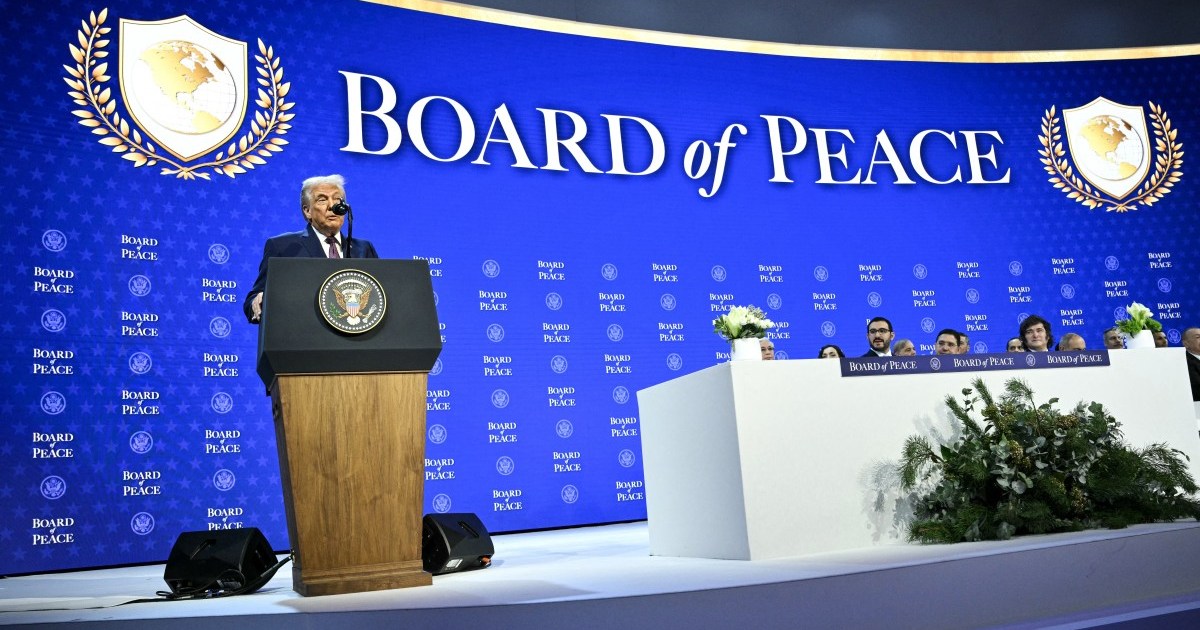
United States President Donald Trump has formally announced the first charter of his so-called “Board of Peace“, a body for resolving international conflicts with a $1bn price tag for permanent membership.
The board, which Trump launched in a signing ceremony in Davos, Switzerland, on Thursday, was originally conceived to oversee the rebuilding of Gaza after Israel’s two-year genocidal war on the Strip. But a draft of the charter does not appear to limit its role to the Palestinian territory.
- list 1 of 3Trump’s ‘Board of Peace’: Who has joined, who hasn’t – and why
- list 2 of 3The Take: Inside Trump’s plan to rebuild Gaza without Palestinians
- list 3 of 3‘The end of the world as we know it’: Is the rules-based order finished?
end of list
“Everybody” wants to be a part of his board, Trump claimed on stage at the World Economic Forum (WEF), before signing documents formally establishing the initiative, surrounded by other members.
Trump is chairman, while members of the executive include former United Kingdom Prime Minister Tony Blair, US Secretary of State Marco Rubio, and Trump’s son-in-law Jared Kushner.
Tens of countries have agreed to join, while many others have yet to respond to invitations from Washington.
However, British Foreign Secretary Yvette Cooper said the UK will opt out of signing on Thursday, joining a growing list of refusals that includes France, Norway, Sweden and Slovenia.
Some fear the Board of Peace will rival or undermine the United Nations. Trump appeared to touch on those concerns in his opening remarks at the ceremony, saying the initiative would “work with many others, including the United Nations”, also listing other major diplomatic issues around the region and worldwide.
As several countries get on board, Palestinians in Gaza are less optimistic about the initiative, said Al Jazeera’s Tareq Abu Azzoum, reporting from the Strip on Thursday.
Advertisement
“There is a sense – that runs deep among Palestinians – that Palestinians are being discussed as a problem to be managed, not as people with rights to be completely addressed,” Abu Azzoum said.
“People on the ground believe the formation of the new Board of Peace feels detached from their reality.”
More to come…
Related News
BRICS wargames: Why they matter, why India opted out

Who got the most nods? The complete list of 2026 Oscar nominations
‘Only time will tell’: Trump says US role in Venezuela could last for years