
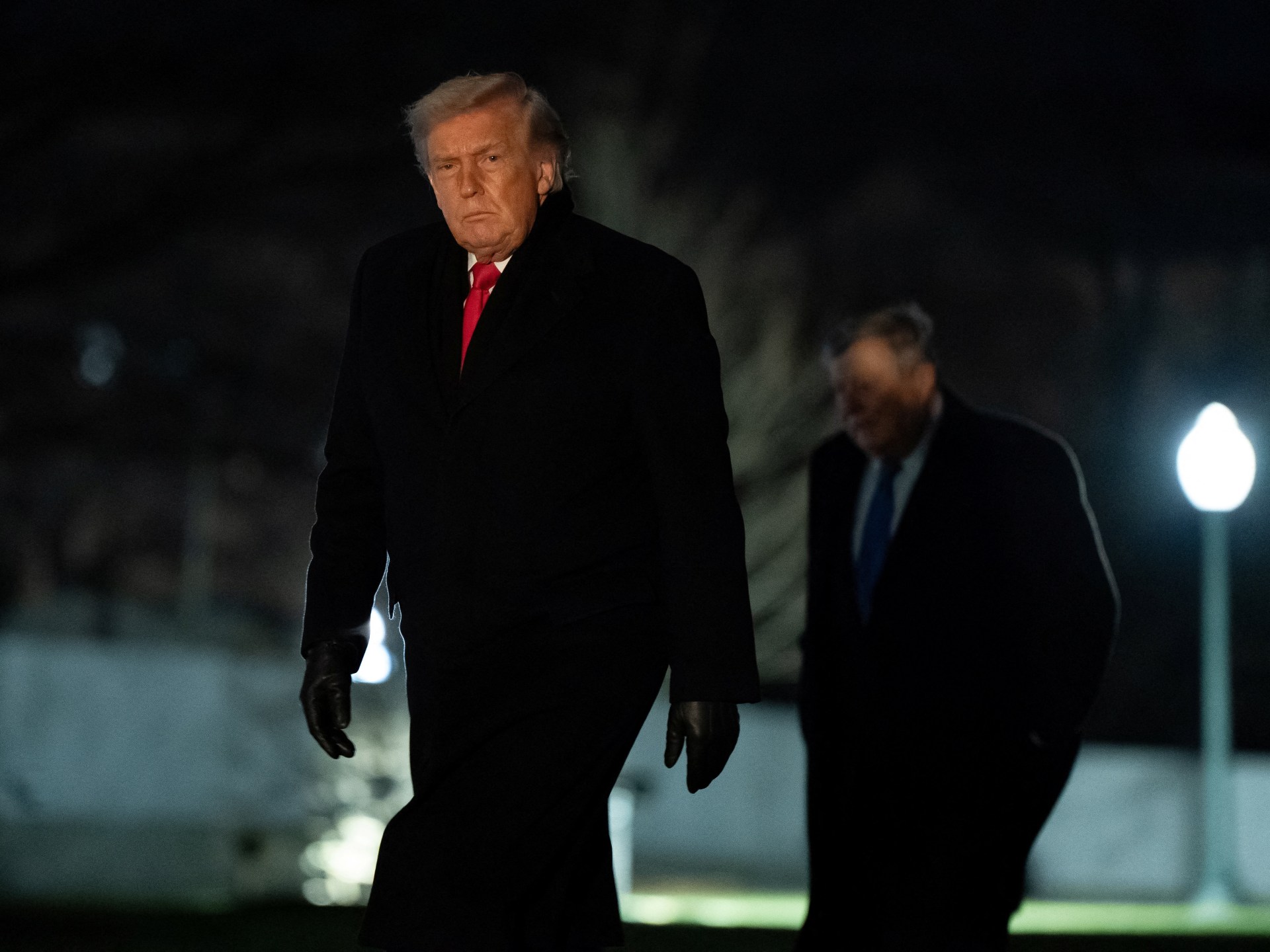
US President Donald Trump is en route to Davos, Switzerland, to attend the annual gathering of the World Economic Forum (WEF), where the issue of Greenland will be front and centre.
Trump’s long-running fixation on acquiring Greenland, an autonomous territory of NATO member Denmark, has escalated into a transatlantic imbroglio, with threats of sweeping new tariffs and even taking Greenland by military force rattling stock markets.
Speaking at a White House media briefing on Tuesday to mark one year since his second-term inauguration, he said Greenland was “imperative for national and world security”.
He warned the United Kingdom, Denmark, Norway, Sweden, France, Germany, the Netherlands, and Finland that they will face 10 percent tariffs on all goods from February 1, rising to 25 percent by June, unless they back his proposed takeover of the Danish autonomous territory. It comes as European leaders meeting in Davos warn the dispute risks a trade war and a rupture in the NATO alliance.
Where is Greenland?
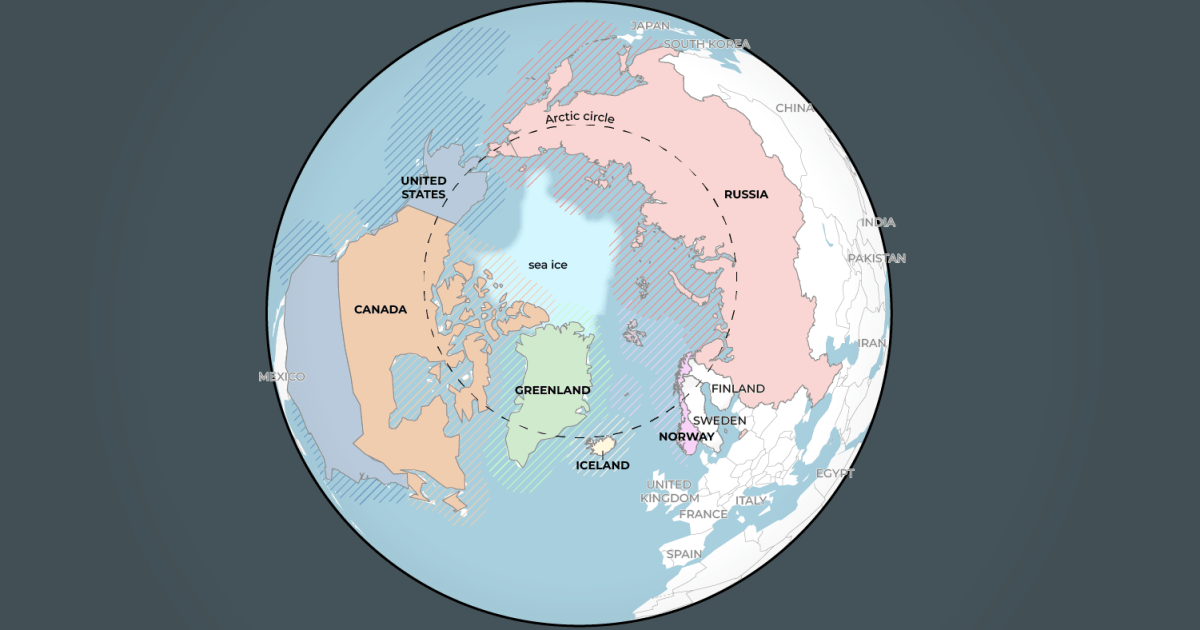
Greenland is the world’s largest island, located mostly within the Arctic Circle between the Arctic and Atlantic oceans. Geographically, it is part of North America, lying northeast of Canada and west of Iceland, but politically it is an autonomous territory within the Kingdom of Denmark.
Approximately 80 percent of Greenland is covered by the Greenland ice sheet, the second-largest body of ice on Earth. Because the interior is largely uninhabitable, most of Greenland’s population lives along the coastline. The capital city, Nuuk, located on the southwest coast, is Greenland’s largest city, home to about one-third of the island’s roughly 56,000 residents.

Countries in the Arctic Circle
The Arctic Circle is an imaginary line at 66.5 degrees north that includes the North Pole, the northernmost point on Earth.
Eight countries, including Canada, Finland, Greenland, Iceland, Norway, Russia, Sweden and the United States, have land lying within this region.
Some Arctic countries are closer to each other than many people realise.
Greenland’s closest neighbour is Canada, and at its narrowest point, between the Nares Strait, the two countries are only 26km (16 miles) apart. Canada and Greenland also technically share a land border, having settled a decades-long dispute over Hans Island, a small rock in the strait, by dividing it in half.
Advertisement
Russia and the US are also neighbours, with Alaska and Russia separated by the Bering Strait, which is about 85km (53 miles) at its narrowest point – a distance similar to that between New York City and New Jersey.
In fact, when you count the Diomede Islands located within the Bering Strait, Russia and the United States are less than 4km (2.4 miles) apart. These small, rocky islands consist of Big Diomede, which belongs to Russia and hosts a weather station, and Little Diomede, part of Alaska. The islands are separated by the International Date Line, creating a 21-hour time difference and marking the boundary between North America and Asia.
How big is Greenland?
On some map projections, which enlarge landmasses near the poles, Greenland appears much bigger than it really is.
In reality, the Arctic island covers 2.17 million square kilometres (836,330 square miles), making it roughly three times the size of the US state of Texas, or about the same size as Saudi Arabia, Mexico or the Democratic Republic of the Congo.

Arctic shipping routes
Most of the Arctic is divided into exclusive economic zones (EEZ) extending 200 nautical miles (370km) from the territorial waters of states and where they have jurisdiction over natural resources.
According to data from Arctic Ship Traffic Data, the number of ships operating in the Arctic has increased 37 percent between 2013 and 2023, driven by melting ice and expanding economic opportunities in the region.
There are three main shipping routes in the Arctic, connecting the Atlantic and Pacific:
- The Northern Sea Route (NSR)/Northeast Passage runs along the Arctic coast of Russia and could cut maritime travel between East Asia and Western Europe by 10-15 days compared with travelling via the Suez Canal. In Soviet Russia, the route was used for military supplies and extraction of resources in the Arctic. Now Russia uses it to transport liquified natural gas (LNG).
- The Northwest Passage (NWP) crosses Canada’s Arctic Ocean and could cut maritime vessel journeys between East Asia and Europe by 10 days compared with vessels travelling via the Panama Canal.
- The Transpolar Sea Route (TSR) goes from the centre of the Atlantic to the Pacific Ocean and is a direct route via the North Pole. While this route avoids the territorial waters of Arctic states, it is rarely used due to the presence of permanent sea ice. Due to melting ice caps, it is predicted that this sea route may be fully open to vessels by the 2050s, potentially even sooner with high-strength icebreakers.

What is the military presence in the Arctic?
Greenland has one major permanent US base, the Pituffik Space Base, and several smaller Danish military facilities.
Advertisement
Pituffik Space Base, formerly known as Thule Air Base, is located in the northwest corner of the island. It supports missile warning, missile defence and space surveillance missions and satellite command and control. It is strategically positioned to counter Russian activities in the Arctic.
About 650 personnel are stationed at the base, including US Air Force and Space Force members, as well as Canadian, Danish and Greenlandic civilian contractors. Under a 1951 agreement with Denmark, the US is permitted to establish and maintain military facilities in Greenland as part of mutual defence within the NATO framework.
The North American Aerospace Defense Command (NORAD), a US-Canadian joint military organisation, also operates systems from Pituffik in the form of a Ballistic Missile Early Warning System (BMEWS) for the organisation’s space surveillance.
In Alaska, NORAD controls the Clear Space Force Station, equipped with missile warning, defence and space awareness capabilities. The US also implements forward operating locations – temporary military airfields and radar stations – in Alaska, which are used to extend US defence and response.
 Denmark manages the defence of Greenland through the Joint Arctic Command (JAC) with its headquarters in the capital, Nuuk. The base’s main tasks are surveillance and search and rescue operations, and the “assertion of sovereignty and military defence of Greenland and the Faroe Islands”, according to Danish Defence.
According to the Center for Strategic and International Studies (CSIS), the Northern Sea route is central to Russia’s security posture in the Arctic. Control of the route sits with Rosatom, giving Moscow the ability to restrict foreign military traffic without direct government approval. In the eastern Arctic, access through the Bering Strait has pushed Russia to expand radar coverage, search and rescue capacity and airfields, including the Sopka-2 radar installations on Wrangel Island and Cape Schmidt.
In the central Arctic, Russia has hardened its military footprint. Bastion-P and Pantsir-S1 systems – mobile defence systems – are deployed on Novaya Zemlya and Kotelny Island, extending area-denial across air and sea approaches.
In the western Arctic, the Northern Fleet, which oversees Russia’s second-strike capability, is based in Severomorsk. CSIS says Moscow has also reactivated dozens of Soviet-era facilities, reopening airbases, radar stations and border posts across the region.
Chinese investments in the Arctic
China has emerged as a key player in the Arctic, stating its desire to create a “Polar Silk Road”, similar to the Belt and Road Initiative, where new shipping routes would emerge as ice sheets recede.
According to the Carnegie Endowment, China views the Arctic as a future transport and industrial corridor. A number of Chinese companies also have mining projects in Greenland, including for iron ore, rare earths and uranium. China also has projects focused on Arctic energy via Russia’s LNG sector.
Chinese state-owned firms have stakes in Novatek’s LNG projects and are a major buyer of Arctic gas. The Chinese have also supplied key equipment to Russia’s Arctic LNG projects, especially after Western sanctions on Russia.
Advertisement
What are Greenland’s resources?
Greenland is rich in natural resources, including zinc, lead, gold, iron ore, rare earth elements (REEs), copper and oil.
It is home to some of the world’s largest deposits of rare earths used in high-tech industries. These resources have attracted significant attention, including from President Trump.
Gold pockets exist in areas like Nanortalik and South Greenland. Greenland also has deposits of diamonds in the Maniitsoq region, just north of Nuuk.
Copper deposits are largely unexplored in Greenland, according to the Mineral Resources Authority, with areas in the northeast and central east largely untapped. Iron ore deposits are dotted around West Greenland, while nickel traces have been found around the island’s southwest coast.
Graphite, used mostly in EV batteries and steel-making, is also reported to exist in Greenland, with exploration around Amitsoq. While zinc has been found in the north of Greenland, titanium and vanadium deposits are located in the southwest, east and south of the territory. Tungsten is also found in central east and Northeast Greenland with assessed deposits in the south and west.

A brief history of Greenland
The first Inuit people settled in Greenland in about 2500 BCE.
In the 10th century, Norse explorers arrived in Greenland and established settlements. By 1721, Denmark had made Greenland a colony.
Though a Danish territory, Greenland became self-governing in 1979 after more than two centuries under Danish control. It is one of Denmark’s two autonomous territories, with the Faroe Islands being the other.
In 1941, during World War II, the US and Denmark agreed to allow American forces to defend Greenland. Its strategic location was vital for countering German submarines and securing shipping routes. The US maintained a military presence throughout the Cold War, using Greenland for early-warning radar and monitoring Soviet activity.
In 2009, Greenland gained self-rule over most of its internal affairs, including control over natural resources and governance. However, Denmark still handles foreign policy, defence and funding.

Related News
Trump undermines key allies UK and France before Davos visit
Trump says he wants to free up Venezuelan oil flow. What was blocking it?
Yemen’s Saudi-backed government appoints new prime minister