‘You’ll find out’: Trump speaks on Greenland’s fate and the future of NATO
 20 January 2026
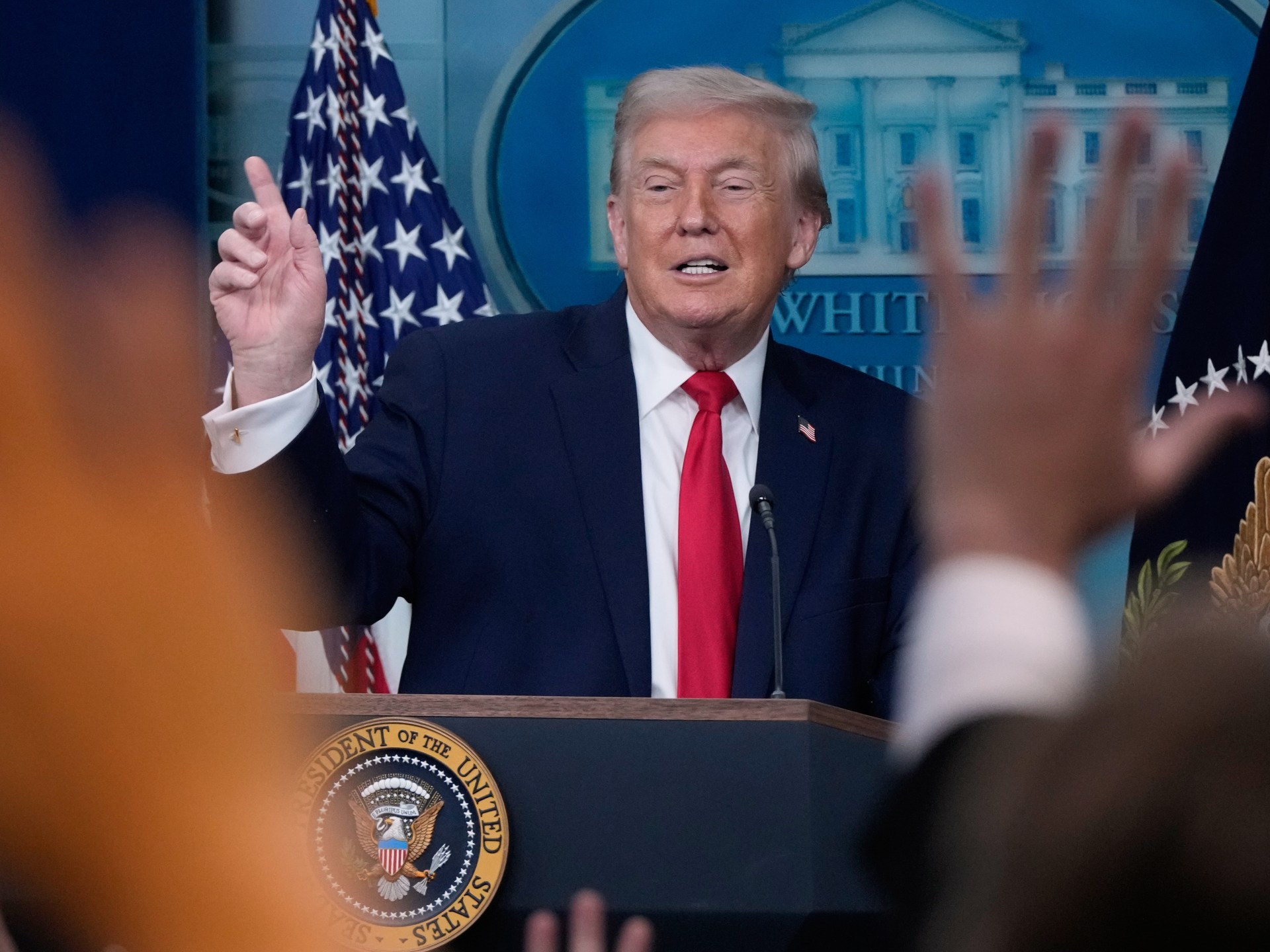

It has been one year since Donald Trump took office for a second term as United States president, and he marked the occasion with a marathon news conference in the White House briefing room, where he zig-zagged between topics ranging from immigration to the future of the United Nations.
“ It’s been an amazing period of time,” Trump said as he took the podium on Tuesday, armed with a stack of printouts.
- list 1 of 3‘Somalia is not even a country’, Trump says in anti-immigrant ramble
- list 2 of 3Trump undermined antiwar vows in first year. Will Democrats seize on this?
- list 3 of 3Trump made many statements on US economy. Most are untrue
end of list
For more than one hour and 40 minutes, the Republican leader ran through a list of his accomplishments, touting a trend of “reverse migration” away from the US and what he called “high economic growth”.
But the briefing was overshadowed by fraying relations between the US and its traditional allies in Europe, as Trump presses ahead with his campaign to own the self-governing Danish territory of Greenland.
European leaders had started to gather at the World Economic Forum in Davos, Switzerland, on Tuesday, where Trump’s threats to acquire Greenland “one way or another” cast a pall over the proceedings.
Some leaders, including Canadian Prime Minister Mark Carney, even suggested it was time for Western allies to imagine a future without US leadership. “We are in the midst of a rupture, not a transition,” Carney told his audience at Davos.
In his news briefing, Trump himself suggested that international institutions like the UN and NATO might not last the test of time. Here are some of the key takeaways from his remarks.
Threatening Greenland
Trump started his day with a fusillade of social media posts on his platform, Truth Social, including one that used images generated through artificial intelligence to show the US laying claim to Canada, Greenland and Venezuela.
Advertisement
Another, also generated with AI, showed Trump planting a US flag on Greenland’s soil, alongside Vice President JD Vance and Secretary of State Marco Rubio.
The images were the latest indication that Trump planned to muscle ahead with his plans to take control of Greenland, as part of his expansionist goals for his second term.
In his news briefing, Trump expressed optimism that his campaign would turn out to be successful, as he faced questions from reporters.
“ We have a lot of meetings scheduled on Greenland,” Trump said of his upcoming trip to Davos on Wednesday. “And I think things are going to work out pretty well, actually.”
He also waved aside concerns that his ambitions of territorial expansion might strip Greenlanders of their right to self-determination. “When I speak to them, I’m sure they’ll be thrilled,” he said.
Still, when confronted with questions about how far he was willing to go to acquire the island, Trump struck an ominous note, saying simply, “You’ll find out.”
Trump has previously refused to take military options off the table, and he has threatened several European allies with a tariff hike should they fail to support his claim to the self-governing island.
Weighing the future of NATO and the UN
The sabre-rattling over Greenland led one reporter to ask whether Trump was willing to risk the breakup of the NATO alliance to achieve his expansionist goals.
Trump responded by largely sidestepping the question. He indicated that a mutually agreeable solution could be struck.
“I think something’s going to happen that’s going to be very good for everybody,” he said of Greenland.
“I think that we will work something out where NATO’s going to be very happy and where we’re going to be very happy, but we need it for security purposes. We need a financial security and even world security.”
He also touted his efforts to boost military spending among NATO members. At a NATO summit in June, most of the member countries agreed to increase defence spending to 5 percent of their gross domestic products (GDPs), though Spain successfully petitioned for an exemption.
“Nobody’s done more for NATO than I have,” Trump said, revisiting a familiar boast.
Still, he questioned one of NATO’s basic foundations. Article Five of the alliance’s treaty requires member states to come to one another’s defence, should any be attacked. But under Trump, allies in Europe and Canada have questioned whether the US would abide by the requirement.
At Tuesday’s briefing, Trump appeared to flip the accusation on its head, casting doubt on whether Europe and Canada would come to its aid.
Advertisement
“The big fear I have with NATO is we spend tremendous amounts of money with NATO, and I know we’ll come to their rescue, but I just really do question whether or not they’ll come to ours,” Trump said. “I’m just asking. Just saying.”
Article Five has only been invoked once, after the attacks in the US on September 11, 2001. NATO allies deployed its first-ever “anti-terror operation” in the aftermath, providing aircraft to patrol US skies to ensure regional safety.
“Sometimes it’s overrated. Sometimes it’s not,” Trump said of the alliance.
The US president similarly equivocated on the subject of the UN, saying the international body “hasn’t been very helpful”.
“It has never lived up to its potential,” Trump told reporters.
When asked if his “board of peace” – designed to oversee the reconstruction of war-torn Gaza – might one day replace the UN, Trump replied, “Well, it might.”
A role for Machado in Venezuela?
While Greenland was front of mind ahead of Trump’s arrival in Davos, the president was also forced to confront questions about another country where the US has made claims: Venezuela.
On January 3, Trump authorised a military action to abduct his longtime adversary, Venezuelan President Nicolas Maduro, who was subsequently transported to the US to face trial on charges of drug trafficking.
Legal experts have largely condemned the operation as a violation of Venezuelan sovereignty.
While Trump initially said the US would “run” Venezuela in the aftermath of the attack, he has since signalled his willingness to cooperate with interim President Delcy Rodriguez, Maduro’s former second-in-command.
Given that Maduro’s last two elections had faced widespread accusations of fraud, many of his critics expected a new vote to be called in the wake of his removal. But the Trump administration has declined to set a timeline for new elections.
Trump also dismissed the prospect of opposition leader Maria Corina Machado, a Nobel Peace Prize winner, taking power in Maduro’s absence.
“I think it would be very tough for her to be the leader. She doesn’t have the support within or the respect within the country,” Trump said within hours of the January 3 operation.
Still, on Tuesday, Trump appeared to shift his tone. He signalled that there could be a role for Machado in Venezuela’s leadership, following their meeting last week at the White House, where she presented him with her Nobel Prize.
“An unbelievably nice woman also did a very incredible thing, as you know, a few days ago,” Trump told reporters. “We’re talking to her, and maybe we can get her involved in some way. I’d love to be able to do that.”
Trump added that the Rodriguez government had been receptive to his administration’s demands and that he expected US oil companies to make “massive investments” in the South American country.
“We’ve taken 50 million barrels of oil out of Venezuela in the first four days,” Trump said. “We’ve got millions of barrels of oil left. We’re selling it on the open market.”
The proceeds have gone into a US-controlled account, and on Tuesday, the Rodriguez administration said it received $300m as part of that arrangement.
Addressing tensions in Minnesota
On the domestic front, Trump used his first-anniversary appearance in the briefing room to defend his controversial immigration operations in Minnesota, where nearly 2,000 federal agents have been deployed.
Advertisement
The large-scale immigration crackdown began in December, after Trump blamed the large Somali American community there for a fraud scandal that had rocked the midwestern state.
At the time, he deployed racist insults to disparage Somali Americans, including by calling them “garbage”.
Trump returned to that theme at Tuesday’s news conference, where he belittled the diaspora’s intelligence by saying they were “a lot of very low IQ people”.
He then framed the fraud scheme as a criminal enterprise masterminded outside the Somali American community that its members ultimately profited from.
“Other people work it out, and they get them money, and they go out and buy Mercedes Benzes,” Trump said.
“They have no money. They never had money. They never had a life. They never had a government. They never had a country, because there’s basically no country. Somalia’s not even a country. They don’t have anything that resembles a country, and if it is a country, it’s considered just about the worst in the world.”
Trump also addressed the January 7 killing of Renee Nicole Good, a 37-year-old US citizen and mother of three.
Good’s death was caught on video amid tensions in Minneapolis over the presence of agents from Immigration and Customs Enforcement (ICE). Bystander video appeared to show Good parked in her car when ICE agents approached her, and when she started to move her vehicle away, an officer fired three shots into her window.
Her death provoked nationwide outrage and protests, as critics questioned the use of force as excessive.
Trump, however, approached the controversy with a “both sides” argument, similar to how he framed the 2017 killing of Heather Heyer at a counter-protest denouncing white supremacists in Charlottesville, Virginia.
“The woman was shot. And I felt terribly about that, and I understand both sides of it,” Trump said of Good’s shooting on Tuesday.
He then blamed “agitators” and “insurrectionists” among the anti-ICE protesters for creating a hostile situation.
“Sometimes ICE is going to be too rough with somebody,” Trump said. “They deal with rough people. They’re going to make a mistake. Sometimes it can happen.”
Still, he expressed sympathy for Good’s family, explaining that he had recently learned her father was one of his supporters.
“He was all for Trump, loved Trump, and it’s terrible. I was told that a lot of people, they said, ‘Oh, he loves you,'” Trump said.
“I hope he still feels that way.”
Related News
China’s trade surplus hits new heights in 2025 despite US tariff war
UN top court set to open Myanmar Rohingya genocide case
Syrian forces make rapid advance as SDF braces for Raqqa attack