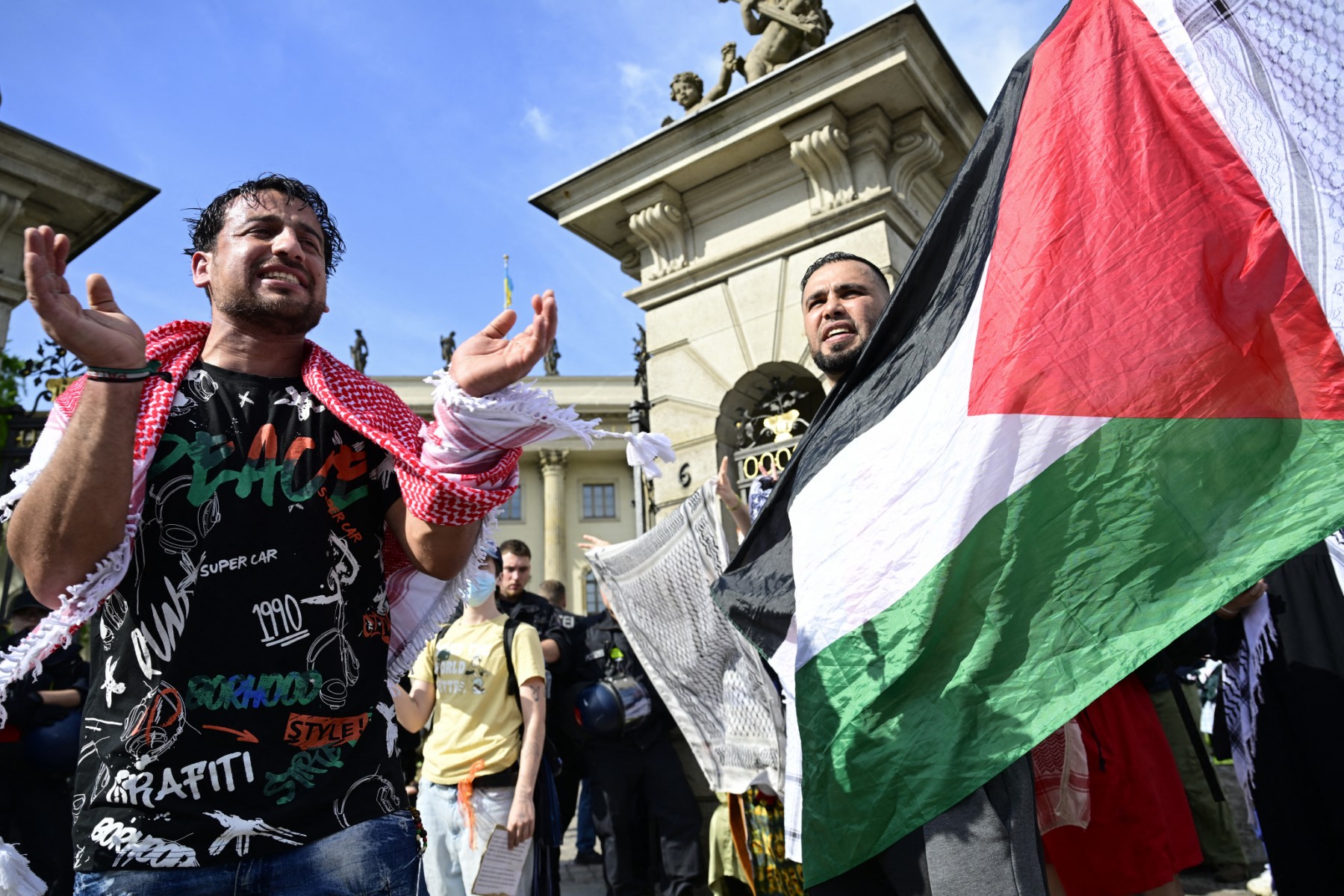

Nearly 700 students from Leipzig University, in Germany, sat down last month on the square outside the college cafeteria, next to the city’s old, ruined fortifications, to vote. A sea of hands rose, holding yellow cards.
The vote was almost unanimous: The student council demanded the university cease all collaboration with Israeli institutions.
- list 1 of 4The rise of global boycotts against Israel’s genocide in Gaza
- list 2 of 4Campaign to boycott Israel looks to future after Gaza ‘ceasefire’
- list 3 of 4Europe’s growing fight over Israeli goods: Boycott movements mushroom
- list 4 of 4‘Love you, from Gaza’: Fans, athletes hail Yamal’s Palestine flag wave
end of list
“All five [Israeli] partner universities of Leipzig University are an essential component of the Israeli military complex: They develop weapons, surveillance systems and recruit on their campus for military units,” 22-year-old Orlando Becker of Students for Palestine Leipzig told Al Jazeera.
“We therefore think that cooperating with those universities is in and of itself problematic, because one is legitimising and normalising those institutions.”
The Leipzig vote is the latest success for a wave of Palestinian solidarity at German universities that has accelerated since March, in which at least three other student councils – in Berlin and Dusseldorf – have put forward similar motions.
Israeli universities have long been accused of complicity in war crimes and other alleged abuses committed by their government. To argue their case, the students put together a report outlining how academic institutions contribute to the Israeli war machine – for example, in Gaza and the occupation of the West Bank – as well as advancing the government’s narratives.
“One example is archaeology projects,” said Becker. “Those often have the goal to prove that Palestinians do not exist and that Palestine was empty before the settlers came. In the name of science, Israel justified ethnically cleansing the Palestinian village of Susya in order to conduct archaeological research there, and later on twisted the findings to prove that the very same people that were ethnically cleansed never existed in the first place. Leipzig University has one archaeology project with Ben Gurion University.”
After sharing the report around campus, Students for Palestine collected 1,300 signatures to convene a general student assembly. The day before the assembly was due to take place, the university withdrew permission to use a lecture hall.
Advertisement
In response to a query, a Leipzig University spokesperson directed Al Jazeera to a statement that permission was denied on the grounds that the students were making a “partisan statement and the intention to restrict academic freedom”.
Becker described “a historic moment for Germany” as more students across the country are joining campaigns in support of Palestinians.
“We are not naive, though. If the past is any indicator, then the rectorate will care more about Israel than about their own democratic institutions and the collective will of the students … Our fight is not concluded until all of Palestine is free.”
‘Students have organised for years’
In March, at the Hertie School, a private university in Berlin, the student council voted on a resolution supporting BDS – the nonviolent Boycott, Divestment, and Sanctions campaign – by cutting ties with Israeli institutions. It was the first German student council to do so.
“Students have organised for years to demand the Hertie School end all collaborations with organisations complicit in human rights violations in the occupied Palestinian territories,” said a member of the Hertie Student Representation (HSR), who requested their name be withheld.

“The university leadership has inadequately responded to these popular student initiatives and ignored many of our demands … Therefore, a coalition of students drafted this resolution to apply the BDS framework to student-administered funds. It was passed by the student council with over 90 percent of votes in favour and none against.”
The Hertie School distanced itself from the HSR, with the Hertie Foundation calling the motion “unacceptable” in a statement. There were mixed reactions among the students, with some reporting a tense atmosphere on campus, and the HSR stepped down after losing a vote of no confidence.
“[The university] used fear tactics like telling students that their job prospects would be damaged by association with BDS, that international students’ visa statuses could be jeopardised, and that the Hertie School’s funding might be cut,” said the HSR member.
“Furthermore, the university leadership implied students in support of the motion were acting outside the bounds of law.”
‘It almost felt like I was back in Russia’
BDS is considered extremist by the Bundestag, Germany’s parliament, although it is not banned.
“I went to a meeting about this situation at the university and was shocked. The entire discussion felt staged,” said Arshak Makichyan, an environmentalist and antiwar activist now in his final year at Hertie.
Advertisement
“It almost felt like I was back in Russia. I feel disappointed that, instead of having an honest discussion at a university where we read academic works about what constitutes genocide and why what Israel is doing is clearly against international law, students cannot even raise these issues … I feel disappointed in Germany and in the other students who did nothing to defend our representatives.”
Support for Israel is considered one of modern Germany’s core national interests, referred to as its Staatsraison, or reason for state.
“Being pro-Israel has always been a way to prove Germany has learned from its past and is amongst the good again,” explained Peter Ullrich, an anti-Semitism researcher at the Technical University (TU) of Berlin, alluding to the legacy of the Holocaust.
“This has resulted in a strange discourse where Israel is nearly sacrosanct in the political establishment, and Palestinian voices and their supporters are treated badly with undifferentiated discourse (and) severe state handling of demonstrations.”
A Jewish student at Hertie, who requested anonymity, said that as a descendant of Holocaust survivors, they have been “alienated”.
“It was insinuated that my commitment to fighting oppression stood in contradiction to my identity, my history, and my love for the Jewish people,” they said. “For many Jews, supporting non-violent political pressure wherever rights are violated is an expression of the moral responsibility thrust upon us by generations of persecution. Levelling accusations of anti-Semitism in this context trivialises a term that should remain reserved for genuine hatred and violence against Jews, and must not be used as a shield against criticism of state power.”
Pro-Palestinian activism at German institutions is suppressed by event cancellations, police interventions and even legal proceedings against students involved.
In November 2023, a Free University of Berlin (FUB) lecture hall was occupied by students in solidarity with Gaza. Then, in May 2024, Humboldt University’s Institute of Social Sciences was occupied and renamed Jabalia Institute, after a besieged Gaza refugee camp.
Both times, police were called and violently removed the students, dozens of whom were injured. People of colour, including those with Arab identities, were reportedly treated more harshly.
Several were charged with trespassing, and four FUB protesters were expelled from the country.
In April, Heinrich-Heine University Dusseldorf (HHU) pledged to continue its collaboration with Israeli institutions despite a student parliament resolution demanding an academic boycott, while last week, another BDS resolution was voted down at the FUB.
“I think you’ll find pretty strong criticism of the current Israeli government or politics at universities, it’s just that the universities in Germany are state-funded,” said Uffa Jensen of the Center for Research on Antisemitism at TU Berlin.
“The real question in Germany is the political support for Israel, and that comes first. Because in the case of Russian universities after the attack on Ukraine, they were officially ordered to stop all collaborations by the German Education and Science Ministry. And they did this immediately … the treatment is strikingly different, even after two years of intense conflict in the Middle East.”
Advertisement
He said the impact on the universities’ leadership was likely to be muted.
“On the individual scholars and on plans for future research collaborations, it might have an effect on various levels, but that’s something nobody will necessarily openly acknowledge.”
Related News
‘Badge of honour’: Israeli settlers shrug off global condemnation

Protests erupt in Kenya over US Ebola quarantine centre in Nanyuki
US, Iran have launched multiple attacks during ceasefire: A timeline